

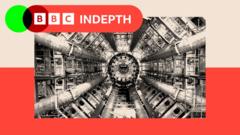
British particle physics faces significant funding reductions as the government restructures how it allocates research money. The Science and Technology Facilities Council announced a 30% cut to its budget earlier this year, affecting funding for particle physics and astronomy projects. This decision threatens Britain’s participation in major international research initiatives, including upgrades to CERN’s Large Hadron Collider.
The cuts come amid a broader reorganization of the UK’s science funding system. The UK Research and Innovation Agency introduced a new allocation framework dividing funds into three categories: blue-sky research driven by curiosity, government-priority research such as AI and quantum computing, and applied research aimed at helping businesses develop commercial products. Critics argue that the restructuring has effectively redirected resources from fundamental research toward applied initiatives intended to boost economic growth.
Scientists warn that reducing blue-sky research investment could have long-term consequences for the UK scientific community and economy. Theoretical physicist Dr. Simon Williams noted that fundamental research has historically led to transformative discoveries with major commercial applications, including the electron, DNA structure, and early computing technologies. Young researchers unable to secure grants are considering relocating abroad or leaving research entirely, potentially damaging the country’s scientific infrastructure.
Official explanations for the cuts attribute them to funding constraints caused by inflation, currency fluctuations, and overambitious project planning. However, internal STFC documents reference a “major shift of funding from curiosity-driven research to priority areas,” contradicting public statements. Senior scientists and government leaders dispute whether funds were diverted, with UKRI leadership denying any reallocation away from fundamental research while internal council minutes suggest otherwise.
The debate reflects broader tensions over how governments should balance investment between theoretical research and practical applications designed to address immediate policy priorities and economic development goals.
Article Attribution | Read More at Article Source
Article summary produced by Claude AI