

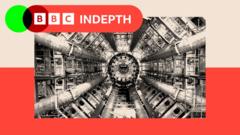
The UK is preparing to reduce its participation in major particle physics and astronomy projects, including upgrades to the Large Hadron Collider at CERN. This decision comes as part of broader cuts to fundamental research funding, with the Science and Technology Facilities Council announcing a potential 30% reduction in funding for these fields.
The cuts have sparked significant concern within the scientific community about the direction of British research priorities. Prof Peter Higgs, who died in 2024, had won the Nobel Prize in Physics in October 2013 for his theoretical prediction of the Higgs boson, discovered a year earlier at CERN. At the time, Higgs emphasized the importance of blue-sky research—investigations aimed at understanding the universe rather than developing immediate commercial applications—noting its value for science and society.
Scientists argue that blue-sky research has historically generated transformative breakthroughs in Britain, including discoveries of the electron and DNA’s structure, as well as the development of the first computer. Though these advances had no immediate practical purpose, they eventually formed the basis of multi-billion pound industries. Dr Simon Williams, a theoretical physicist at Durham University, warns that cutting fundamental research will not only harm scientists but also damage British industry that depends on this work, stating that if research leaves the country, industry will follow.
The funding reductions appear connected to a reorganization of Britain’s science funding system under the UK Research and Innovation Agency. The new structure allocates money into three categories: blue-sky research, government priorities such as artificial intelligence and quantum computing, and business development support. Evidence suggests funding has shifted toward the latter two categories at the expense of fundamental research. Internal documents from the Science and Technology Facilities Council indicate discussion of “a major shift of funding from curiosity-driven research to priority areas,” though leadership denies this occurred deliberately.
The cuts have already affected young researchers, with approximately 30 early-career physicists unable to secure grants to continue work in the UK, potentially forcing them to seek opportunities abroad or leave research entirely.
Article Attribution | Read More at Article Source
Article summary produced by Claude AI