

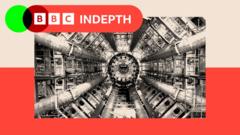
Britain’s scientific community is expressing serious concerns about proposed reductions in funding for fundamental research, particularly in particle physics and astronomy. The debate centers on a reorganization of the UK’s scientific funding system that has raised questions about whether resources are being shifted away from blue-sky research toward applied research with immediate economic applications.
The proposed cuts include a likely 30% reduction to the Science and Technology Facilities Council’s budget for particle physics and astronomy research. This would force British scientists to reduce or withdraw entirely from major international collaborations, including experiments at CERN aimed at answering fundamental questions about the universe’s origins and composition. The reductions have prompted criticism from leading researchers, with Scotland’s Astronomer Royal Catherine Heymans describing the situation as “genuinely catastrophic and devastating for the UK.” Additionally, funding delays have left approximately 30 young physicists unable to secure grants to continue research in Britain this year.
At the center of the dispute is a new funding structure that divides research money into three categories: blue-sky research, government priorities such as artificial intelligence and quantum computing, and commercial product development. Officials including Science Minister Lord Vallance and UK Research and Innovation Agency head Ian Chapman maintain that fundamental research remains protected and adequately funded. However, internal documents from the funding council reference “a major shift of funding from curiosity-driven research to priority areas,” and investigators from the Science Innovation and Technology Select Committee have expressed frustration with the opacity of funding accounting systems.
Historically, Britain’s strength in fundamental research produced major discoveries without immediate practical applications—including the electron, DNA structure, and early computers—that eventually spawned billion-pound industries. Researchers argue that cutting blue-sky research harms not only scientific advancement but also the businesses that eventually commercialize these discoveries. The government has acknowledged that delays in grant decisions were a “mistake” and pledges to address funding problems.
There is broad agreement among scientists and policymakers that a resolution is urgently needed, though disagreement persists about whether the funding reorganization was implemented too quickly and with insufficient consultation from the scientific community.
Article Attribution | Read More at Article Source
Article summary produced by Claude AI