

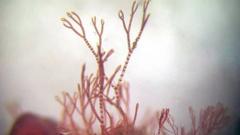
A professor studying underwater ecosystems in the United Kingdom has finally confirmed the identity of an unusual seaweed specimen she discovered decades earlier while conducting research on maerl beds—distinctive marine habitats composed of free-living calcified seaweed pieces that create some of the richest underwater ecosystems.
Prof Christine Maggs initially found a fragment of pink-striped seaweed on a maerl bed during her doctoral research 40 years ago. Despite extensive literature searches and continued observations throughout her career, she lacked sufficient material to formally identify the organism. The search continued intermittently, with occasional sightings of the specimen in unexpected locations, until researchers surveying Cornish maerl beds approximately two years ago collected a sample that Maggs suspected matched her long-sought discovery.
With the newly collected material, Maggs cultivated the seaweed in controlled storage conditions to obtain samples suitable for DNA sequencing. In collaboration with Prof Beatriz de Barros Barreto, molecular analysis confirmed the organism represented a previously unknown species to science. The findings will be published in the peer-reviewed journal Phycologia, and a specimen has been added to the Natural History Museum’s collection.
The discovery holds significance beyond the satisfaction of resolving a decades-long mystery. Maerl beds represent rare and threatened habitats in British waters, classified as declining ecosystems under international environmental protections. The identification of a previously unknown species inhabiting these areas underscores their ecological complexity and biodiversity value. Researchers emphasize that maerl beds provide critical nurseries for fish populations and support extensive marine life, making their conservation important for maintaining ecosystem health and marine productivity.
While some maerl sites in the UK currently receive formal protection, other surveyed areas lack official designation. Scientific divers continue documenting species within these habitats as part of ongoing research into maerl bed health and composition. The newly confirmed seaweed will be designated ceramium ruenessianum scientifically, with common name suggestions including “pink-zebra weed,” and Maggs is soliciting public input on preferred nomenclature.
Article Attribution | Read More at Article Source
Article summary produced by Claude AI