

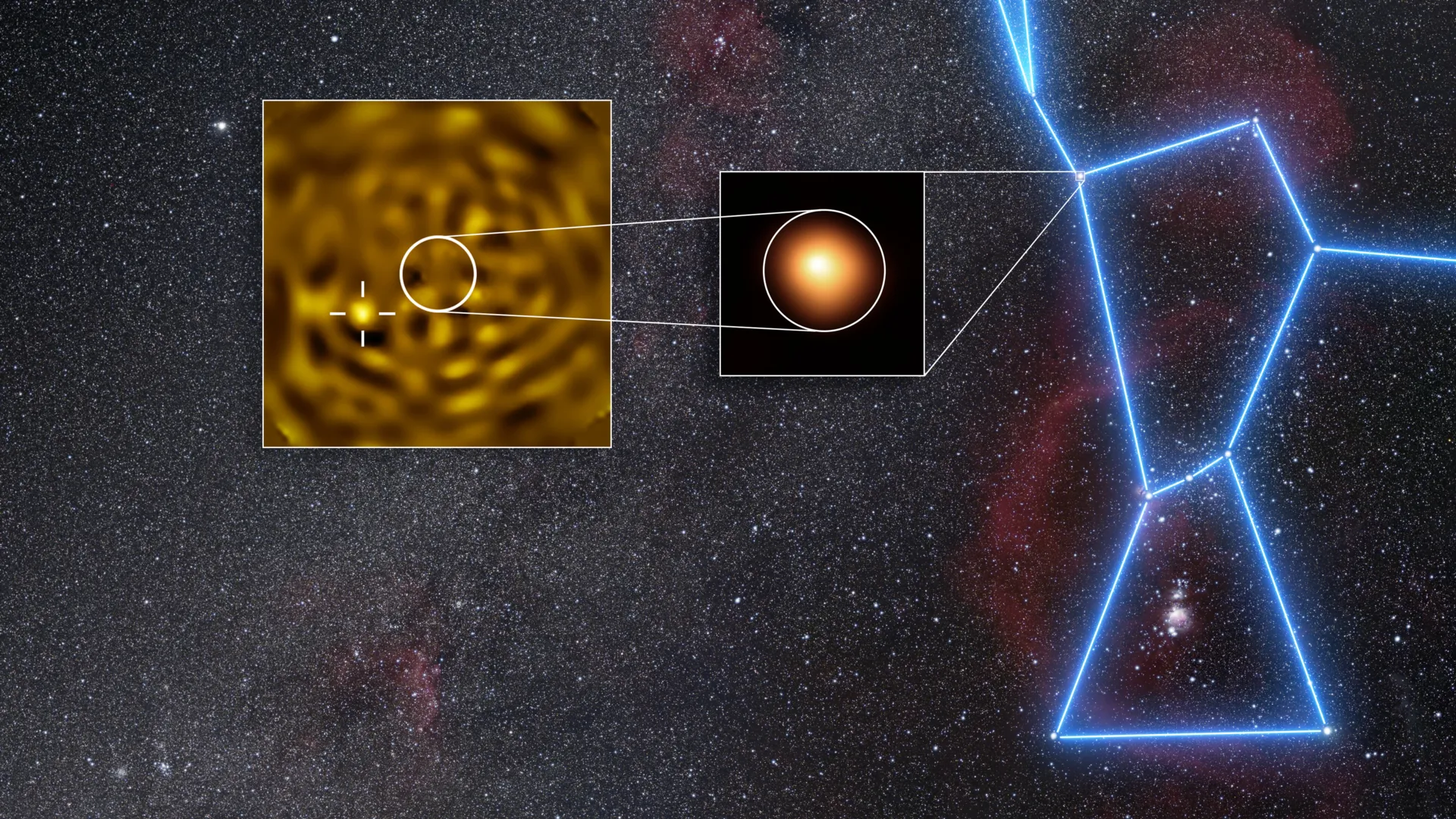
An international team of astronomers led by Miguel Montargès has obtained direct imaging evidence of a previously elusive companion star orbiting Betelgeuse, one of the most recognizable stars in Earth’s night sky. The observations were conducted using the SPHERE instrument on the European Southern Observatory’s Very Large Telescope in Chile’s Atacama Desert. The detection represents the culmination of efforts spanning roughly a century to confirm the existence of what researchers call Betelgeuse B.
The companion’s existence had been theorized for approximately a century as a potential explanation for variations in Betelgeuse’s brightness. Two studies published in 2024 provided critical predictions about where the companion should be located, indicating that December 2024 would offer optimal viewing conditions when Betelgeuse B would be at its maximum apparent separation from the primary star. Montargès and his team conducted observations that month and spent several months processing and analyzing the data before reaching their conclusions.
The newly detected companion proved more substantial than initially expected. Scientists had predicted the companion would have approximately the same mass as the Sun, but the observations suggest Betelgeuse B possesses two to three times the Sun’s mass, making it considerably brighter and more massive than theoretical models had suggested. This unexpected discovery underscores the significance of the finding, as detecting a previously unknown massive companion around such a well-studied star represents a notable achievement in astronomical observation.
While the evidence is compelling, astronomers have not yet considered the case definitively closed. Researchers plan to conduct follow-up observations to confirm the companion’s location aligns with orbital predictions. The discovery introduces new considerations for understanding Betelgeuse’s evolution, including the red supergiant’s eventual supernova explosion. Scientists will now investigate whether the companion’s gravitational influence might affect the primary star’s development and ultimate fate.
Article Attribution | Read More at Article Source
Article summary produced by Claude AI