

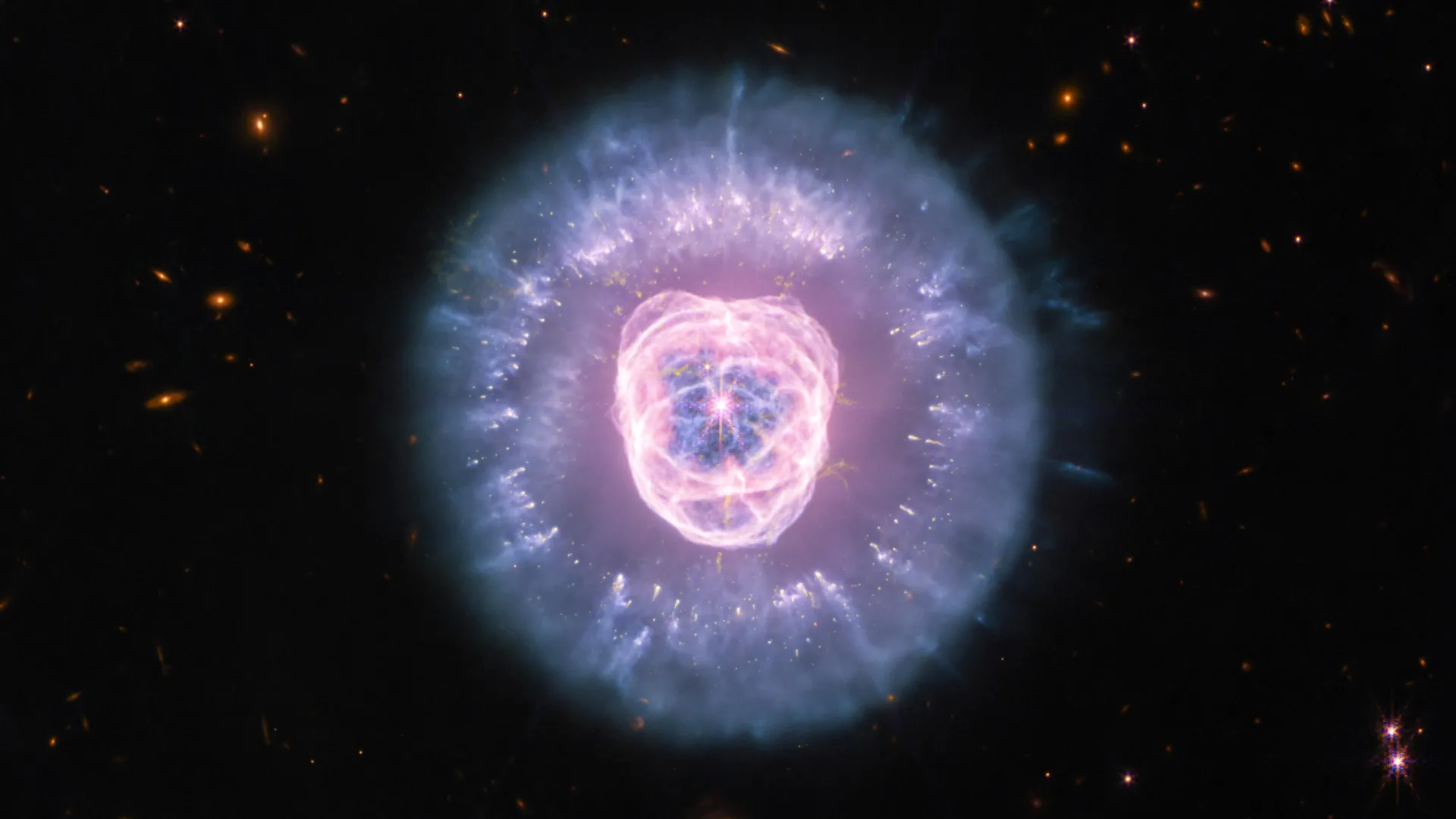
The James Webb Space Telescope has obtained new observations of NGC 2392, commonly referred to as the Lion Nebula, showcasing the cosmic structure in infrared wavelengths with unprecedented detail. The nebula had been previously studied by the Hubble Space Telescope in 2000 using visible light observations, which documented its distinctive lion-shaped appearance featuring a prominent mane composed of wispy formations. Webb’s infrared imaging capabilities, utilizing both its Near Infrared Camera and Mid Infrared Instrument, provide enhanced resolution and reveal features not readily apparent in visible light, including concentrated dust regions and ionized gas formations.
The materials comprising the nebula have been in a state of continuous evolution over several thousand years and remain dynamic today. At the heart of this activity lies the remnant of a deceased star, which appears as a small central feature within the lion’s form. The radiation and energy emanating from this stellar remnant drives the development of the intricate structures visible throughout the nebula. Most stars in the universe eventually shed their outer layers into space as they reach instability in their late life stages. The expelled material forms expanding shells of gas and dust classified as planetary nebulae, with radiation from the exposed stellar core propelling this material outward.
The stellar core that remains following this mass-ejection process becomes an extremely hot white dwarf. In the case of NGC 2392, the oxygen-rich central star has expired, leaving behind a white dwarf that continues to intensely radiate energy throughout the nebula. This radiation creates an expanding bubble of ionized gas that produces the lion’s recognizable facial shape. As this bubble expands, it sweeps through surrounding material and destroys dust in its trajectory. The mechanisms behind the formation of the complex ring and shell patterns observed in planetary nebulae remain subjects of ongoing astronomical study.
The lion’s distinctive mane corresponds to an inner dust shell illuminated by the central white dwarf, containing features resembling hair tufts and comet-like formations. These structures represent dense dust clumps that have proven resistant to the stellar core’s radiation. By blocking portions of this radiation, the dense material shields whatever lies behind it from the star’s intense energy. Webb’s observations capture the nebula at a single moment within its extended evolutionary timeline, though the consequences of the star’s demise continue to unfold. The gas and dust progressively travel away from the central remnant, gradually altering the nebula’s appearance over time. Astronomers project that the Lion Nebula will eventually disperse over approximately 10,000 years, which represents a relatively brief timeframe on astronomical scales.
Article Attribution | Read More at Article Source
Article summary produced by Claude AI