

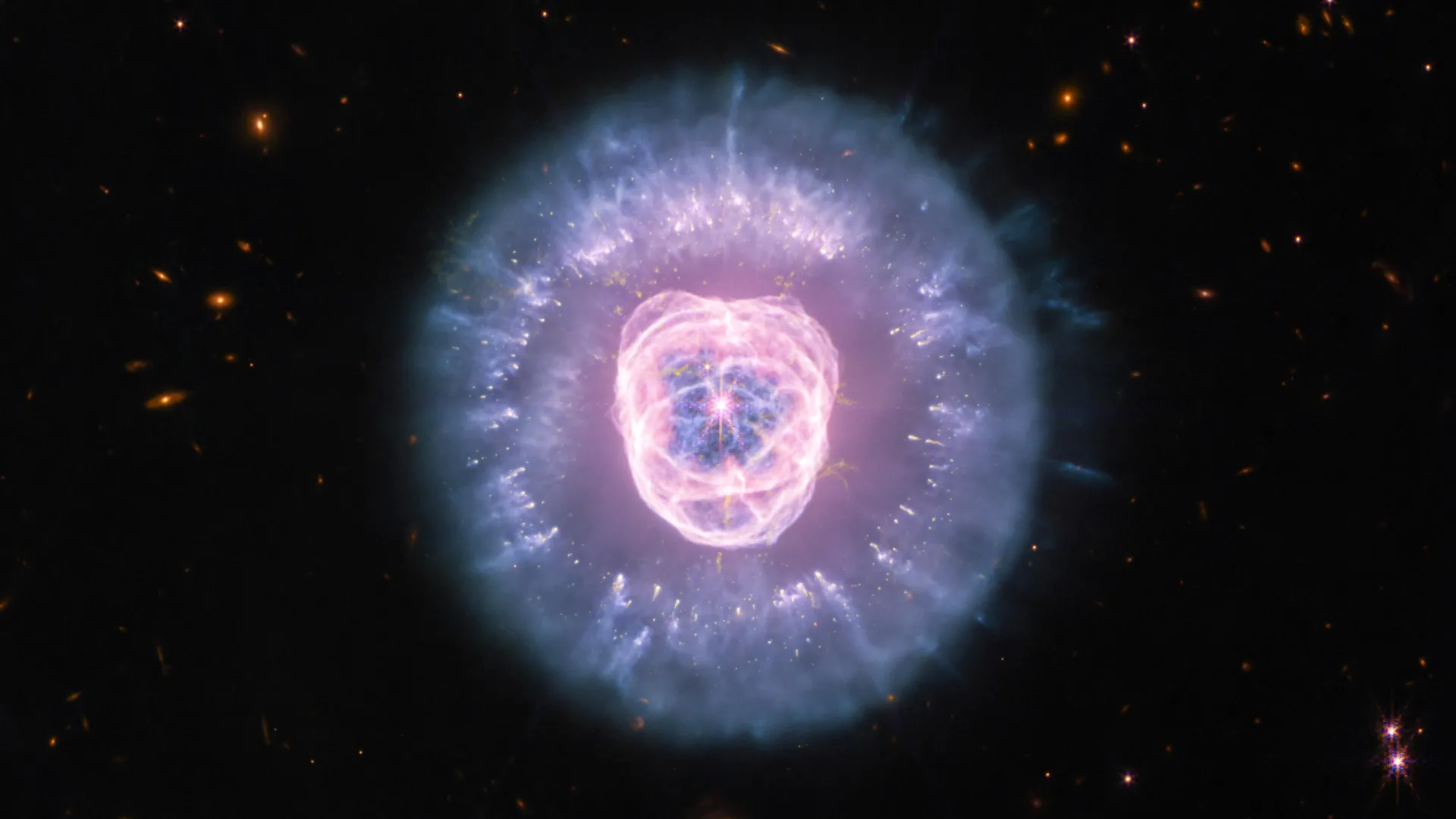
The James Webb Space Telescope has obtained new infrared observations of NGC 2392, a planetary nebula colloquially referred to as the Lion Nebula. The observations represent a significant advancement over previous imaging conducted by the Hubble Space Telescope in 2000, which captured the nebula in visible light and documented its distinctive lion-shaped appearance characterized by a prominent “mane” composed of wispy structures.
Webb’s infrared instruments, including its Near Infrared Camera and Mid Infrared Instrument, have provided enhanced resolution and revealed features that are not readily apparent in visible light observations, such as dense dust concentrations and ionized gas regions. The gaseous and dusty materials comprising the nebula have been undergoing evolution over several millennia and continue to change at the present time. The structures visible today represent the consequences of activity originating from the stellar remnant positioned at the nebula’s center.
The Lion Nebula was formed through the death of a lower-mass star, which differs from the comparatively rare supernova explosions associated with very massive stellar objects. As the star exhausted its nuclear fuel, it became unstable and began pulsating, causing it to expel its outer layers into the surrounding space. This ejected material comprises the expanding shells of gas and dust that define the planetary nebula. The exposed stellar core, now an intensely hot white dwarf, continues to radiate energy that pushes the discarded material outward and ionizes the gas, creating the lion’s recognizable facial features.
The nebula’s distinctive mane corresponds to the inner region of a dust shell illuminated by the central white dwarf. The mane-like features consist of compact dust clumps that have withstood the intense radiation from the stellar core by blocking some of that energy and shielding material situated behind them. Astronomers continue investigating the mechanisms responsible for the formation of the complex ring and shell arrangements commonly observed in planetary nebulae.
Webb’s observations document the Lion Nebula at a specific point in its extended evolutionary timeline. The gas and dust will continue to disperse away from the central stellar remnant, gradually altering the nebula’s appearance. Scientific estimates suggest the Lion Nebula will undergo complete dispersal in approximately 10,000 years, a comparatively brief interval on astronomical timescales.
Article Attribution | Read More at Article Source
Article summary produced by Claude AI