

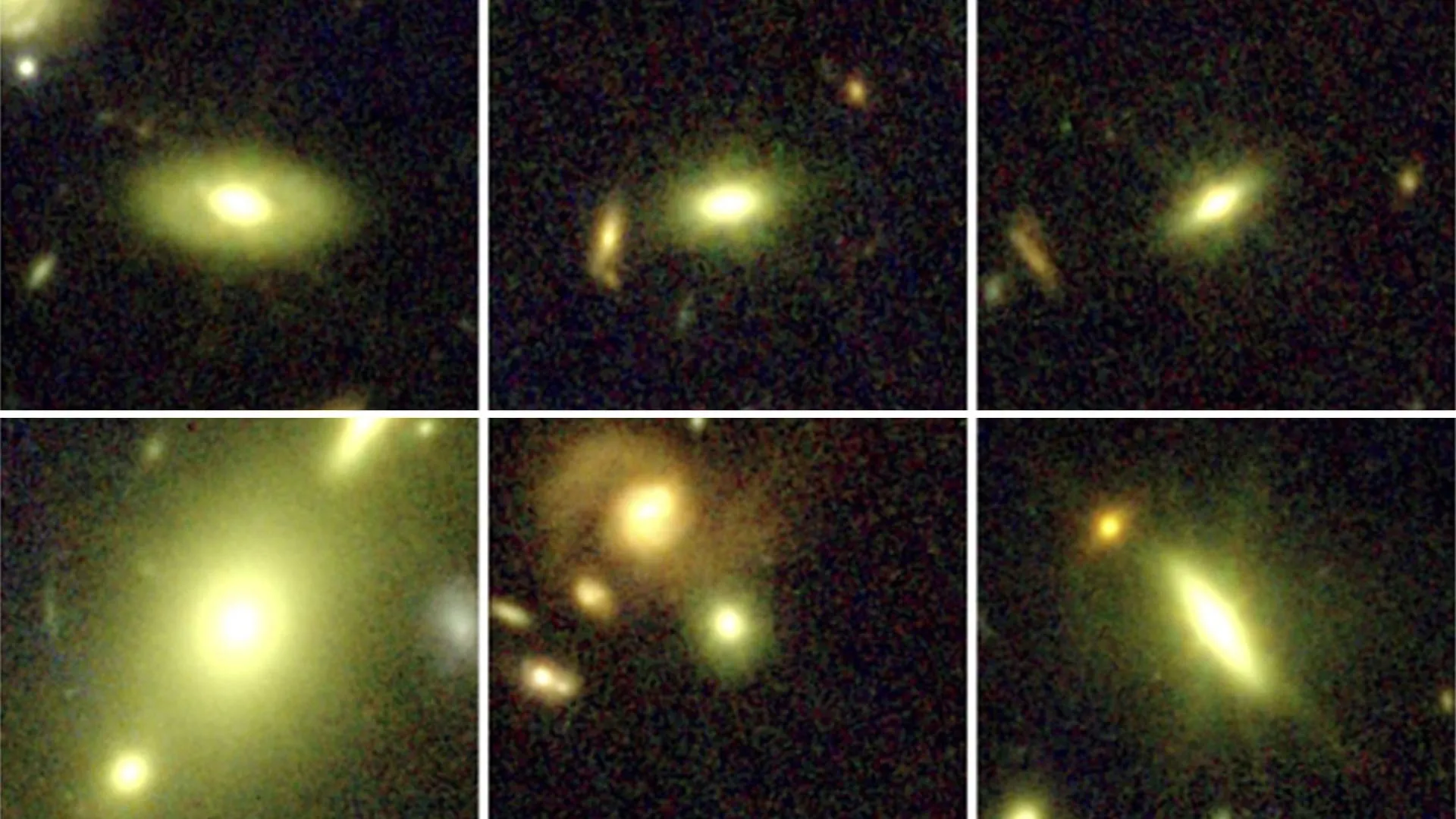
An international research team, including scientists from Penn State, has revealed that some of the largest galaxies in the early universe are significantly more massive than previously calculated. The discovery, published in Nature Astronomy, was made possible through observations from NASA’s James Webb Space Telescope combined with ground-based data from the Very Large Telescope.
The researchers examined nine massive, mature galaxies that ceased producing new stars billions of years ago. By analyzing the light spectrum from these distant galaxies, the team was able to identify and measure the populations of small, faint stars alongside the large, bright stars that typically dominate observations. One particular galaxy that formed less than one and a half billion years after the Big Bang may contain as much as four times the mass previously estimated.
The challenge in detecting these stellar populations stems from the fact that bright, massive stars overwhelm the light signatures of smaller, dimmer stars. According to the research team, bright stars function like skyscrapers in a city, obscuring the vast population of low-mass stars concealed between them. The findings challenge the long-standing assumption that stars form in consistent proportions throughout the universe. Instead, the most massive galaxies in the early universe appear to contain a much greater proportion of low-mass stars compared to smaller galaxies like the Milky Way.
The discovery carries significant implications for cosmological models. Since JWST began observations, astronomers have repeatedly identified unexpectedly massive and mature galaxies existing relatively soon after the Big Bang. Adding substantially larger stellar populations to these early galaxies intensifies existing tensions in galaxy formation theories, raising questions about how such enormous numbers of small stars could have formed so early in cosmic history.
Beyond galaxy formation, the findings may have broader astronomical consequences. The greater abundance of low-mass stars in the early universe could suggest that more planets formed in that epoch than previously believed, since many planets orbit low-mass stars. The research team plans to continue using this technique to study galaxies from even earlier cosmic periods, pushing observations closer to when the universe’s first stars and galaxies emerged.
Article Attribution | Read More at Article Source
Article summary produced by Claude AI