

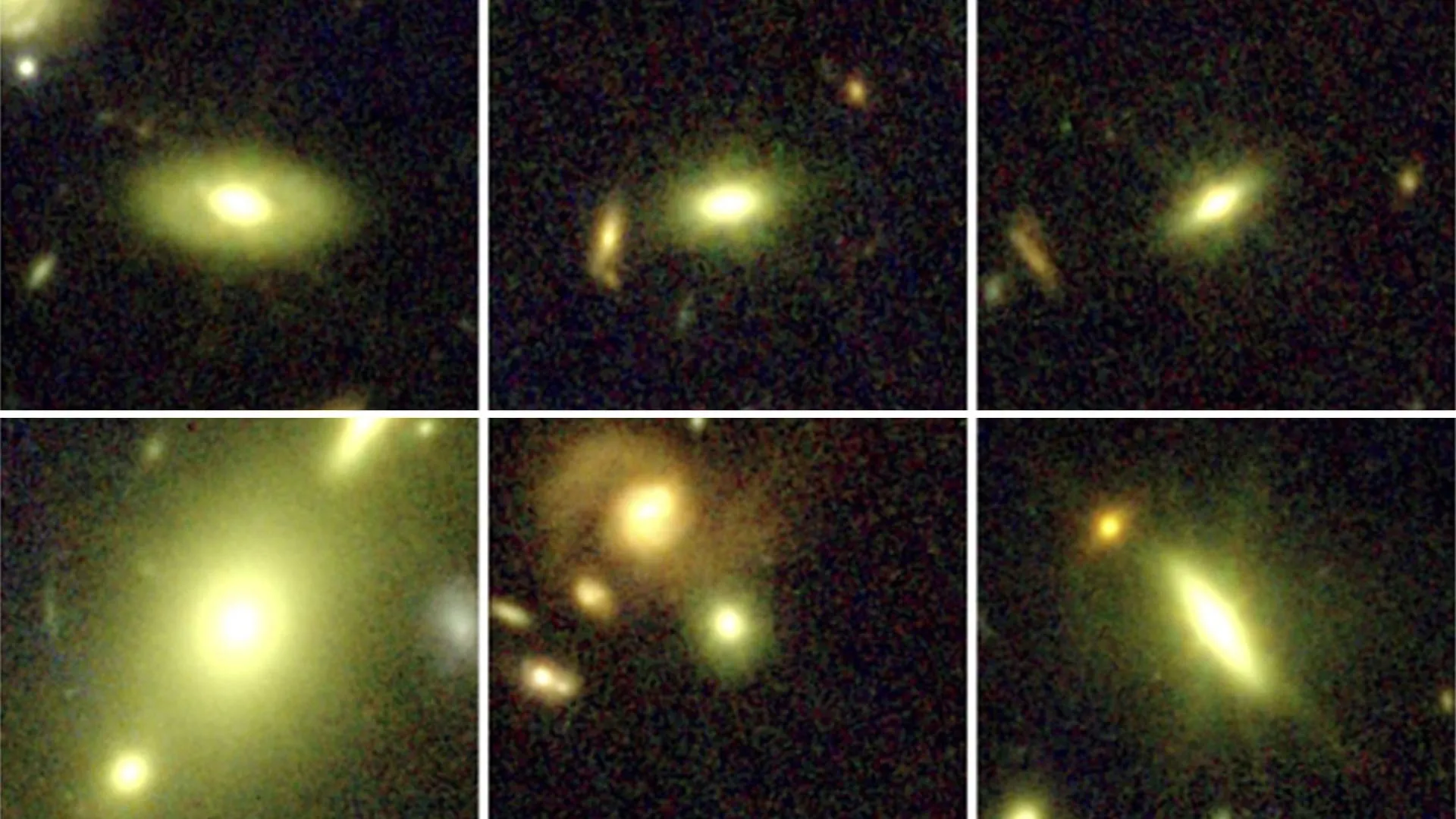
An international research team, including scientists from Penn State, has used NASA’s James Webb Space Telescope to reveal previously hidden stellar populations in ancient galaxies. The study examined nine large, mature galaxies that ceased forming new stars billions of years ago, combining observations from the telescope with ground-based data from the Very Large Telescope.
Researchers developed new techniques to estimate the relative abundance of small, faint stars compared to large, bright stars in distant galaxies. The methodology involved analyzing how each galaxy’s light separates into a spectrum, with subtle color variations revealing the presence of different stellar types. While massive, luminous stars dominate the visible light output from these distant systems, the team’s refined models successfully identified the signatures of numerous low-mass stars that had previously remained undetectable.
The findings challenge conventional assumptions about stellar populations across the universe. Astronomers traditionally assumed that stars formed in relatively consistent proportions regardless of galaxy size, but the new data indicates that massive early galaxies contain significantly higher proportions of low-mass stars than do smaller galaxies like the Milky Way. One particularly notable galaxy, which likely formed less than one and a half billion years after the Big Bang, appears to contain approximately four times more mass than previous calculations suggested.
The discovery amplifies existing puzzles concerning early universe formation. Since JWST began its observations, astronomers have repeatedly detected surprisingly massive and mature galaxies existing relatively shortly after the Big Bang, already straining theoretical models of galaxy development. The revelation that these ancient galaxies harbor substantially more stellar mass than recognized intensifies questions about how such enormous numbers of small stars could have formed so rapidly in cosmic history.
The research team plans to apply the same analytical techniques to examine galaxies from even earlier cosmic periods. Beyond implications for galaxy formation theory, the findings suggest that the early universe may have hosted more planets than previously estimated, since numerous planets orbit low-mass stars.
Article Attribution | Read More at Article Source
Article summary produced by Claude AI