

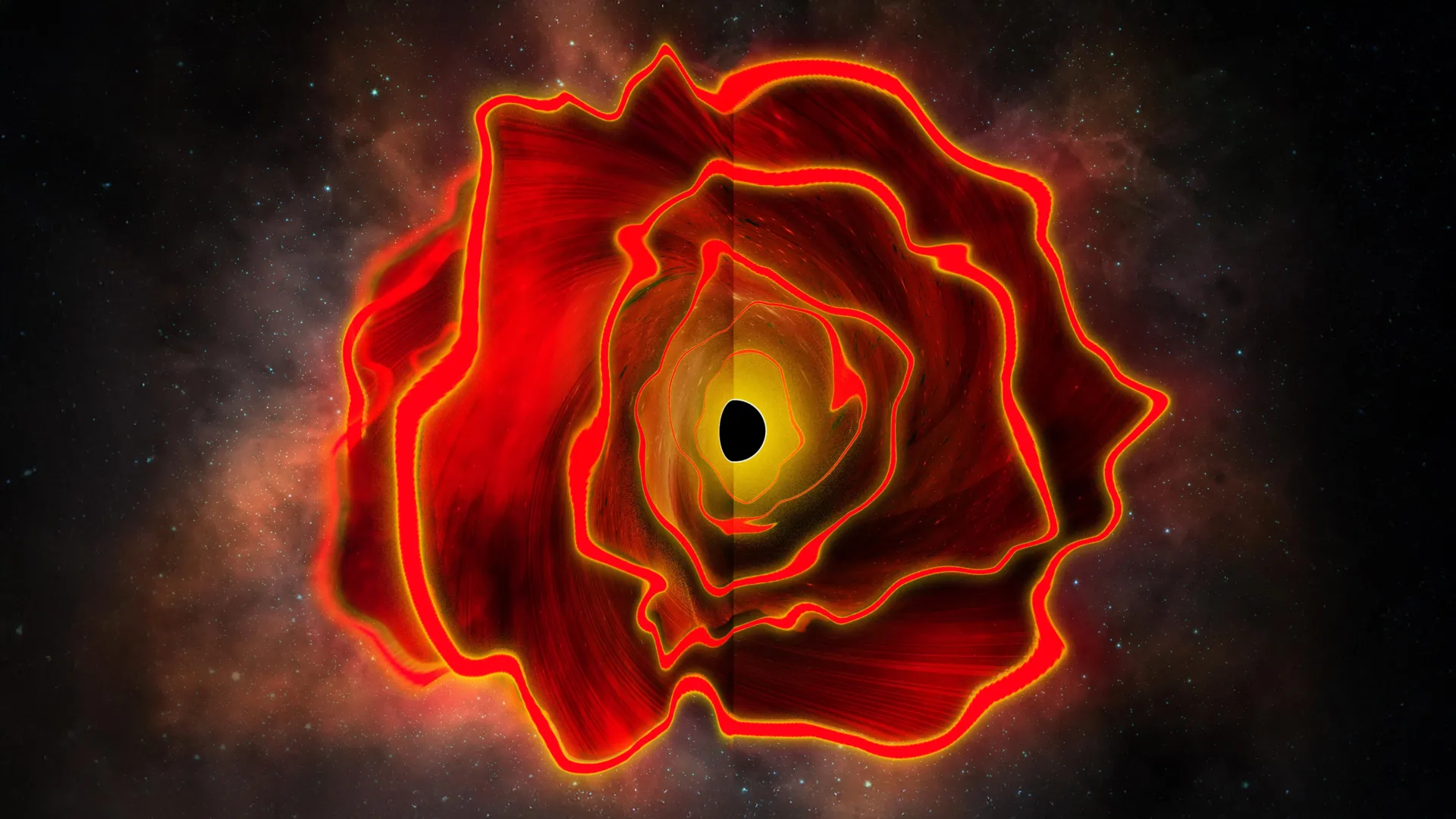
Researchers from MIT and collaborating institutions have identified an unusual bright red object detected by NASA’s James Webb Space Telescope in the early universe, only a few hundred million years after the Big Bang. The discovery is described in a study published on August 12 in Nature. The object exhibits characteristics that do not match conventional astronomical phenomena, prompting scientists to propose it represents a previously unknown category of astrophysical source they term a “black hole star.”
The object’s energy output is approximately 100 billion times greater than any known star could produce through conventional means, placing its power generation at levels typically associated with black holes rather than stars. Initial observations suggested the object’s red appearance might be due to obscuring dust, but spectroscopic analysis revealed features inconsistent with that explanation. Most notably, the object displays an exceptionally deep “Balmer break”—a sudden drop in light at certain wavelengths—along with an atmosphere composed almost entirely of hydrogen and helium with no detectable heavier elements.
Lead researcher Rohan Naidu and colleagues propose that the most plausible explanation involves a central black hole approximately 100,000 times the mass of the Sun, surrounded by an extremely dense and extensive envelope of hydrogen gas that resembles a star the size of the solar system. Computer simulations demonstrated that such a configuration could account for the object’s unusual spectral characteristics and its extreme brightness. The discovery may help explain the mystery of numerous “little red dots” observed throughout JWST’s deep space images, which appear abundant in the early universe but are essentially absent in the present day.
The research team was not initially seeking this type of object. While conducting a survey aimed at identifying the earliest and most distant galaxies, they encountered this source displaying characteristics too anomalous to ignore. The findings suggest that some unusually bright objects observed in the early universe may represent this previously unknown class of objects rather than extraordinarily distant or early-forming galaxies as initially interpreted.
Article Attribution | Read More at Article Source
Article summary produced by Claude AI