

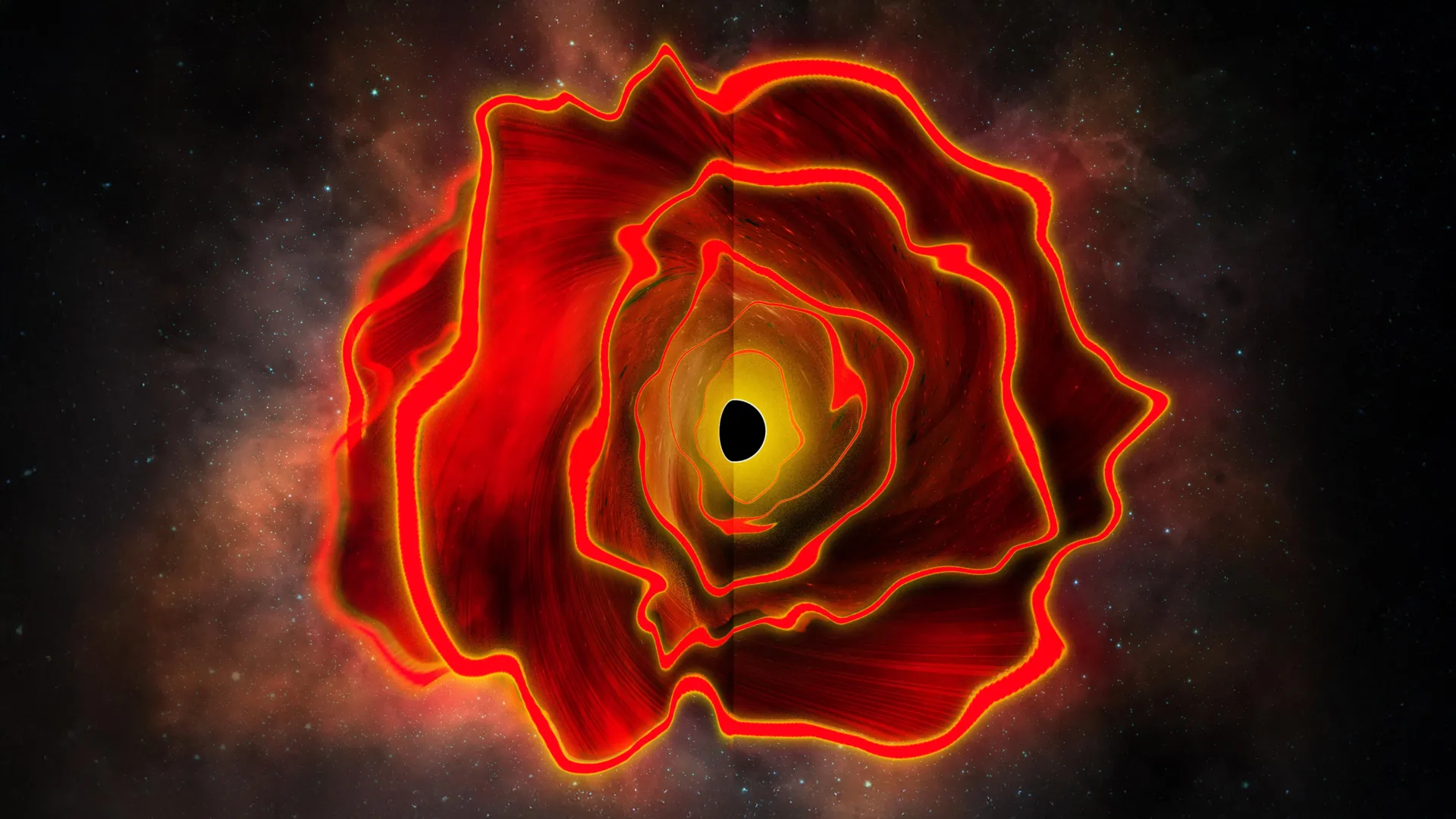
Researchers from MIT and other institutions have identified an exceptional bright object in the early universe using NASA’s James Webb Space Telescope. The discovery, described in a study published on August 12 in Nature, reveals an object that displays characteristics unlike anything previously documented by astronomers.
The object initially appeared to be an enormous star with dimensions comparable to the solar system. However, detailed spectroscopic analysis revealed it was producing approximately 100 billion times more energy than any known star could generate through nuclear fusion. This extreme brightness level is more consistent with the energy output of black holes. The combination of stellar-like appearance with black hole-level energy generation led researchers to propose this represents a new class of astrophysical object they termed a “black hole star.”
The researchers, led by Rohan Naidu of MIT’s Kavli Institute for Astrophysics and Space Research, were initially conducting a survey to identify the earliest galaxies when they spotted this unusual red source. The object exhibited a notably deep “Balmer break,” a pattern where light suddenly drops at certain wavelengths. This feature is typically associated with dense gas but appeared at unprecedented intensity in this object. Further analysis showed the light contained almost no elements beyond hydrogen and helium.
Through computational modeling comparing various astrophysical scenarios, the team determined the most plausible explanation involved a central black hole approximately 100,000 times the mass of the Sun, surrounded by an extremely dense envelope of hydrogen extending across roughly the size of the solar system. This configuration could account for the object’s unusual coloration, distinctive spectral features, and extraordinary brightness.
The research has potential implications for understanding numerous other unexplained bright objects, referred to as “little red dots,” that have appeared throughout JWST’s deep space observations. These mysterious sources have been among the most debated phenomena of the JWST era. If black hole stars represent a common type of object in the early universe, they may explain the prevalence of these red dots and subsequently disappear over cosmic time.
Article Attribution | Read More at Article Source
Article summary produced by Claude AI