

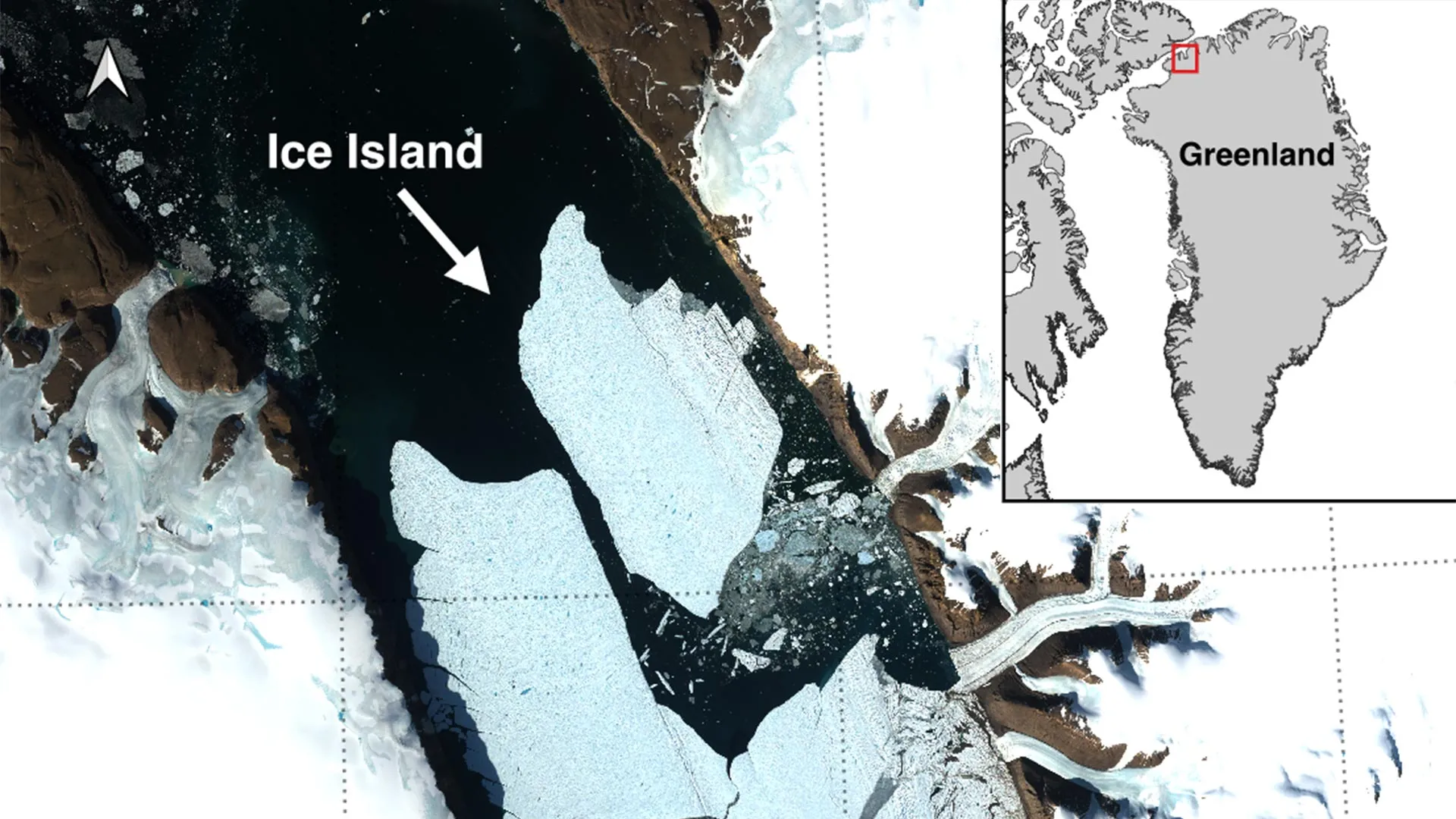
An international research team documented a significant calving event at Petermann Glacier in northwest Greenland this month. On August 4, 2026, the glacier released a 76.4 square kilometer ice island with a thickness of up to 150 meters. The newly separated tabular iceberg, identified by Adam Garbo, a glaciology PhD student at the University of Ottawa, has a surface area comparable to Manhattan Island. The discovery emerged from collaborative research involving institutions including the University of Ottawa, University of Stirling, Environment and Climate Change Canada, Lancaster University, and the University of Leeds.
Satellite observations conducted since 2019 provided advance warning of the separation. European Space Agency Sentinel-1 imagery detected deterioration along the glacier’s floating ice tongue centerline on August 3, with the ice island fully detached by August 4. Scientists had anticipated the break for years based on expanding fractures visible in long-term monitoring data. According to Dr. Anna Crawford of the University of Stirling, Arctic ice islands of this scale are notably uncommon compared to their Antarctic counterparts, making them particularly valuable for studying glacier behavior and polar region changes.
Researchers project additional calving events at Petermann Glacier in the coming period. Two more ice sections, measuring approximately 94 square kilometers and 84 square kilometers respectively, are expected to separate as existing rifts continue to propagate through the ice. Combined, these three calving episodes would reduce the glacier’s floating ice tongue by roughly 22 percent, removing approximately 254 square kilometers total.
Beyond scientific interest, the ice island poses practical considerations for Arctic operations. Environment and Climate Change Canada is monitoring the floating mass to assess potential hazards to marine vessels and offshore infrastructure. Dr. Abigail Dalton of the Canadian Ice Service noted that such thick ice blocks can drift intact for extended periods before gradually fracturing into smaller, difficult-to-track fragments that create navigation risks. Ongoing satellite, aerial, and tracking observations will continue documenting the ice island’s evolution and informing broader understanding of Arctic ice shelf dynamics.
Article Attribution | Read More at Article Source
Article summary produced by Claude AI