

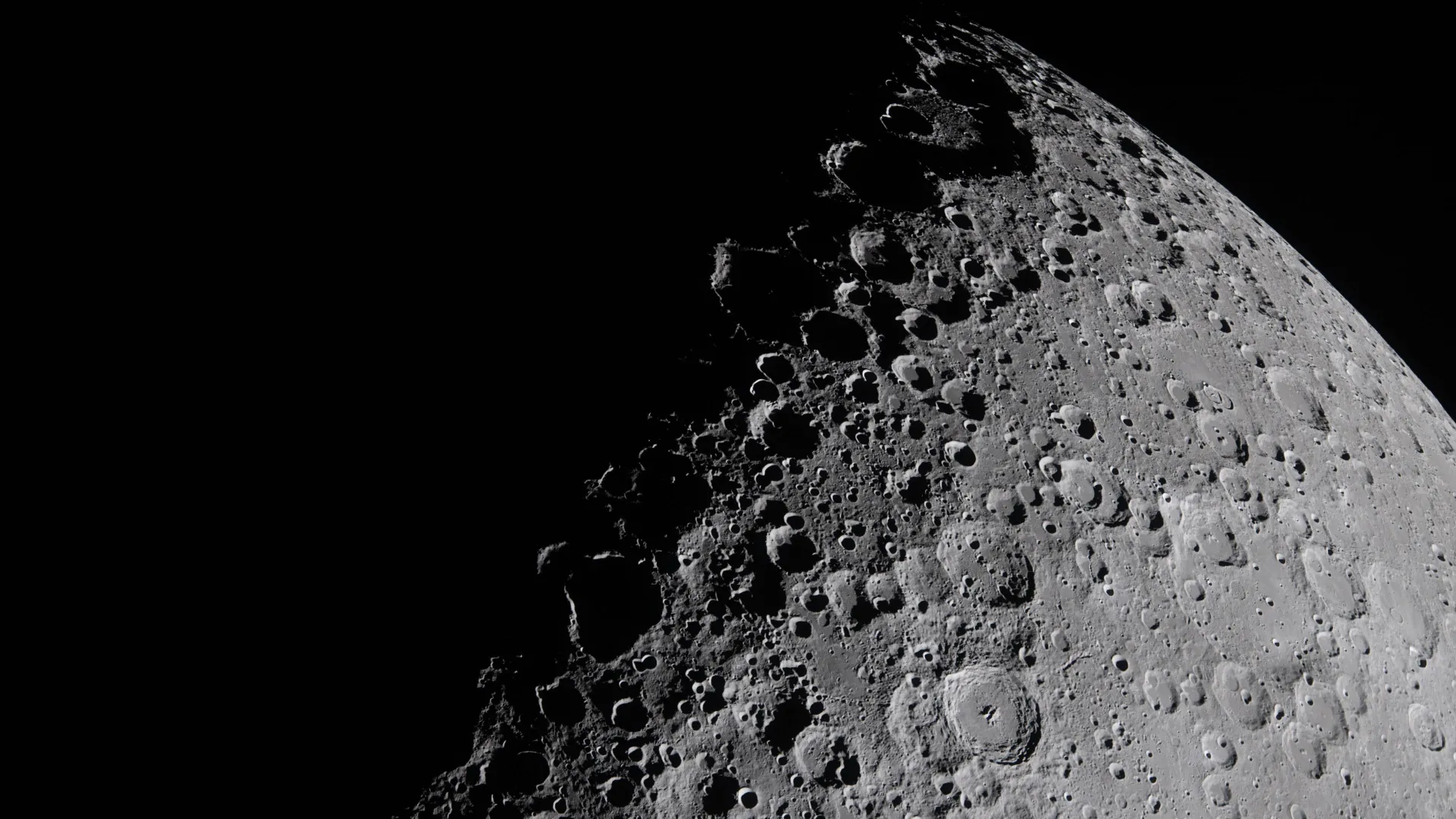
Scientists from the University of Maryland, Lawrence Berkeley National Laboratory, and the University of Hawaii have identified a technique for locating subsurface water ice on the moon by analyzing how seismic vibrations travel through the lunar ground. The research, published on July 31, 2026, comes as space agencies prepare for renewed lunar exploration activities. The method relies on the principle that frozen material causes seismic waves to travel two to three times faster than they do through dry soil, while also reflecting seismic energy in ways that can be detected and measured.
Locating accessible water resources on the moon holds significant implications for future human missions. Once extracted and processed, lunar ice could provide drinking water, oxygen for breathing, and hydrogen for fuel production, substantially reducing the need to transport supplies from Earth. NASA’s Artemis program is targeting the moon’s south polar region for crewed landings in 2028, where permanently shadowed craters are believed to contain valuable ice deposits. Having a local water supply would extend mission duration and enable more sustainable long-term operations on the lunar surface.
The research team validated their approach through multiple experimental and analytical methods. One researcher examined how ice forms within volcanic rock samples resembling lunar soil using X-ray imaging, while another developed temperature models for the moon’s south polar region to identify craters cold enough to preserve ice for geological timescales. Computer simulations were used to predict how seismic waves would behave when traveling through underground ice deposits. All three approaches produced consistent results, demonstrating measurable changes in seismic properties caused by the presence of ice.
Opportunities to test the methodology on the moon are approaching. China’s Chang’e-7 mission, expected to land near Shackleton Crater in late 2026, will carry a seismometer positioned near suspected ice deposits. NASA’s Artemis missions could deploy additional seismic instruments starting in 2028. Beyond supporting resource extraction, lunar ice may preserve evidence of the early solar system and provide insights into how water was distributed throughout the cosmos billions of years ago.
Article Attribution | Read More at Article Source
Article summary produced by Claude AI