

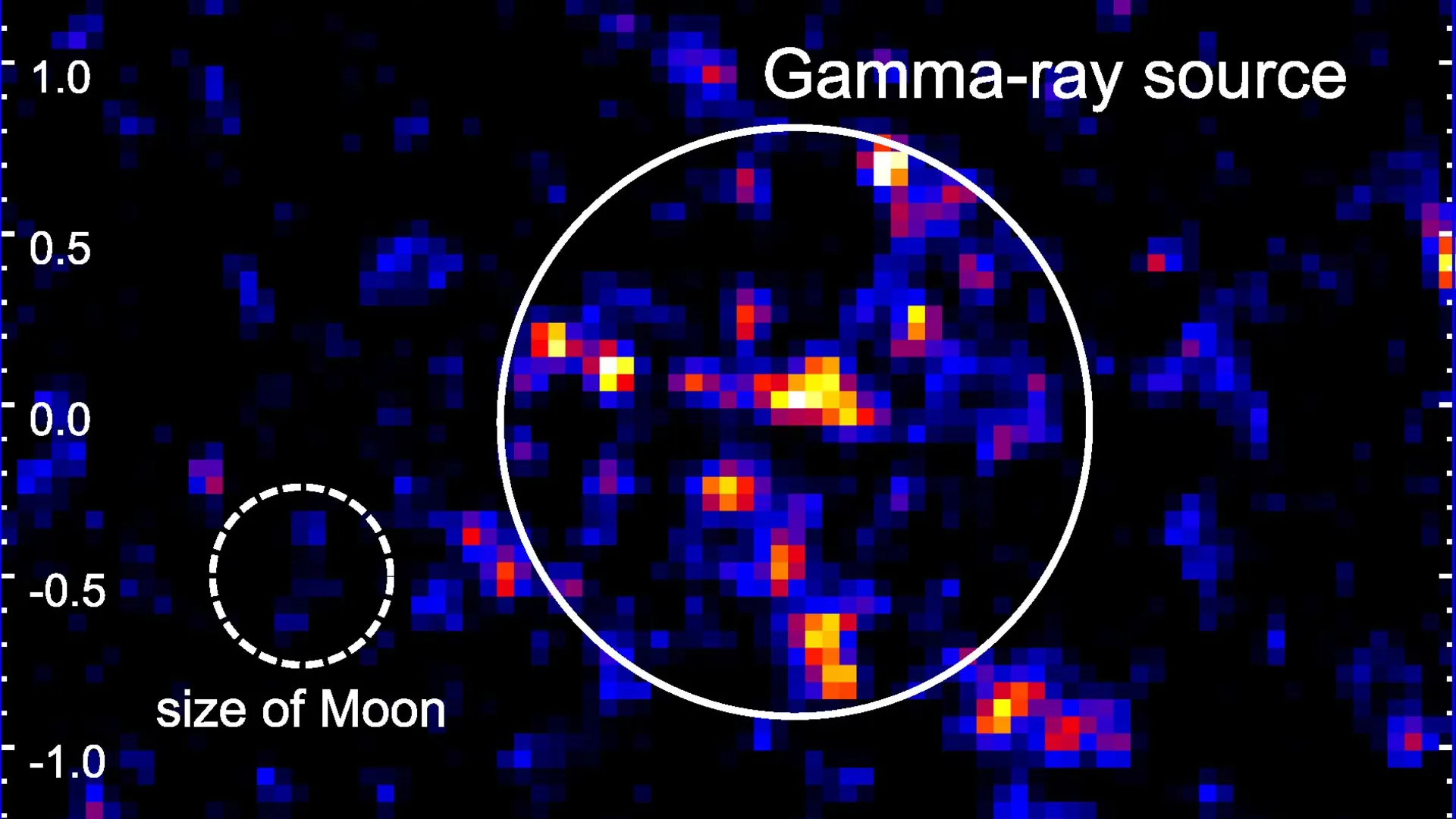
Scientists have confirmed the existence of a natural particle accelerator within the Milky Way galaxy that achieves some of the highest energy levels observed in cosmic ray research. The discovery was made by an international team led by Hiroshima University and published in The Astrophysical Journal on July 16, 2026. The identified object, designated LHAASO J1912+1014u and located in the constellation Aquila, represents a significant achievement in astrophysics research.
Cosmic rays are high-energy particles predominantly composed of protons that travel through interstellar space. While human-built particle accelerators such as the Large Hadron Collider push particles to extreme velocities, natural cosmic accelerators in space achieve even greater energy levels. Objects capable of accelerating protons beyond the peta electron volt threshold—roughly one quadrillion electron volts—are termed proton PeVatrons. Distinguishing these proton accelerators from other high-energy sources has proven challenging for researchers due to overlapping signals from alternative particle types.
The research team employed a multiwavelength analysis approach, combining data from multiple observatories to characterize LHAASO J1912+1014u. The Tibet AS gamma experiment and China’s Large High Altitude Air Shower Observatory initially detected the source through gamma-ray emissions. However, definitive identification required additional observations from NASA’s Fermi Large Area Telescope, which measured lower-energy gamma rays, along with X-ray data from NASA’s Chandra Observatory and radio observations from Japan’s FUGIN survey.
Three key findings supported the proton PeVatron classification. The gamma-ray signal exhibited a continuous spectrum across a broad energy range, suggesting proton rather than electron acceleration. The distribution of lower-energy gamma rays aligned with patterns of interstellar gas detected through radio observations, consistent with proton collisions producing gamma-ray emissions. Additionally, Chandra detected only weak X-ray signals, which would have been stronger if the source primarily accelerated electrons.
Researchers indicated that numerous other candidate objects likely represent proton PeVatrons within the Milky Way. Future investigations will focus on characterizing these additional sources to determine their prevalence and identify the underlying mechanisms powering such cosmic accelerators.
Article Attribution | Read More at Article Source
Article summary produced by Claude AI