

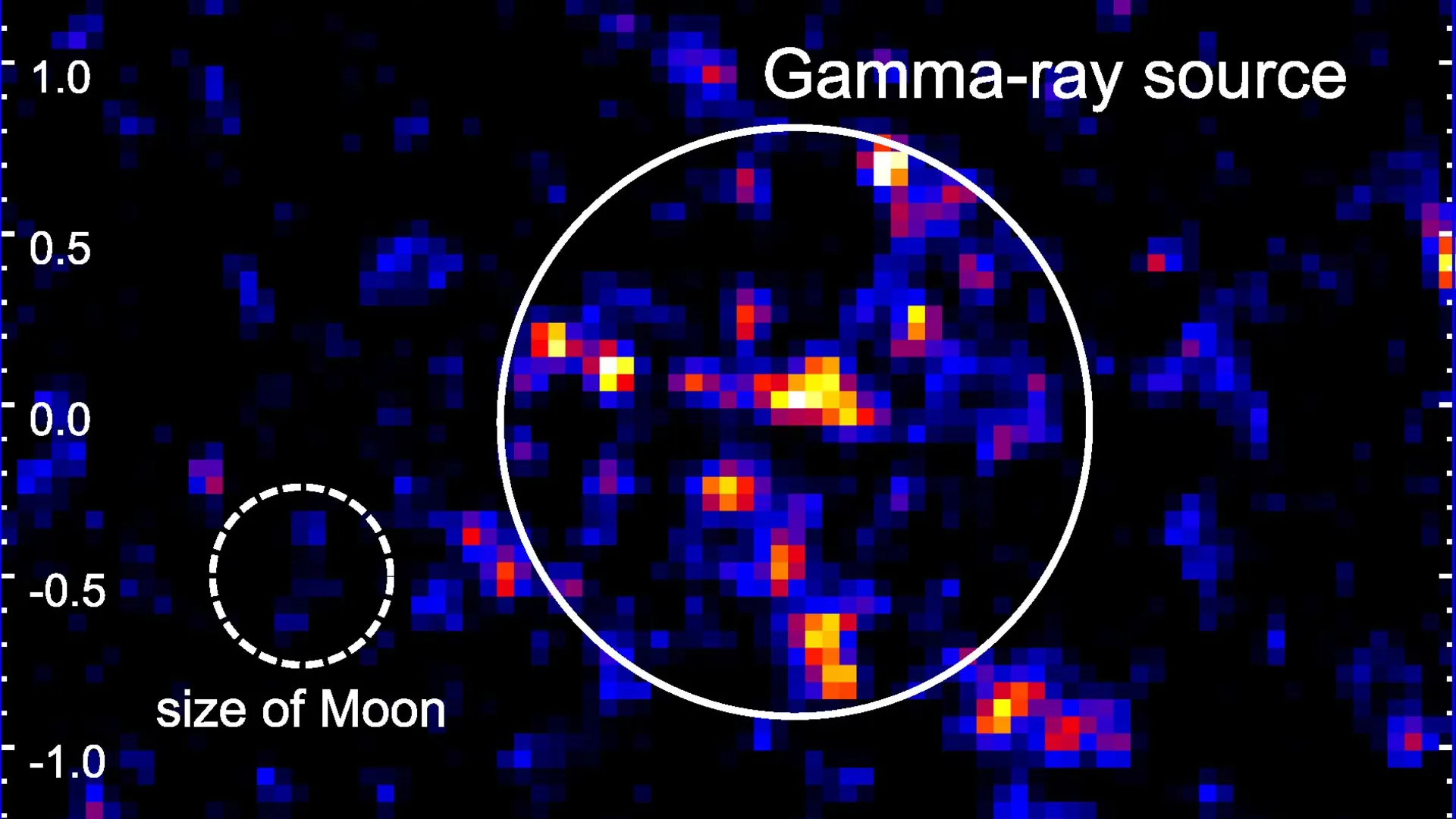
An international research team led by Hiroshima University has confirmed the discovery of a natural cosmic accelerator capable of propelling protons to unprecedented energy levels within the Milky Way. The source, designated LHAASO J1912+1014u and located in the constellation Aquila, represents one of the most significant finds in high-energy astrophysics. Results from the investigation were published in The Astrophysical Journal on July 16, 2026.
Cosmic rays, which consist primarily of protons along with a smaller number of electrons, reach energies that exceed those produced by human-built particle accelerators such as the Large Hadron Collider. Objects capable of accelerating protons beyond one petaelectron volt—a threshold known as PeV—are termed proton PeVatrons. Identifying these natural accelerators poses significant technical challenges, as researchers must distinguish signals generated by accelerated protons from those produced by highly energetic electrons.
The research team employed a multiwavelength approach, combining observations from the Fermi Large Area Telescope, China’s Large High Altitude Air Shower Observatory, the Chandra X-ray Observatory, and Japan’s FUGIN radio survey. This comprehensive dataset spanned the electromagnetic spectrum from radio waves to gamma rays. The integration of measurements across multiple energy ranges allowed researchers to construct a detailed model of the source and differentiate between competing explanations for its characteristics.
Three key findings supported the classification of LHAASO J1912+1014u as a proton PeVatron. The gamma-ray signal exhibited continuity across a wide energy range from over 100 trillion electron volts down to 400 million electron volts, making electron acceleration unlikely as the dominant mechanism. Additionally, the distribution of lower-energy gamma rays matched patterns of surrounding interstellar gas, consistent with proton-gas interactions. Finally, weak X-ray emissions detected by Chandra further supported the proton explanation, as sources dominated by accelerated electrons would typically produce stronger X-ray signals.
The researchers indicate that numerous other candidate proton PeVatrons likely exist throughout the Milky Way. Future investigations will focus on systematically studying these candidates to establish confirmation rates and identify which types of cosmic objects produce these extreme acceleration phenomena.
Article Attribution | Read More at Article Source
Article summary produced by Claude AI