

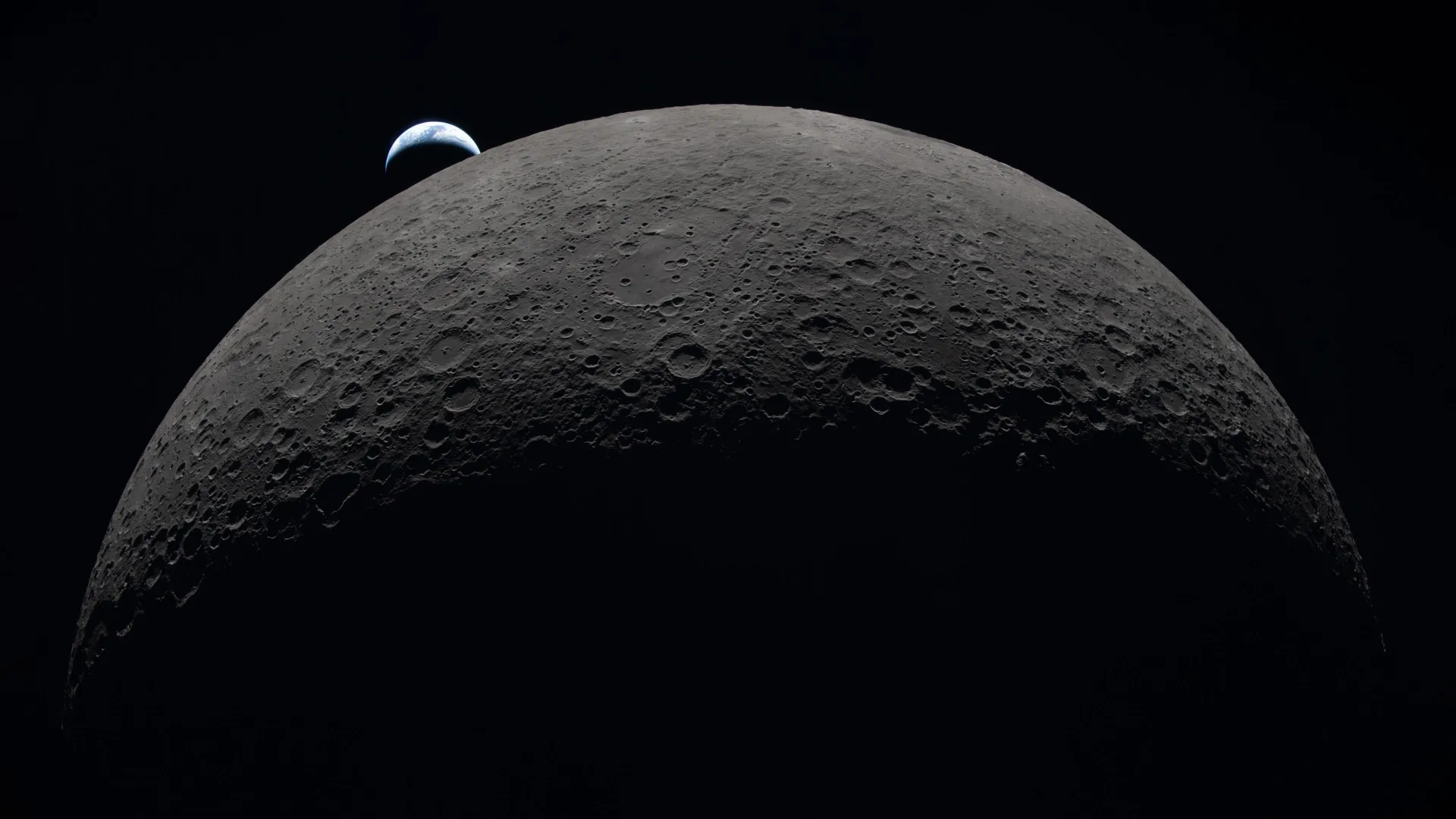
NASA scientists have determined that some microorganisms carried to the Moon by human explorers may be capable of surviving in protected shadowed areas near the lunar South Pole, according to findings published on Aug. 19, 2026, in Science Advances. The research highlights the significance of understanding microbial persistence in extreme lunar environments as humanity establishes a more permanent presence on the Moon. Biological contamination from human activities could complicate scientific efforts to distinguish ancient lunar geology from material introduced by astronauts, an issue that will also be relevant for future missions searching for life on Mars.
Humans naturally carry microorganisms, with approximately one million bacteria inhabiting each patch of skin the size of a pencil eraser. Some of these organisms can escape spacesuits and habitats into the surrounding environment. Scientists recognize this as a major challenge when attempting to study chemical evidence related to the Moon’s ancient geology or possible biology. However, researchers propose that carefully monitored shadowed regions near the South Pole could serve as a valuable natural laboratory to test the actual limits of microbial survival under conditions difficult to replicate on Earth. Establishing a clear baseline of human-introduced contaminants is essential before such experiments can proceed.
The study examined five microorganisms selected for their demonstrated resilience in spaceflight conditions, including Aspergillus niger, a fungus commonly found in warm, humid environments. Even rigorous sterilization procedures cannot eliminate every hardy organism. Scientists were particularly surprised that microbes could withstand exposure on the exterior of the International Space Station, as these organisms are not typically classified as extremophiles. While NASA can reduce biological contamination on robotic spacecraft through extreme heating, this approach is not feasible for crewed missions.
Researchers analyzed how sunlight reaches the lunar poles to determine where microbes might survive. The Moon’s minimal axial tilt means the Sun remains close to the horizon at the poles, creating a patchwork of shadowed areas that can remain extremely cold, preserve water, and protect organisms from damaging radiation. Scientists modeled conditions at three locations near the lunar South Pole using elevation and temperature maps from NASA’s Lunar Reconnaissance Orbiter. The analysis identified “survivable niches” ranging from large crater floors to areas as small as an astronaut’s boot print. Aspergillus niger proved particularly resilient due to its resistance to ultraviolet radiation. Researchers emphasize that survival differs from growth, as some microbes may remain dormant in protected regions without the conditions necessary to reproduce.
Article Attribution | Read More at Article Source
Article summary produced by Claude AI