

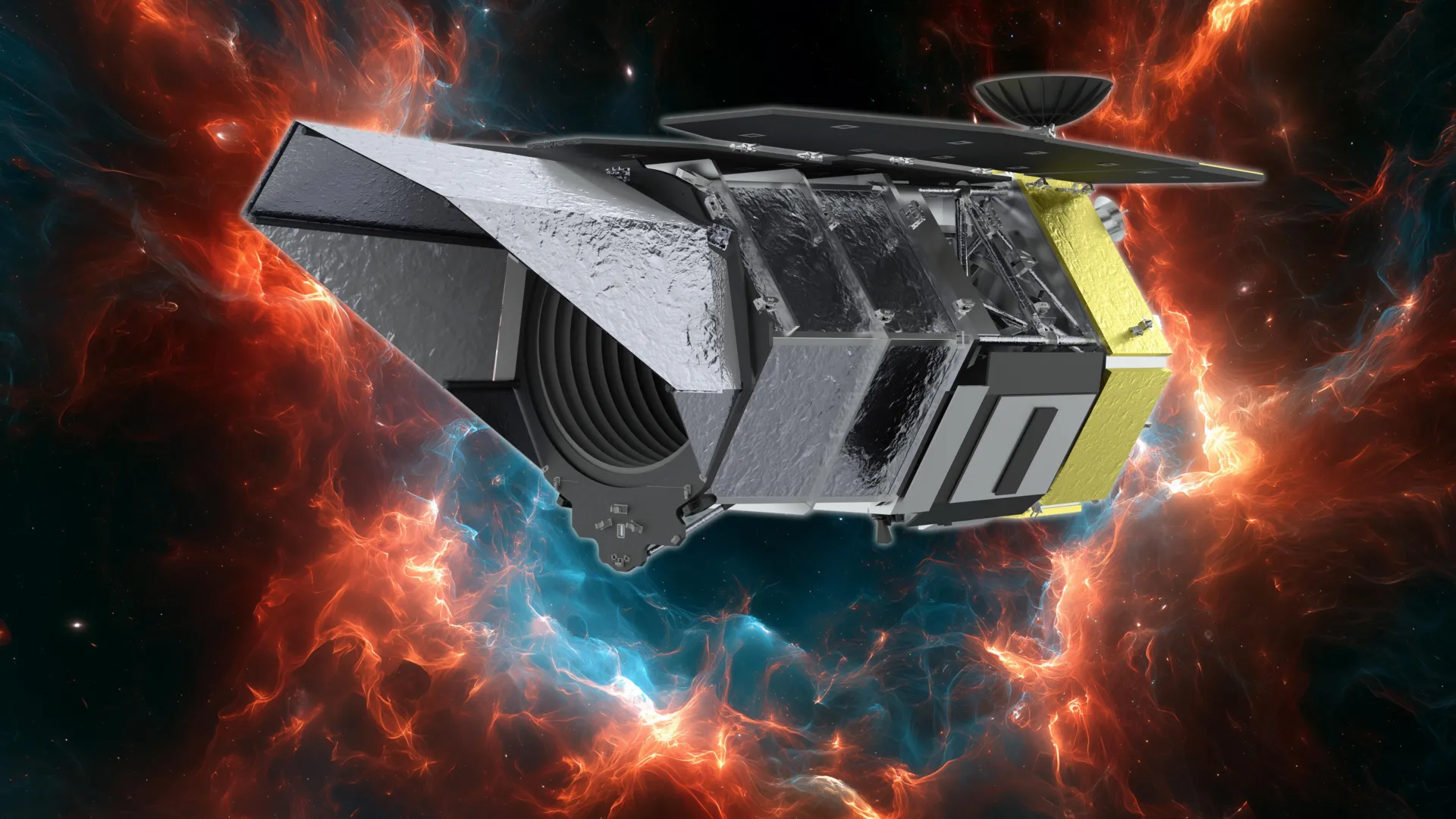
NASA and SpaceX have advanced preparations for the Nancy Grace Roman Space Telescope following a successful Flight Readiness Review at Kennedy Space Center. Mission leaders from the space agency, the Roman team, and SpaceX conducted a formal assessment on Friday to evaluate the spacecraft, launch vehicle, launch site infrastructure, and overall mission readiness. The review process involved examining all critical systems and operational procedures to determine whether final launch preparations could proceed.
Following the favorable review outcome, mission managers authorized Roman to move into the final phases of preparation work. NASA and SpaceX are targeting a launch window opening no earlier than 7:26 a.m. EDT Sunday, Aug. 30. The telescope will be carried into orbit aboard a SpaceX Falcon Heavy rocket, one of the company’s most powerful launch vehicles, which operates using three connected boosters to generate sufficient thrust for large spacecraft missions. The launch will occur from Launch Complex 39A at Kennedy Space Center in Florida.
In the coming days before launch, technicians will transport the Roman observatory to SpaceX’s facility at the pad and complete final integration work. The telescope is already enclosed within Falcon Heavy’s protective fairing, a shell designed to shield the spacecraft during ascent from aerodynamic forces and atmospheric effects. Once the encapsulated observatory is connected to the rocket, both will be moved to the launch pad for terminal countdown operations.
The Roman Space Telescope represents NASA’s latest generation of space-based observatory and is intended to provide astronomers with an expanded perspective of the cosmos. The mission is designed to address fundamental questions in astronomy by studying cosmic evolution, investigating the mechanisms driving universal expansion, and surveying exoplanets orbiting distant stars. Through wide-field observations, Roman is expected to offer researchers enhanced capabilities for examining the universe’s history and large-scale structure while advancing knowledge of planetary systems beyond Earth’s solar system.
Article Attribution | Read More at Article Source
Article summary produced by Claude AI