

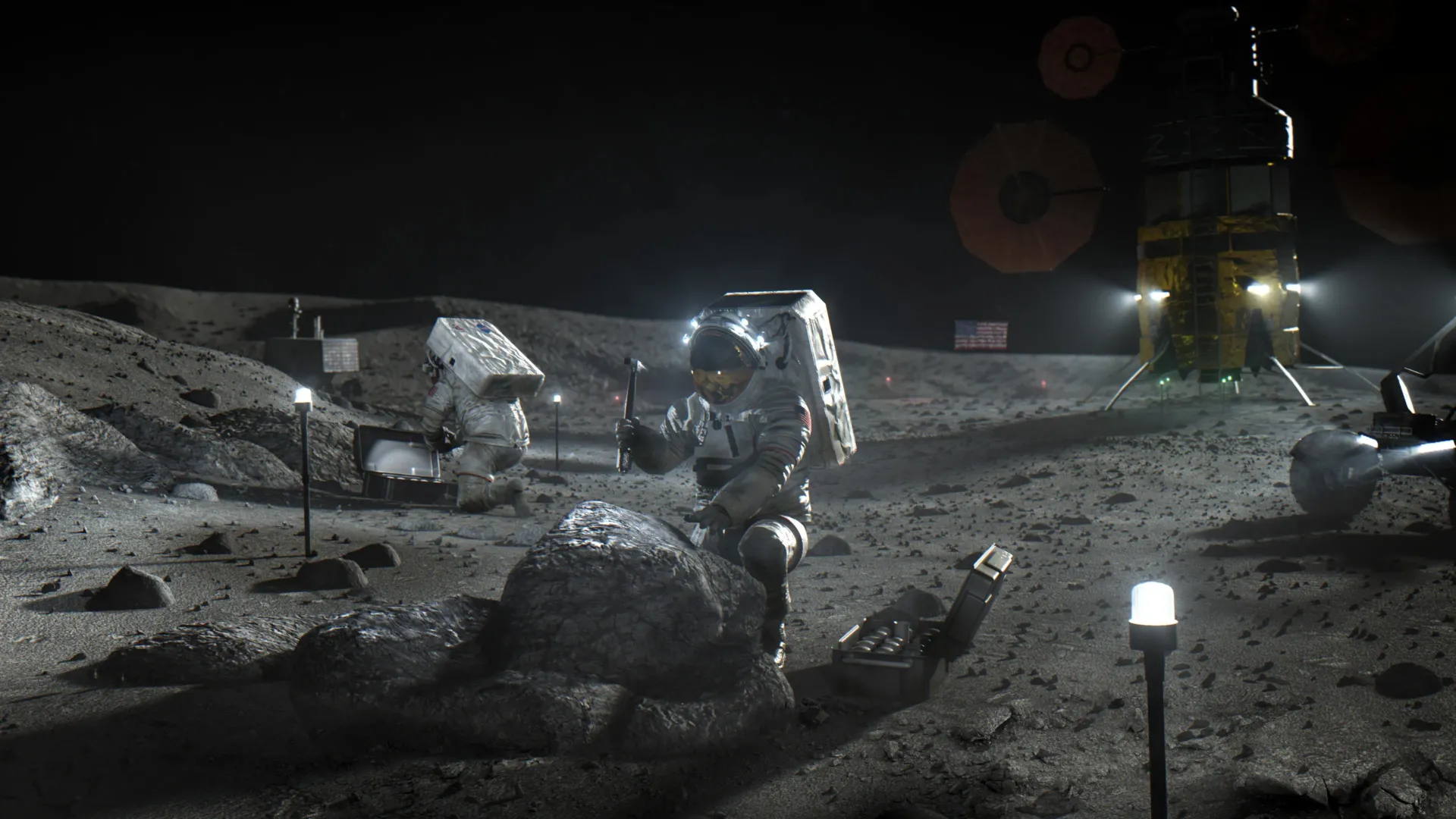
NASA is progressing with its Moon Base initiative, a permanent outpost planned for the Moon’s South Pole region designed to enable scientific research, technology development, and eventual human operations. The agency is partnering with four commercial companies—Blue Origin, Firefly Aerospace, Intuitive Machines, and Voyager Lunar Systems—to develop and deploy landers capable of delivering essential infrastructure and equipment to the lunar surface through 2028.
Phase I of the Moon Base architecture plan, currently underway through 2029, encompasses more than twenty robotic landing missions. Each mission is designed to build incrementally on previous efforts by enhancing capabilities and validating critical systems before subsequent flights arrive. These early robotic missions will deploy scientific instruments to assess lunar conditions, test new technologies, and install foundational infrastructure required for future human habitation. NASA’s Commercial Lunar Payload Services initiative aims to establish a dependable lunar supply chain that will support sustained robotic and human presence on the Moon.
Blue Origin’s Blue Moon MK1 lander, designated for the Endurance mission, has completed environmental and thermal vacuum testing at NASA’s Johnson Space Center. The spacecraft’s structure, propulsion systems, and avionics are fully assembled, with upcoming tests planned for payload integration and cryogenic propellant loading. Firefly Aerospace is developing Blue Ghost Mission 2, a larger configuration built on the company’s successful 2025 lunar landing, designed to target the Moon’s far side and become the first American landing in that region. The mission will investigate far side geology and deploy three NASA payloads to advance scientific research and test technologies for future lunar operations.
Intuitive Machines is preparing its IM-3 mission, featuring the Nova-C lander Trinity and the company’s inaugural Altus-1 lunar data relay satellite. The spacecraft has undergone extensive thermal vacuum testing and will deploy one satellite and multiple payloads to explore Reiner Gamma’s geomagnetic environment. Voyager Lunar Systems is conducting environmental testing of its Griffin-1 lander at NASA’s Jet Propulsion Laboratory, with the infrastructure-class spacecraft scheduled for launch in late 2026 and expected to deliver the largest commercial payload to the lunar surface to date.
NASA is also collaborating with Northrop Grumman on three technology demonstration payloads utilizing power and avionics hardware adapted from the Gateway program. These demonstrations will evaluate systems designed to withstand lunar night conditions and test shared surface power infrastructure. Collectively, these commercial and government efforts are establishing the systems, capabilities, and supply chains necessary to support NASA’s long-term objectives for robotic and human exploration on the Moon.
Article Attribution | Read More at Article Source
Article summary produced by Claude AI