

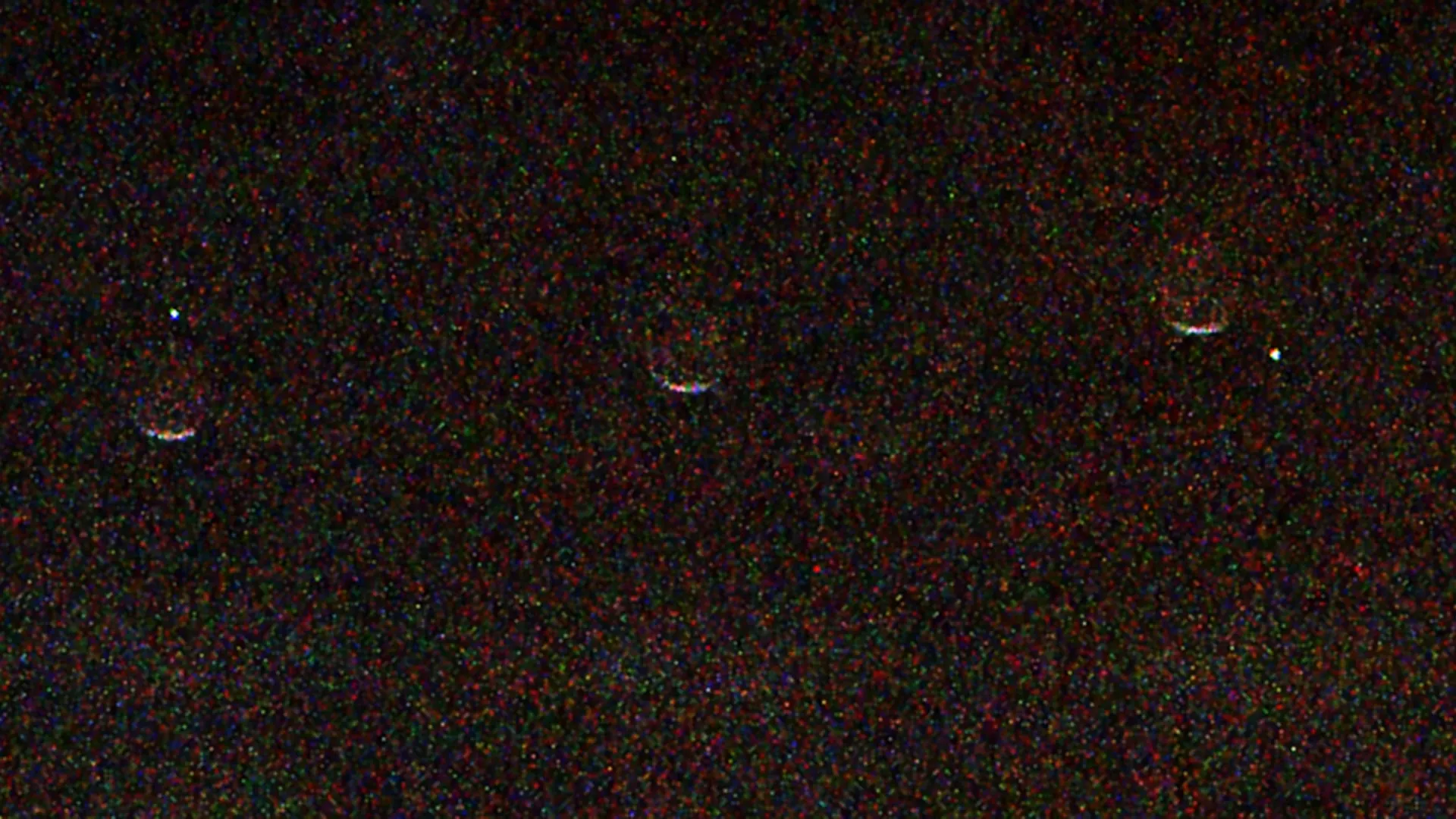
NASA’s Perseverance Mars rover has documented a rare celestial occurrence in which Earth briefly disappeared from view as Phobos, one of Mars’ two moons, passed directly in front of it. The observation represents the first instance of humanity recording such an event from the surface of another planet. The rover captured the sequence using its Mastcam-Z instrument at approximately 7 p.m. local solar time on July 2, during the 1,907th Martian day of the mission.
The composite image shows Earth as a tiny point of light moving diagonally across the frame while Phobos travels in the opposite direction. The two objects align in the third image of the sequence, with Earth momentarily disappearing behind the shadowed edge of the small moon. Scientists at NASA’s Jet Propulsion Laboratory noted that this image serves as a unique self-portrait taken from another planet, with Phobos creating an unexpected photographic element.
The contrast between the two celestial bodies is striking when viewed from Perseverance’s location along the rim of Jezero Crater. Phobos, a lumpy moon approximately 17 miles across at its widest point, orbits Mars at a distance of about 4,850 miles and appeared roughly one-third as wide as Earth’s Moon appears from Earth. Earth, by contrast, was situated approximately 195 million miles away and appeared in the images as merely a single-pixel-sized point of light.
Astronomers classify the event as an occultation, which occurs when a nearer object appears larger and completely blocks a more distant object from view. This differs from eclipses, which involve one object entering the shadow of another, and transits, which occur when a smaller-appearing object crosses the face of a larger one. Perseverance has also observed Martian transits, including instances where Phobos or Deimos passes across the Sun as viewed from the Martian surface.
The observation required careful planning and timing, as astronomers noted that while Phobos crosses the Martian sky three times daily and Earth remains visible for extended periods, aligning the two objects for direct observation involves both strategic coordination and favorable conditions. The Mastcam-Z instrument is operated by Arizona State University in collaboration with Malin Space Science Systems.
Article Attribution | Read More at Article Source
Article summary produced by Claude AI