

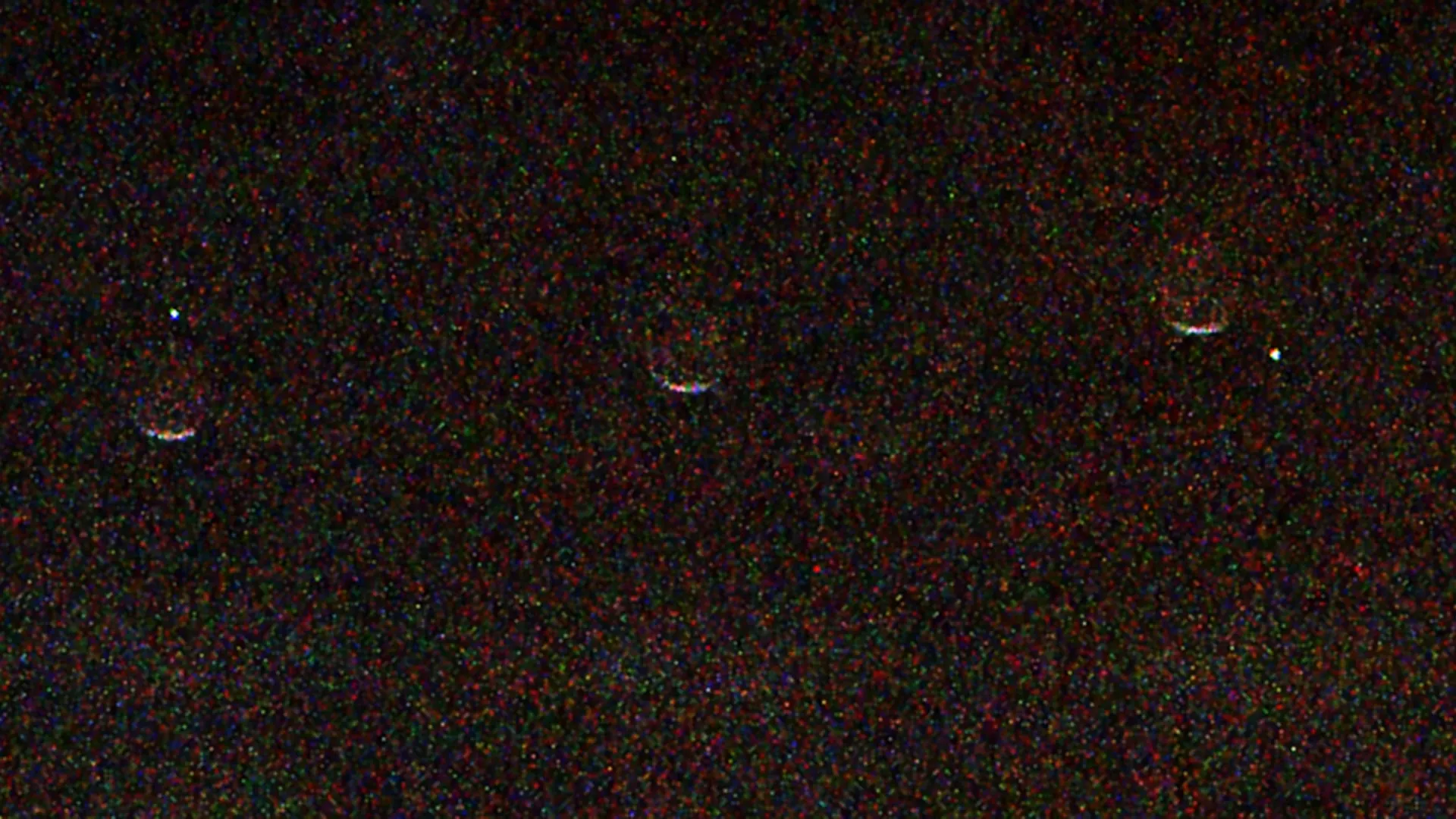
NASA’s Perseverance rover documented a rare celestial event in which Earth vanished behind Phobos, one of Mars’ two moons, as observed from the Martian surface. The rover recorded the sequence using its Mastcam-Z instrument during the Martian evening on July 2, the 1,907th sol of the mission. This observation represents the first instance of humanity capturing Earth disappearing behind another celestial object as seen from the surface of a different planet.
In the composite image sequence, Earth appeared as a single pixel-sized point of light while Phobos traveled across the sky in the opposite direction. By the third image, the two objects aligned, and Earth briefly disappeared behind Phobos’ shadowed edge. Justin Maki, deputy principal investigator for Mastcam-Z at NASA’s Jet Propulsion Laboratory, described the images as a unique self-portrait of Earth taken from another planet’s surface.
The observation highlighted the dramatic differences in scale and distance between the two objects. Phobos, a potato-shaped moon measuring approximately 17 miles across, orbits Mars at a distance of 4,850 miles and appeared roughly one-third as wide as Earth’s Moon appears from Earth. In contrast, Earth was positioned approximately 195 million miles away at the time of observation, rendering the entire planet as only a single point of light in the images. According to Mark Lemmon, a Mastcam-Z co-investigator who planned the observation, such alignments require both careful planning and favorable timing, as Phobos crosses the Martian sky three times daily while Earth remains visible for several months.
The event Perseverance witnessed is classified as an occultation, occurring when one object larger from the viewer’s perspective completely obscures a more distant object behind it. This distinction separates occultations from eclipses and transits, both of which the Perseverance rover has also documented during its mission on Mars. The rover has previously observed transits involving Phobos and Deimos passing in front of the Sun, events informally referred to as Martian solar eclipses.
NASA’s Jet Propulsion Laboratory, managed by Caltech, oversees Perseverance’s operations as part of the agency’s Mars Exploration Program. Arizona State University leads operations of the Mastcam-Z instrument, working alongside Malin Space Science Systems in San Diego on the design and operation of the imaging equipment.
Article Attribution | Read More at Article Source
Article summary produced by Claude AI