

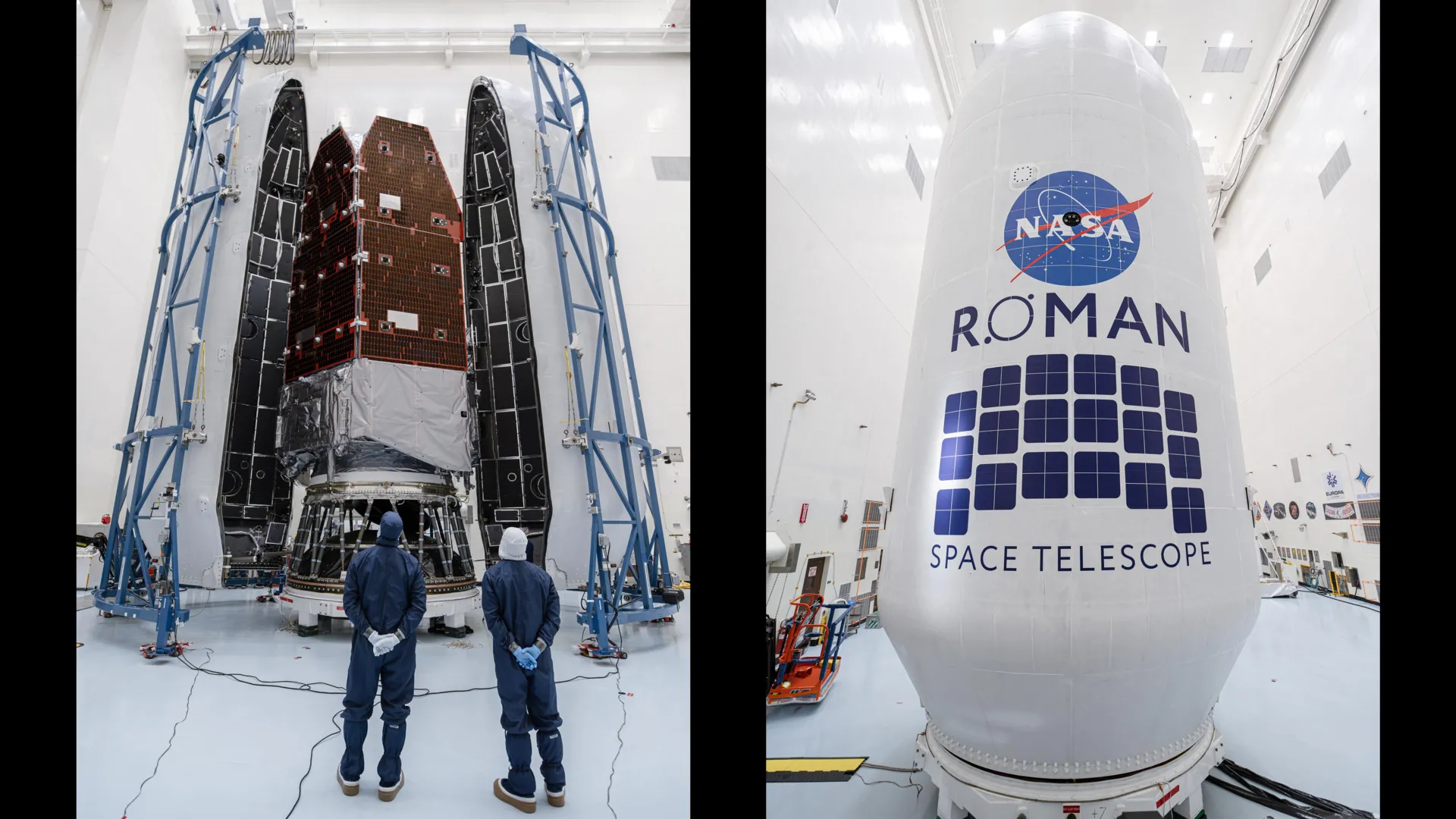
The Nancy Grace Roman Space Telescope reached a significant milestone when teams at NASA’s Kennedy Space Center in Florida secured it within the protective fairing of a SpaceX Falcon Heavy rocket on August 21. The fairing, a 43-foot-tall shell, serves dual purposes during the launch phase by shielding the observatory from environmental threats while on the ground and by maintaining controlled conditions as personnel transport the equipment between facilities.
During launch, the Roman Space Telescope will face extreme conditions as the Falcon Heavy accelerates through Earth’s atmosphere. The payload will encounter intense sound waves, aerodynamic pressure, and significant heat during the initial stages of flight. The fairing is specifically engineered to protect the observatory from these stresses. Several minutes after liftoff, once the rocket reaches an altitude where atmospheric conditions are no longer a threat, the fairing will separate into two sections and fall back to Earth, with SpaceX planning to recover both pieces.
Following the initial ascent, Roman will travel toward Sun-Earth Lagrange point 2, a location in space where gravitational forces from both the Sun and Earth allow spacecraft to maintain a relatively stable orbital position. This location offers favorable conditions for continuous astronomical observations. Before launch, the encapsulated observatory will be transported to SpaceX’s facility at Launch Pad 39A, where it will be attached to the Falcon Heavy rocket. NASA and SpaceX have set no-earlier-than 7:26 a.m. EDT Sunday, August 30, as the targeted launch time.
Once operational, the Roman Space Telescope is expected to identify thousands of exoplanets and contribute to understanding fundamental questions in cosmology. Scientists anticipate the mission will help determine the prevalence of various planetary system types and identify worlds with characteristics similar to planets in Earth’s solar system. The observatory will also conduct investigations into dark matter and dark energy, two of contemporary cosmology’s most significant unknowns, by surveying large sky areas and analyzing matter distribution throughout the cosmos.
Article Attribution | Read More at Article Source
Article summary produced by Claude AI