

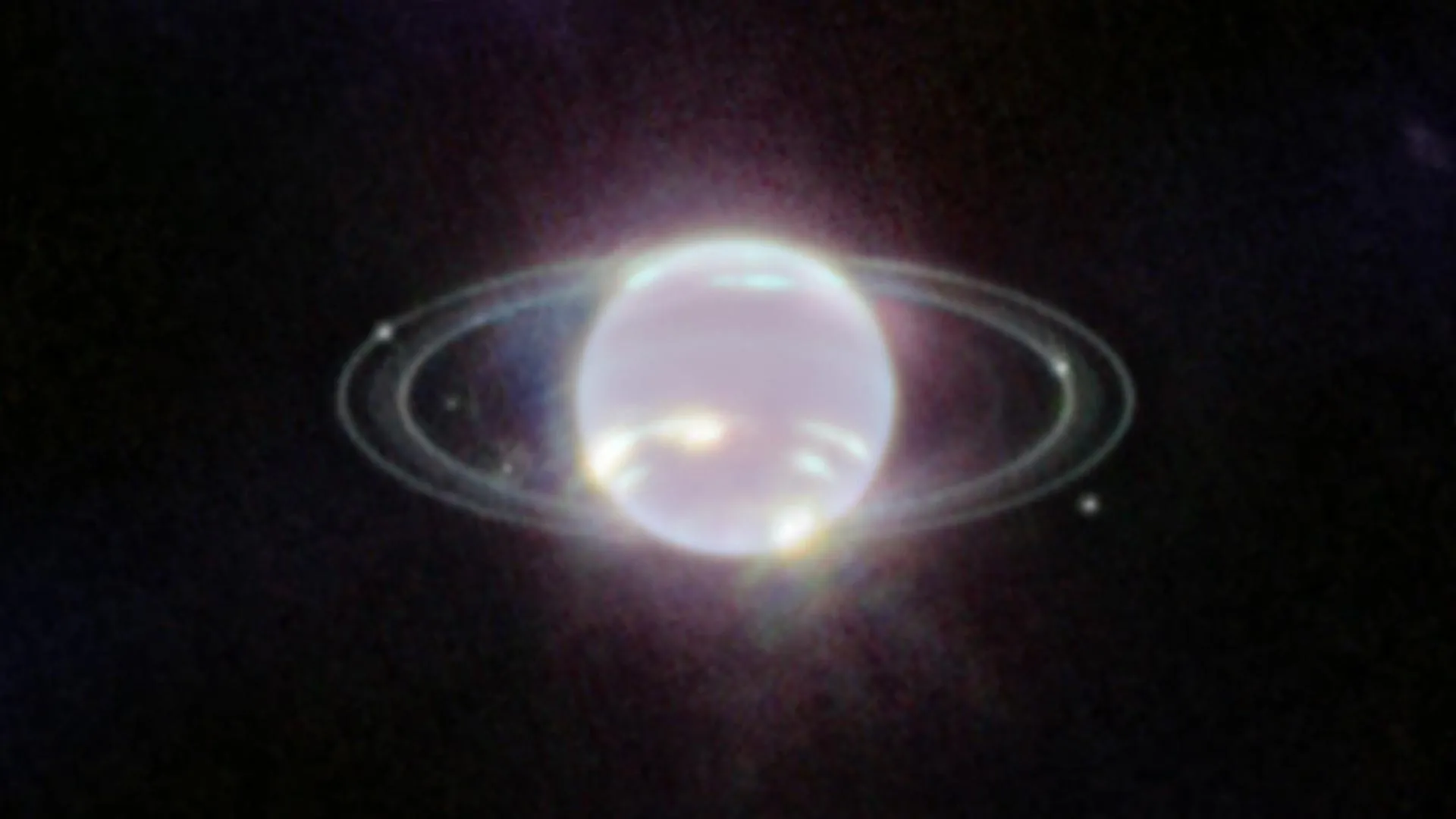
A research team led by Caltech scientists used the James Webb Space Telescope to conduct the first detailed chemical analysis of three of Neptune’s inner moons—Larissa, Galatea, and Proteus—along with the planet’s rings. The observations revealed the presence of phyllosilicates, or clay minerals, which had never before been detected in the outer solar system beyond Jupiter. This unexpected discovery provides new evidence supporting the theory that Neptune once possessed an entirely different system of moons that was catastrophically destroyed.
The presence of clay minerals on the moons presents a significant puzzle for researchers. These minerals require liquid water to form, yet the observations showed no evidence of water ice on any of the three moons or in the rings examined. Scientists theorize that these clay deposits must have originated from much larger bodies, as the current small moons would not have been large enough to generate sufficient internal heat to melt water ice and create such minerals. The most likely source, according to the researchers, was Neptune’s original system of icy moons that existed before a dramatic upheaval in the planetary system.
The catastrophic event researchers believe shaped Neptune’s current moon system involves Triton, the planet’s largest moon. Scientists propose that Triton was captured by Neptune’s gravity after forming elsewhere in the solar system. This capture event would have been violent enough to completely destroy Neptune’s original orderly system of large moons—similar to what exists around Uranus today. The debris from this collision later coalesced to form the small inner moons that orbit Neptune in the present day.
Notably, Proteus, the largest of the three moons studied, did not display the same clay mineral signature as the other two moons, adding another layer of complexity to the analysis. Researchers also identified a hydrated mineral on all three moons that does not match any known material in the solar system, indicating substantial gaps remain in understanding Neptune’s moon system. An alternative explanation being considered involves a large Kuiper Belt object, similar in size to Pluto, being torn apart by Neptune’s gravitational forces, though the team believes the original moon destruction scenario is more probable.
Article Attribution | Read More at Article Source
Article summary produced by Claude AI