

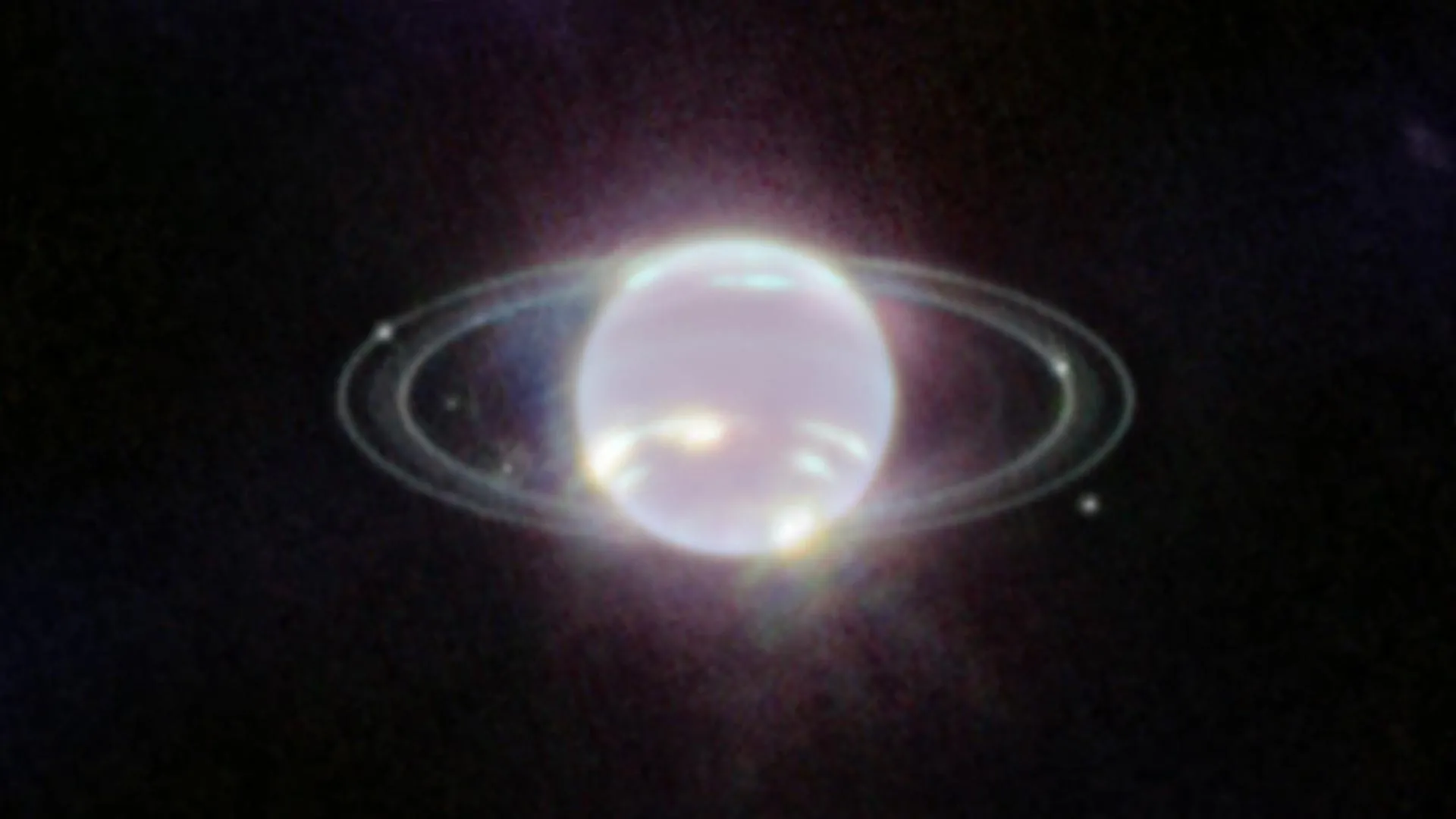
Researchers at Caltech used NASA’s James Webb Space Telescope to conduct detailed observations of Neptune’s rings and three inner moons—Larissa, Galatea, and Proteus—in an effort to understand the planet’s unusual moon system. The observations, published in Science Advances, revealed an unexpected chemical composition on these celestial bodies that offers clues to Neptune’s violent past.
The spectroscopic analysis detected magnesium-rich phyllosilicates, or clay minerals, on Larissa, Galatea, and Neptune’s rings. These minerals typically form only in the presence of liquid water, yet no water ice signatures appeared in the spectra of the three moons or rings examined. This paradox suggests the clay minerals originated from deep within much larger bodies that possessed sufficient internal heat to melt water ice, pointing to an ancient moon system that no longer exists.
The research supports the hypothesis that Neptune once possessed a substantial satellite system comparable to the moon systems observed around Uranus. Scientists theorize this original system was catastrophically destroyed when Triton, Neptune’s largest moon, was captured by the planet’s gravitational field after forming elsewhere in the solar system. The debris from this violent event subsequently reassembled to create the small inner moons visible today. Alternative explanations include the tidal disruption of a large Kuiper Belt object similar in size to Pluto that ventured too close to Neptune.
Proteus, the largest of the three moons studied, did not display the same phyllosilicate signature, suggesting it may have formed from material in a different region of the debris disk or experienced subsequent heating that destroyed existing clay minerals. The team also identified an unclassified hydrated mineral present on all three moons that does not match any known spectral signatures in existing reference libraries.
The findings highlight Neptune’s inner moons as a unique scientific opportunity, as they represent the only known location in the solar system where researchers can directly observe material from the deep interior of a large icy world. These interior compositions are normally inaccessible elsewhere, making the debris field around Neptune exceptionally valuable for understanding the compositions and histories of ancient planetary bodies.
Article Attribution | Read More at Article Source
Article summary produced by Claude AI