

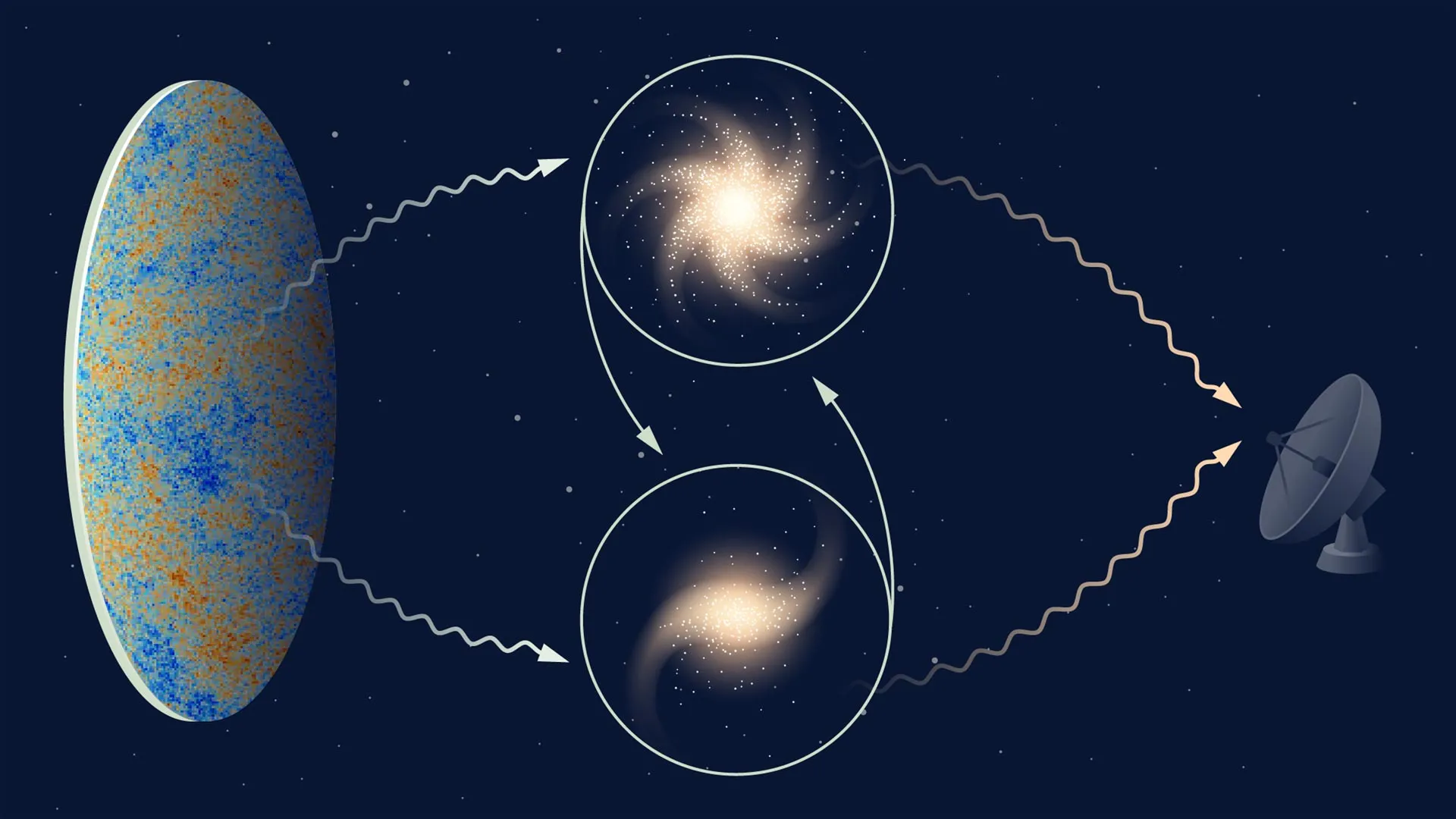
An international team of astronomers has conducted the largest-scale test of gravitational theory to date, examining how gravity behaves across galaxy clusters separated by hundreds of millions of light-years. The research, led by Patricio A. Gallardo at the University of Pennsylvania and published in Physical Review Letters, used observations from the Atacama Cosmology Telescope to measure gravitational effects on some of the universe’s most massive structures.
The investigation was motivated by a longstanding puzzle in cosmology: many astronomical objects move at speeds that cannot be explained by the amount of visible matter they contain. Stars in the outer regions of galaxies orbit faster than gravitational calculations suggest they should, and entire galaxies within clusters move at unexpectedly high velocities. This discrepancy has prompted researchers to question whether the gravitational theories established by Isaac Newton and later refined by Albert Einstein remain valid across all cosmic scales, or whether the laws of gravity themselves require modification.
To test which explanation best accounts for these observations, the team analyzed ancient light from the cosmic microwave background as it passed through massive galaxy clusters. The light from this radiation, released approximately 380,000 years after the Big Bang, experiences subtle distortions as it travels through galaxy clusters and their gravitational fields. By examining these effects across hundreds of thousands of clusters, researchers determined how gravity operates at the universe’s largest scales.
The results strongly support conventional gravitational theory. The measurements showed that gravity decreases with distance almost exactly as predicted by Newton’s inverse square law and Einstein’s theory of general relativity. This finding contradicts alternative theories such as Modified Newtonian Dynamics, which propose that gravitational laws change at very large scales to account for unexplained cosmic motions. The results instead suggest that an unseen component—dark matter—supplies the additional gravitational influence needed to explain the observed movements.
While the findings provide significant evidence supporting the existence of dark matter, they do not resolve what dark matter actually consists of, a question that remains among the most pressing in physics. Future observations and surveys are expected to allow increasingly precise tests of gravitational theory.
Article Attribution | Read More at Article Source
Article summary produced by Claude AI