

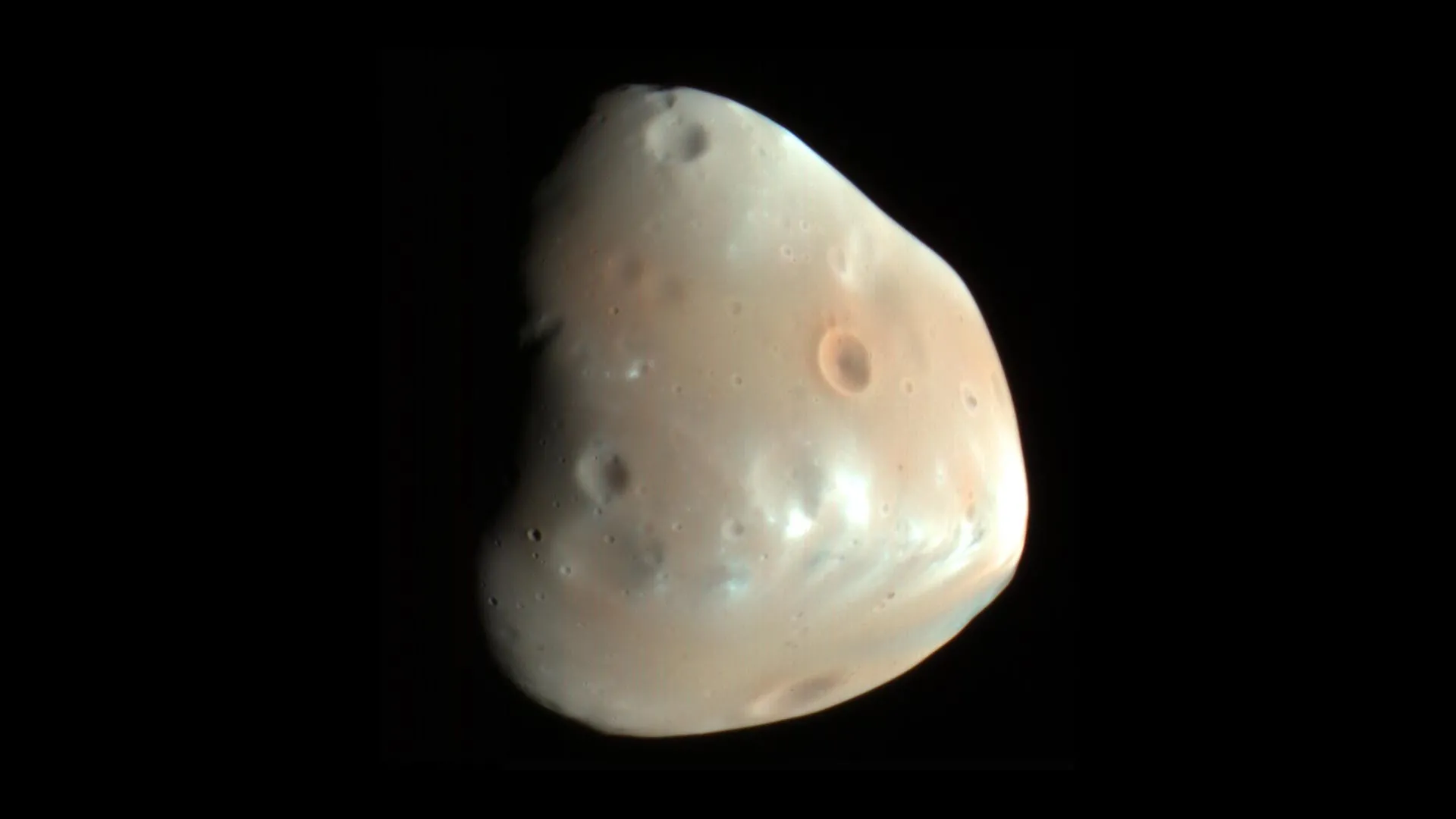
Researchers at the University of Bern, leading an international collaboration, have developed a hypothesis that a single asteroid collision reshaped Deimos, the smaller of Mars’ two moons. The team combined advanced computer modeling with high-resolution images captured by ESA’s Hera spacecraft to reach their conclusions. The study represents the first scientific work to incorporate observational data from Hera’s recent flyby of the Martian moon and was published in Nature Astronomy.
The research addressed two long-standing questions about Deimos’ unusual characteristics. Unlike Phobos, Mars’ other moon, Deimos exhibits a remarkably smooth surface blanketed in regolith—a layer of loose dust and rocky debris—rather than displaying numerous impact craters. Additionally, the moon features a prominent depression near its south pole whose origin remained unclear. The international team, which included scientists from multiple institutions including the Observatoire de la Côte d’Azur, University of Arizona, and University of Tokyo, investigated whether these two features could result from a common cause.
Using the Bern Smoothed Particle Hydrodynamics code, a sophisticated simulation tool developed at the University of Bern, the researchers conducted approximately one hundred different impact scenarios. The simulations suggested that an asteroid roughly 320 meters in diameter striking Deimos at a 45-degree angle could have produced both the observed southern depression and the widespread regolith coverage. The impact would have been sufficiently powerful to eject material across the entire moon’s surface, burying older features under layers potentially exceeding 200 meters in depth, yet not so forceful as to destroy the moon entirely.
The analysis also provided insights into Deimos’ internal structure. The simulations indicated that the moon’s upper layers are exceptionally weak while its interior is highly porous, characteristics that would have helped the moon withstand the collision by absorbing impact energy. Researchers noted that Deimos’ physical properties more closely resemble rubble-pile asteroids than Earth’s Moon, though this does not definitively establish its origin.
The findings carry implications for future exploration efforts. The Japan Aerospace Exploration Agency’s Martian Moons eXploration mission is scheduled for launch in 2026 and will study both Martian moons in detail while collecting samples from Phobos, providing opportunities to test the impact hypothesis with direct observations.
Article Attribution | Read More at Article Source
Article summary produced by Claude AI