

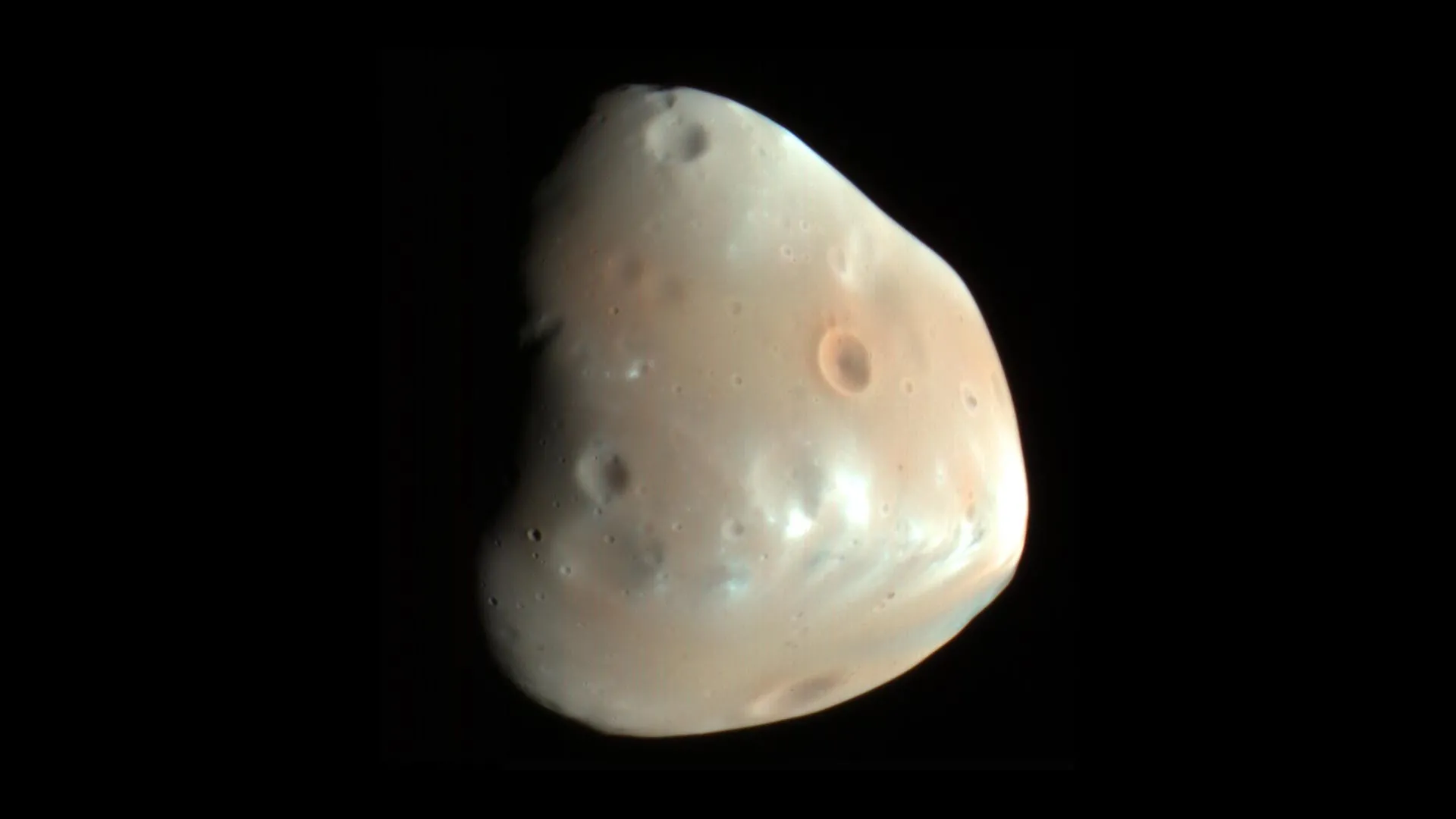
Researchers led by the University of Bern have proposed that a single asteroid impact may account for two prominent features of Deimos, Mars’ smaller moon. The study combined high-resolution computer simulations with recent imagery collected by ESA’s Hera spacecraft during its flyby of the moon. The findings mark the first scientific publication to incorporate observational data from Hera’s encounter with Deimos and could inform future exploration efforts.
The research team modeled approximately one hundred collision scenarios using the Bern Smoothed Particle Hydrodynamics code, a sophisticated simulation tool developed at the University of Bern over roughly two decades. Scientists varied multiple parameters including impactor size, velocity, and angle of impact while adjusting assumptions about Deimos’ internal structure. Each simulation required approximately one week of processing time on the university’s high-performance computing cluster. The analysis suggested that an asteroid approximately 320 meters in diameter striking at a 45-degree angle could have generated the distinctive depression visible near Deimos’ south pole.
According to the simulations, the same collision would have ejected vast quantities of material across the moon’s surface, creating the widespread layer of loose dust and rocky debris known as regolith that currently blankets much of Deimos. In certain regions, this deposited material may reach depths exceeding 200 meters. The impact would have been sufficiently powerful to redistribute material globally yet not so destructive as to fragment the moon entirely. The analysis also revealed insights into Deimos’ physical composition, indicating exceptionally weak upper layers and a highly porous interior that likely absorbed and dissipated collision energy.
The research, published in Nature Astronomy, offers a unified explanation for two features of Deimos that have puzzled scientists for decades. While alternative explanations remain possible, the proposed impact scenario provides testable predictions for future missions. The Japan Aerospace Exploration Agency is preparing the Martian Moons eXploration mission for launch in 2026, which will conduct detailed studies of both Martian moons and collect samples from Phobos to return to Earth.
Article Attribution | Read More at Article Source
Article summary produced by Claude AI