

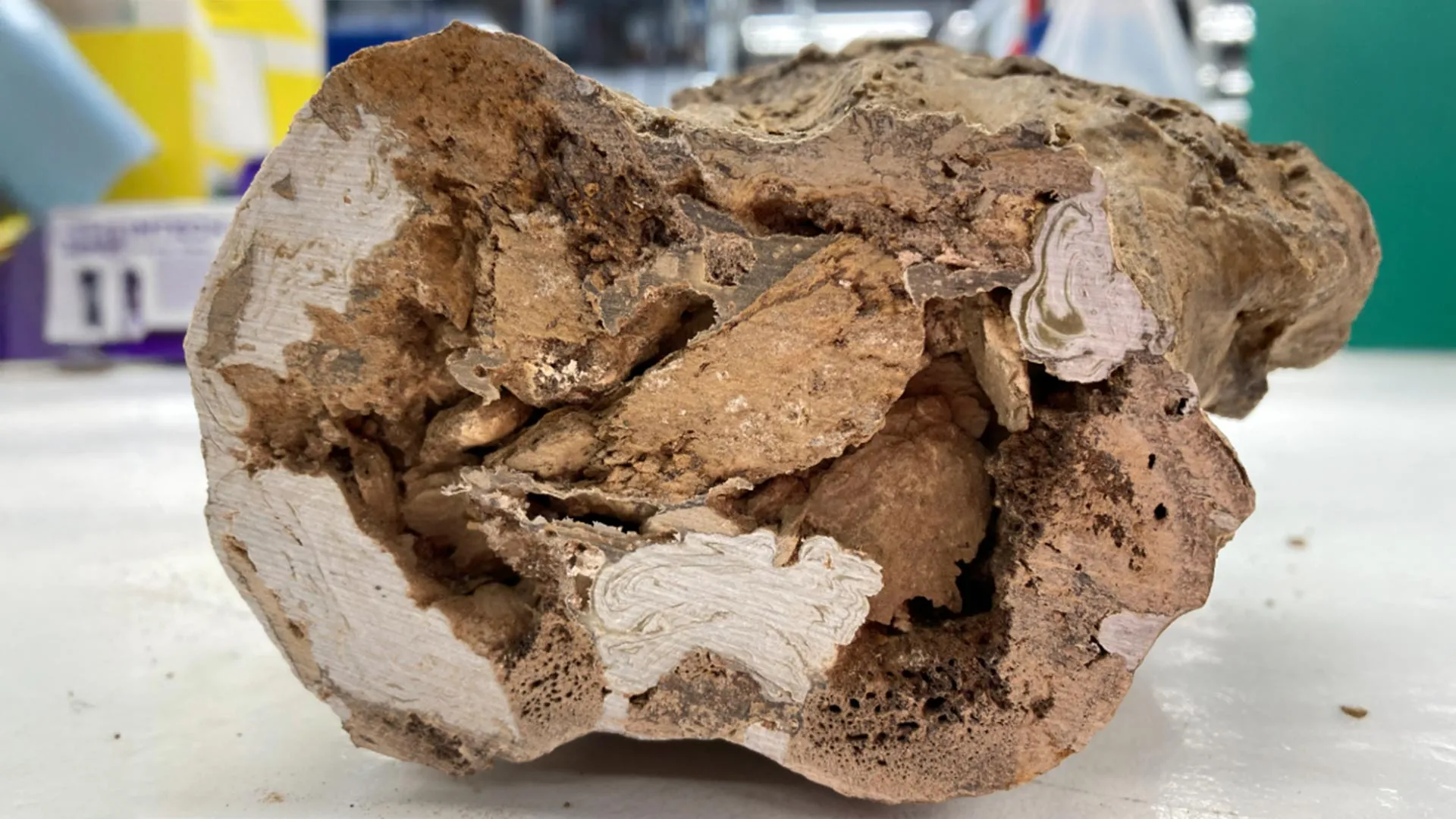
A study led by the University of Liverpool has identified traces of collagen, a structural protein, within the fossilized hip bone of an Edmontosaurus, a duck-billed dinosaur. The findings, published in Analytical Chemistry, represent a significant development in an ongoing scientific debate spanning approximately three decades regarding whether original organic materials can persist in Mesozoic fossils.
The research team examined an exceptionally well-preserved sacrum, a fused section of vertebrae connected to the pelvis, excavated from Upper Cretaceous rock layers in the Hell Creek Formation of South Dakota. The fossil, weighing 22 kilograms and now housed in the University of Liverpool’s collections, proved ideal for analysis using advanced modern techniques. Researchers employed protein sequencing, mass spectrometry, and cross-polarized light microscopy to detect molecular signatures characteristic of collagen. Notably, the team identified hydroxyproline, an amino acid specifically associated with collagen in bone tissue, and confirmed the presence of collagen alpha-1, the primary form of collagen in bone.
The discovery carries considerable implications for paleontological science. Professor Steve Taylor of the University of Liverpool’s Mass Spectrometry Research Group noted that the results refute earlier contentions that any organic materials detected in fossils must derive from external contamination introduced by microbes, soil handling, or environmental exposure. This finding strengthens the argument that at least some detected material genuinely originated within the fossilized bone rather than from more recent sources.
The research opens new investigative pathways for paleontologists. Approximately a century of cross-polarized light microscopy images of fossil bone exist in scientific archives. If characteristic patterns of preserved collagen can be identified in these historical images, researchers may possess an extensive collection of promising fossils for molecular analysis using contemporary techniques. This potential resource could enable scientists to investigate relationships among dinosaur species and other biological questions that traditional anatomical methods cannot fully address.
The persistence of collagen fragments across tens of millions of years remains scientifically puzzling, as proteins generally degrade over extended periods. The collaborative investigation, involving researchers from UCLA and multiple departments within the University of Liverpool, has provided the first quantitative detection of hydroxyproline in dinosaur bone, establishing a foundation for further exploration into the mechanisms enabling protein survival within ancient fossils.
Article Attribution | Read More at Article Source
Article summary produced by Claude AI