

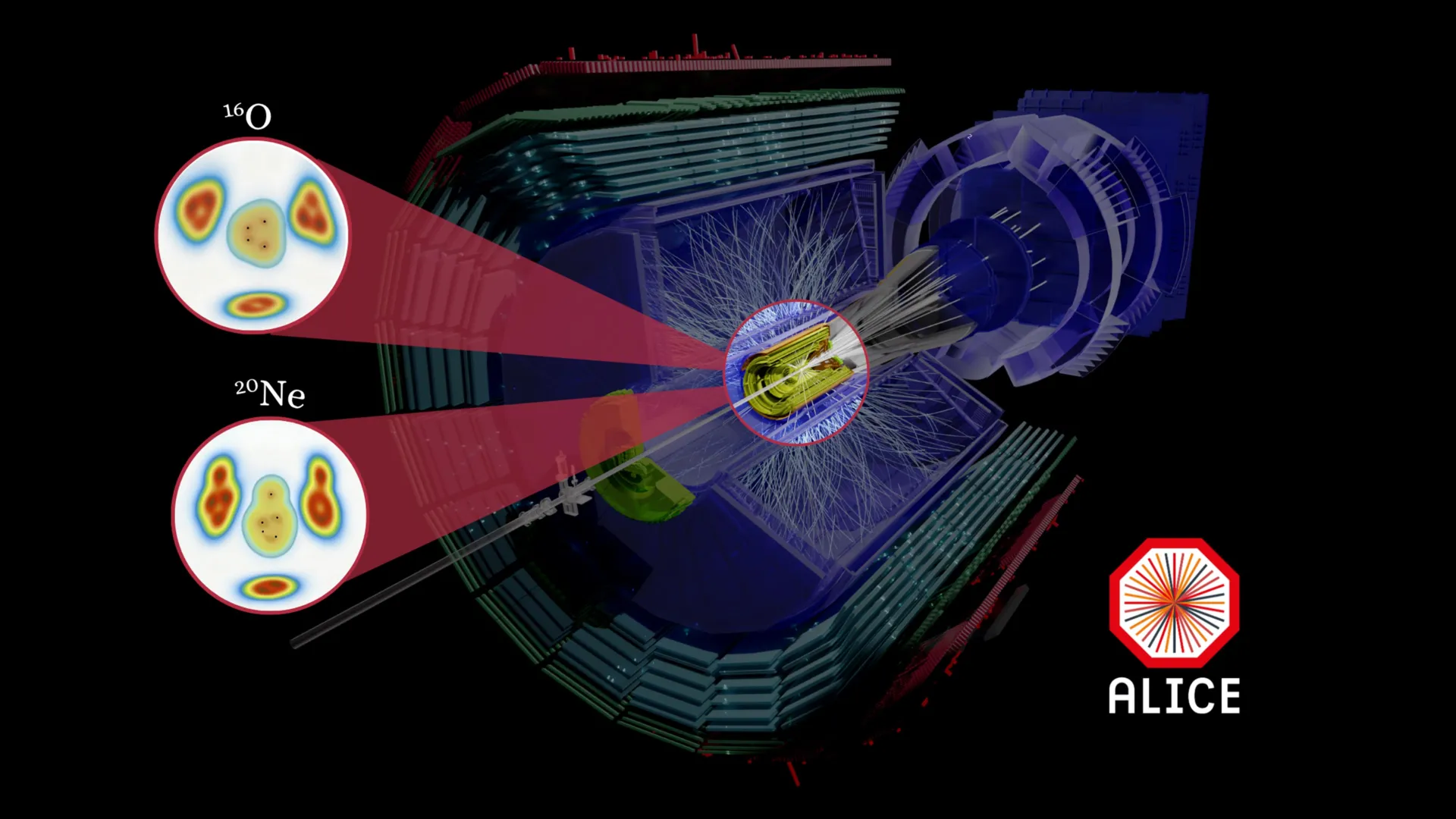
Researchers from the Niels Bohr Institute and the international ALICE collaboration at CERN have successfully created quark-gluon plasma by colliding relatively small atomic nuclei, demonstrating that this primordial state of matter can be produced with far smaller particles than previously believed necessary. The team generated the plasma through collisions between oxygen-16 and neon-20 nuclei, pushing the boundaries of what scientists thought possible in recreating the extreme conditions that existed in the Universe during its first moments after the Big Bang.
The researchers cannot directly observe the plasma itself, which survives only briefly before transforming into other particles. Instead, they analyze the movement patterns of the particles that emerge from the collision to extract information about the original state. The findings reveal that these movement patterns reflect the geometric shapes of the colliding nuclei, with oxygen collisions producing a rounded pattern and neon collisions creating a distinctive bowling-pin-shaped pattern. This discovery allows physicists to infer nuclear structures indirectly, similar to determining an object’s shape by observing its shadow.
This research offers a novel approach to understanding atomic nuclei, which scientists have studied for over 70 years. Traditionally, physicists have investigated nuclear structure through low-energy experiments measuring how nuclei rotate and vibrate. The new methodology reverses this strategy by using the highest-energy collisions available and reconstructing nuclear shapes from the patterns they leave behind. This technique has potential applications for investigating atomic nuclei whose internal structures remain poorly understood, and could represent a significant shift in how scientists probe nuclear physics.
The work, published in Physical Review Letters, also demonstrates a surprising connection between nuclear structure and early Universe conditions. Understanding nuclear shapes provides insights into the strong force, one of nature’s four fundamental forces. The research team plans to conduct additional experiments with even lighter nuclei, including helium-4, to determine exactly how small a collision system can be while still producing quark-gluon plasma.
Article Attribution | Read More at Article Source
Article summary produced by Claude AI