

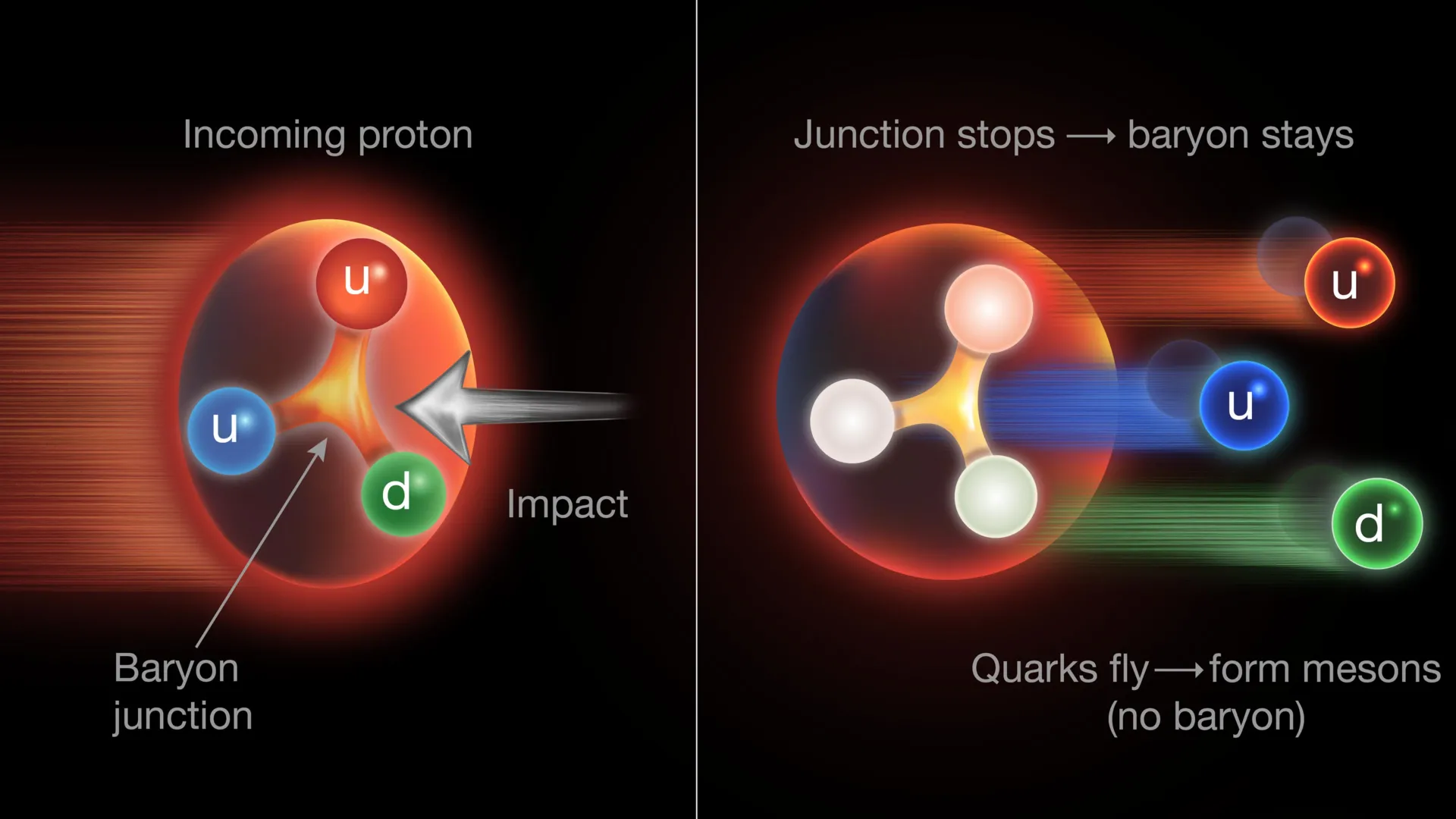
Scientists at the STAR detector facility have released findings that challenge conventional understanding of how protons maintain one of their fundamental properties. The research, published in Science, suggests that gluons—particles responsible for binding quarks together—may be the primary carriers of baryon number, contradicting long-held assumptions that this quantum property belongs exclusively to the three main quarks within protons.
The concept of a gluon junction, a Y-shaped configuration connecting a proton’s three valence quarks, was first proposed in the 1970s. In 1996, theoretical physicist Dmitri Kharzeev suggested this junction itself could carry baryon number rather than individual quarks. The STAR collaboration has now developed experimental methods to test this hypothesis using collision data collected at the Relativistic Heavy Ion Collider, which operated through early 2026.
Baryon number conservation holds significance across multiple scales of physics. At the cosmic level, the total number of baryons has remained constant since the Big Bang, contributing to the universe’s matter-antimatter imbalance. On smaller scales, baryon number conservation explains why protons are extraordinarily stable and do not appear to decay under normal conditions, enabling the formation of stable atomic nuclei.
A key observation driving this research was an unexpected pattern in collision data: more baryons than antibaryons consistently emerge perpendicular to the direction of incoming particle beams. Standard models explaining this pattern require assumptions that appeared problematic under scrutiny. The STAR team investigated by comparing baryon number measurements with electric charge redistribution patterns across different collision types, providing a test of whether the gluon junction hypothesis better explains experimental observations.
If confirmed through further research, these findings would require revisions to textbook descriptions of proton structure, which traditionally depict baryon number as equally divided among three valence quarks. The discovery underscores that real protons are far more complex than simplified models suggest, containing not only quarks but also numerous interacting gluons and virtual particle-antiparticle pairs.
Article Attribution | Read More at Article Source
Article summary produced by Claude AI