

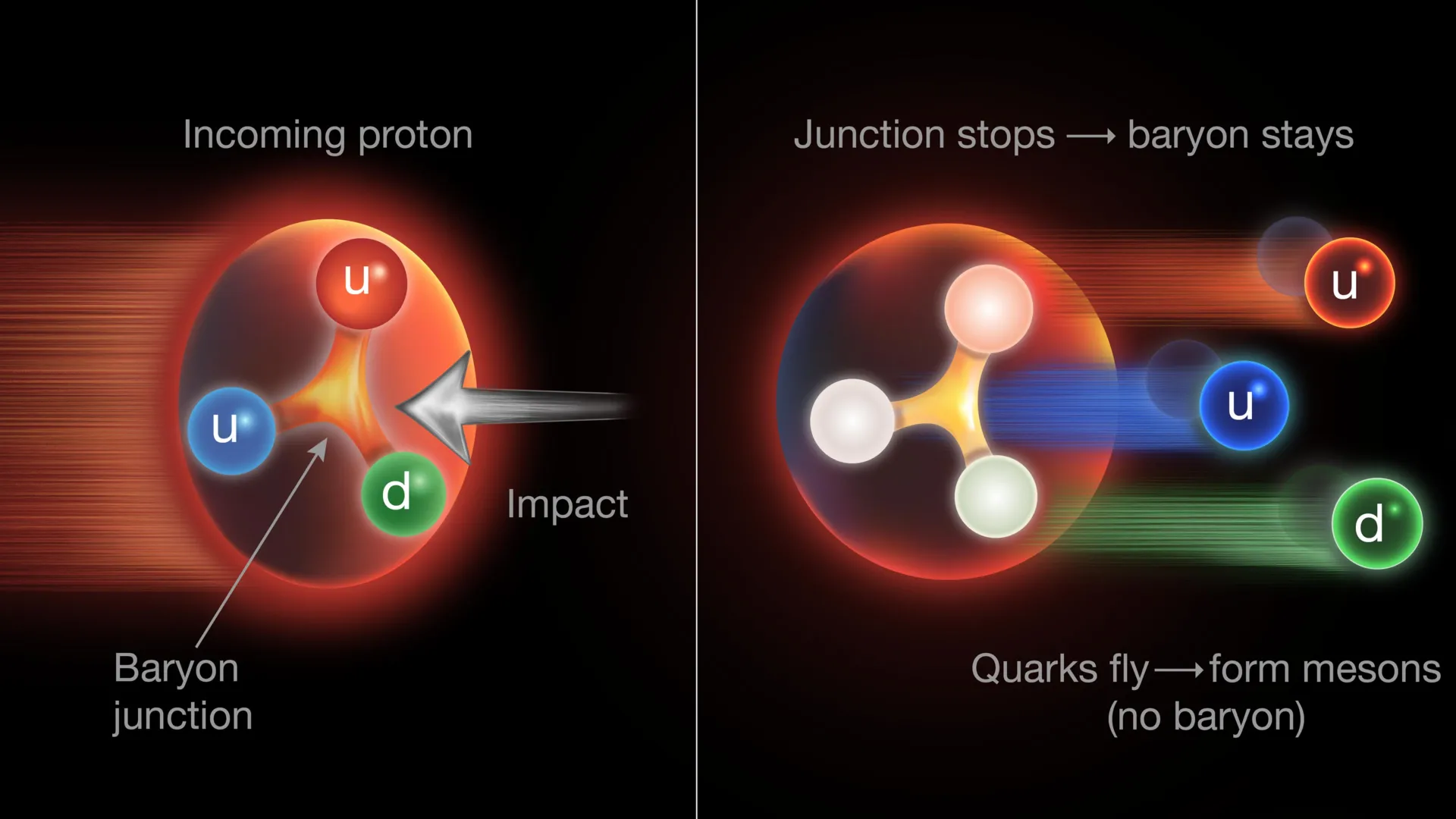
Researchers at the STAR detector facility at the Relativistic Heavy Ion Collider have published findings suggesting a fundamental revision to the understanding of how protons maintain baryon number, a key quantum property. The research, appearing in Science, proposes that gluons—particles that bind quarks together—may be responsible for carrying and conserving baryon number rather than the three valence quarks themselves as conventionally taught.
The concept of a gluon junction connecting a proton’s quarks dates to the 1970s, but a 1996 theoretical proposal suggested this junction might actually carry baryon number itself. The STAR collaboration developed experimental methods using multiple collision types at RHIC to test this possibility. Analysis of data from different particle collisions produced results indicating that baryon number is transported by gluons in a specialized configuration rather than distributed equally among individual quarks.
The significance of this finding extends beyond particle physics. Baryon number conservation applies universally—the total count of three-quark particles like protons and neutrons remains constant before and after collisions and across cosmic time scales. This conservation principle remains poorly understood and connects to fundamental mysteries such as why the universe contains more matter than antimatter. Additionally, baryon number conservation explains the extraordinary stability of protons, which appear not to decay under normal conditions and form the foundation for atomic nuclei and all observable matter.
The RHIC facility, which operated through early 2026, revealed an unexpected pattern in high-energy nuclear collisions: more baryons consistently emerged perpendicular to incoming beam directions than predicted by traditional models where valence quarks alone carry baryon number. The team investigated this discrepancy by comparing baryon number measurements with electric charge redistribution across various collision events, finding results that support the gluon junction hypothesis. If confirmed, these findings would necessitate revising standard textbook descriptions of proton structure that currently depict a simple three-quark model.
Article Attribution | Read More at Article Source
Article summary produced by Claude AI