

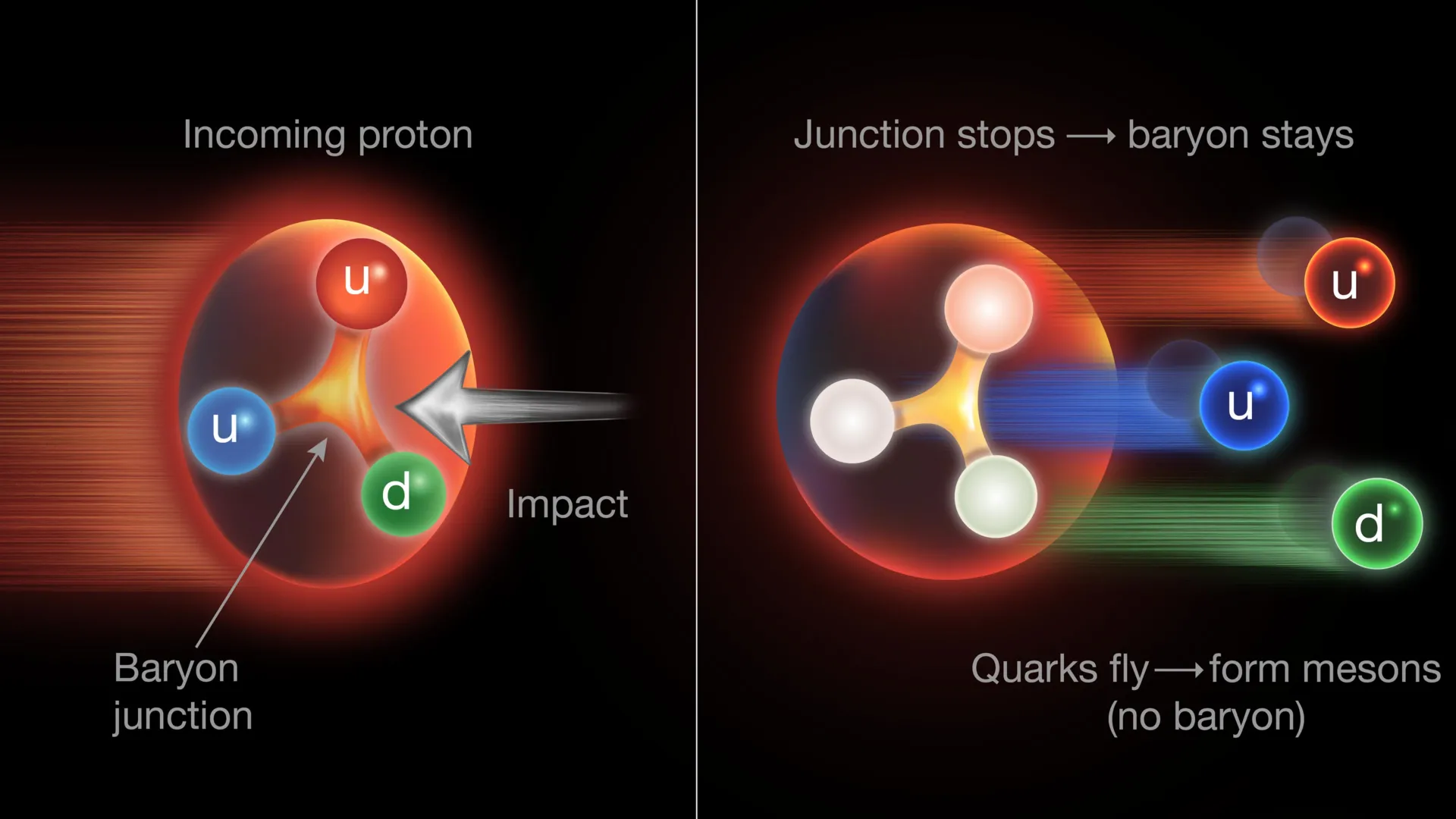
Researchers at the STAR detector facility at the Relativistic Heavy Ion Collider have identified new evidence suggesting that gluons play a previously underappreciated role in determining baryon number within protons. The findings, published in Science, indicate that a Y-shaped junction of gluons connecting three quarks may be responsible for carrying baryon number, rather than the quarks themselves distributing this property equally among themselves as traditionally assumed.
The concept of gluon junctions was first proposed in the 1970s, and theoretical physicist Dmitri Kharzeev suggested in 1996 that such a junction might fundamentally carry baryon number. The STAR collaboration developed experimental methods using high-energy particle collisions to test this hypothesis. Analysis of data from different collision types at RHIC provides support for the idea that gluons arranged in this specific configuration transport baryon number more effectively than individual quarks alone.
Baryon number conservation has significant implications across multiple scales of physics. The principle ensures that the total number of baryons remains constant before and after particle collisions, and this same conservation principle applies universally. Understanding what carries baryon number may help explain the proton’s exceptional stability and provide insights into fundamental questions about matter and antimatter asymmetry in the universe.
The traditional simplified model describes a proton with baryon number one divided equally among three valence quarks, each carrying one-third. However, actual proton structure proves far more intricate, involving numerous gluons, virtual quark-antiquark pairs, and complex interactions described by quantum chromodynamics. One puzzling observation prompted this investigation: RHIC collisions consistently produced more baryons than antibaryons emerging perpendicular to the incoming beam direction, a pattern difficult to explain using conventional models of quark-only baryon number distribution.
The research team employed electric charge properties of quarks as an experimental tool to investigate baryon number distribution in various nuclear collisions, providing a novel approach to testing whether gluon junctions fundamentally change our understanding of proton composition.
Article Attribution | Read More at Article Source
Article summary produced by Claude AI