

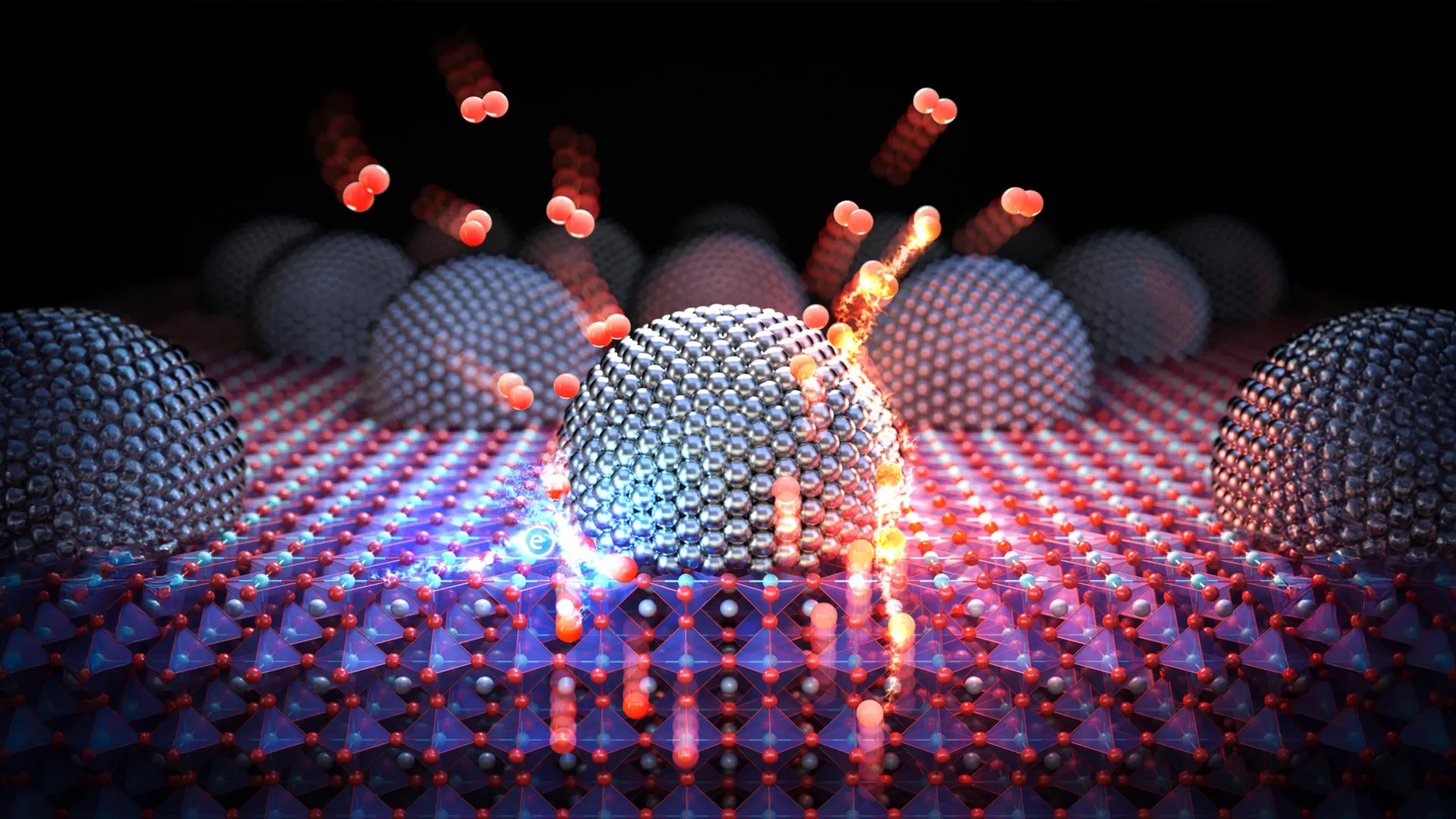
Scientists from Seoul National University, KAIST, and the Korea Basic Science Institute have identified a previously unknown property of silver nanocatalysts used in solid oxide cells. The research, published in Energy & Environmental Science, reveals that the same catalyst material can perform its chemical reactions at different locations depending on the cell’s operational mode.
Solid oxide cells function by moving oxygen ions through solid materials to either generate electricity or split water for hydrogen production. This dual capability makes them valuable for various clean energy applications, including distributed power systems in buildings and factories, as well as renewable energy-based hydrogen generation. However, the exact mechanisms by which metal nanocatalysts enhance cell performance remained unclear, particularly whether the most important reactions occurred on the catalyst surface or at the interface between the catalyst and the electrode material.
To investigate these questions, the research team constructed model electrodes with precisely controlled structures rather than studying conventional electrodes with complex architectures. Metal nanoparticles of uniform size were arranged in organized patterns, enabling detailed examination of their catalytic activity. After testing several metals including silver, cobalt, palladium, and platinum, silver demonstrated the strongest catalytic improvement.
The team then systematically varied the silver nanoparticle dimensions and arrangements to determine reaction locations. During electricity generation, reaction rates increased with the boundary length between silver particles and the electrode, indicating the interface serves as the primary reaction site. During hydrogen production, reaction rates instead increased with silver particle surface area, showing the particle surface becomes dominant. Further analysis using synchrotron-based methods and atomic-scale calculations demonstrated that silver alters the electrode’s electronic properties in ways that differ between electricity generation and hydrogen production.
These findings suggest a new design approach for solid oxide cells where catalyst surface and electrode interface can be engineered separately rather than optimizing the catalyst as a single component. The researchers also developed their model electrode platform as a tool for studying other catalytic systems beyond solid oxide cells. The research was supported by South Korean government agencies and POSTECH’s Pohang Accelerator Laboratory.
Article Attribution | Read More at Article Source
Article summary produced by Claude AI