

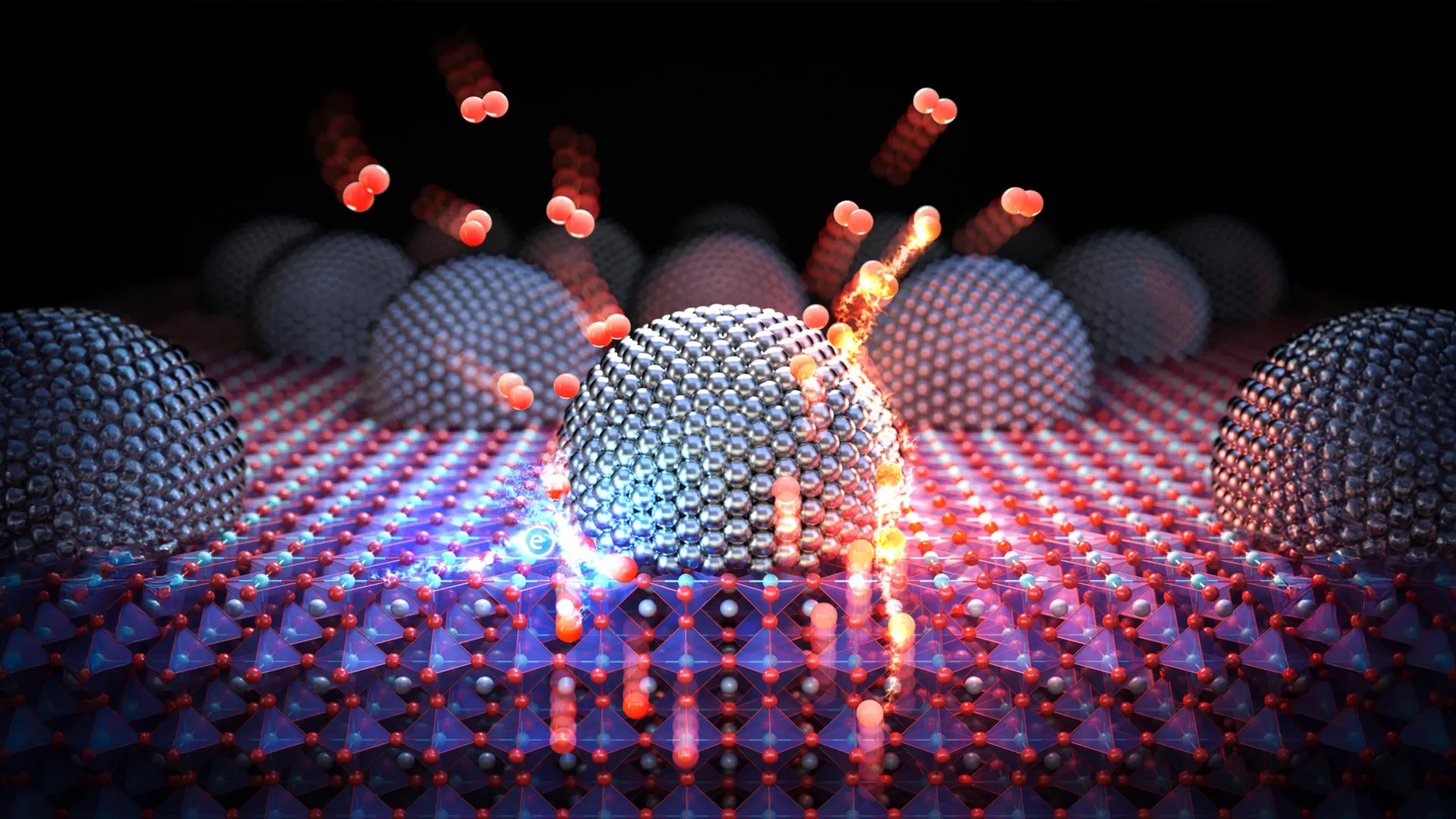
A collaborative research team from Seoul National University, KAIST, and the Korea Basic Science Institute has identified a previously unknown property of silver nanocatalysts used in solid oxide cells. The discovery reveals that these catalysts operate at different locations within the cell depending on its mode of operation, either generating electricity or producing hydrogen through water splitting.
Solid oxide cells are considered a promising technology for expanding clean energy applications and hydrogen production. The devices function by moving oxygen ions through solid material, enabling them to serve dual purposes in systems ranging from combined heat and power installations in buildings to renewable energy-based hydrogen generation. However, the performance and durability of these cells depend significantly on how efficiently oxygen reactions occur at the air electrode, a process complicated by the intricate structure of conventional electrodes.
To conduct their investigation, the research team developed a model electrode with precisely controlled structure and composition, featuring uniformly sized metal nanoparticles arranged in ordered patterns. This approach allowed for more accurate examination of catalytic behavior compared to conventional electrode designs. Testing multiple metal catalysts including cobalt, palladium, and platinum, the researchers found that silver produced the strongest catalytic improvement among the metals tested.
Their analysis revealed that silver nanocatalysts exhibit location-dependent behavior. During electricity generation through oxygen reduction, the reaction rates increased with the length of the boundary between the silver nanoparticles and the electrode, indicating that this interface serves as the primary reaction site. Conversely, during hydrogen production through oxygen evolution, reaction rates increased with the surface area of the silver particles themselves, showing that the particle surface becomes the dominant reaction location in this mode.
These findings introduce a new design strategy for developing solid oxide cells, suggesting that engineers should optimize the catalyst surface and catalyst-electrode interface separately rather than treating the catalyst as a single component. If successfully implemented in practical applications, this approach could enhance electricity generation efficiency in distributed energy systems and reduce the electrical energy required for renewable energy-powered water electrolysis used in green hydrogen production. The research team also developed a platform using their precisely controlled nanoparticle arrays that could prove useful for studying catalytic behavior in other electrochemical energy conversion technologies and hydrogen production systems.
Article Attribution | Read More at Article Source
Article summary produced by Claude AI