

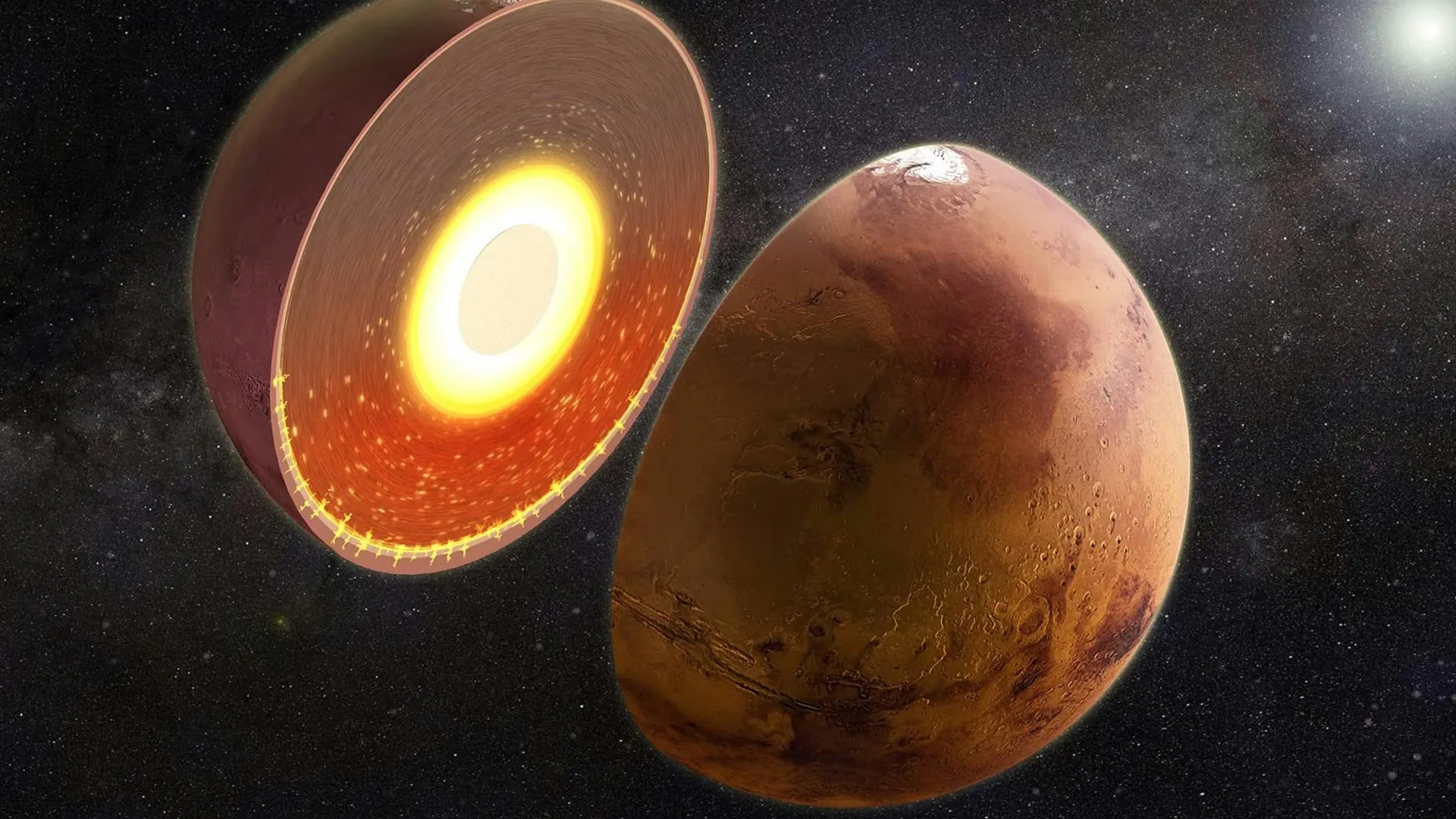
Researchers have identified a major thermal imbalance within Mars, with gravity measurements indicating that the planet’s southern interior is approximately 200 to 400 degrees Celsius warmer than the northern hemisphere and may be partially molten. The discovery offers new perspective on the Red Planet’s geological development and periods when conditions may have been suitable for life.
The research, led by Alexander Berne of the University of Arizona and published on August 27 in Nature, employed a novel approach to planetary science. During his graduate work at Caltech, Berne developed a model utilizing subtle gravitational variations to determine the internal structure of planetary bodies. The team applied this methodology to Mars by analyzing decades of observational data from three spacecraft: Mars Global Surveyor, Mars Odyssey, and Mars Reconnaissance Orbiter. By measuring minute changes in the spacecrafts’ velocities, researchers reconstructed Mars’s gravitational field and employed a technique called tidal tomography to examine how gravitational signatures fluctuate over time.
The finding reveals that Mars exhibits thermal asymmetry beneath its surface, extending the planet’s well-documented hemispheric contrasts deeper than previously understood. The southern hemisphere’s surface features tall mountains and heavily cratered terrain, while the northern region consists primarily of broad plains. The discovery of a hotter southern mantle may explain several other unusual characteristics of Mars, including distinctive magnetic signatures detected in iron-rich southern minerals and the rapid energy loss of seismic waves observed in that region.
The thermal difference could provide important clues regarding Mars’s water-based history. Understanding the temperature distribution may illuminate processes that shaped the planet’s hydrology, including the formation of basins that potentially contained water when liquid water existed on the surface. Researchers have proposed multiple hypotheses for the anomaly’s origin, including a massive ancient impact that released heat from the north, spontaneous convection within the southern mantle, or thick geological structures in the south that trapped heat and prevented its dissipation. The study was funded by NASA and involved collaborators from multiple international institutions.
Article Attribution | Read More at Article Source
Article summary produced by Claude AI