

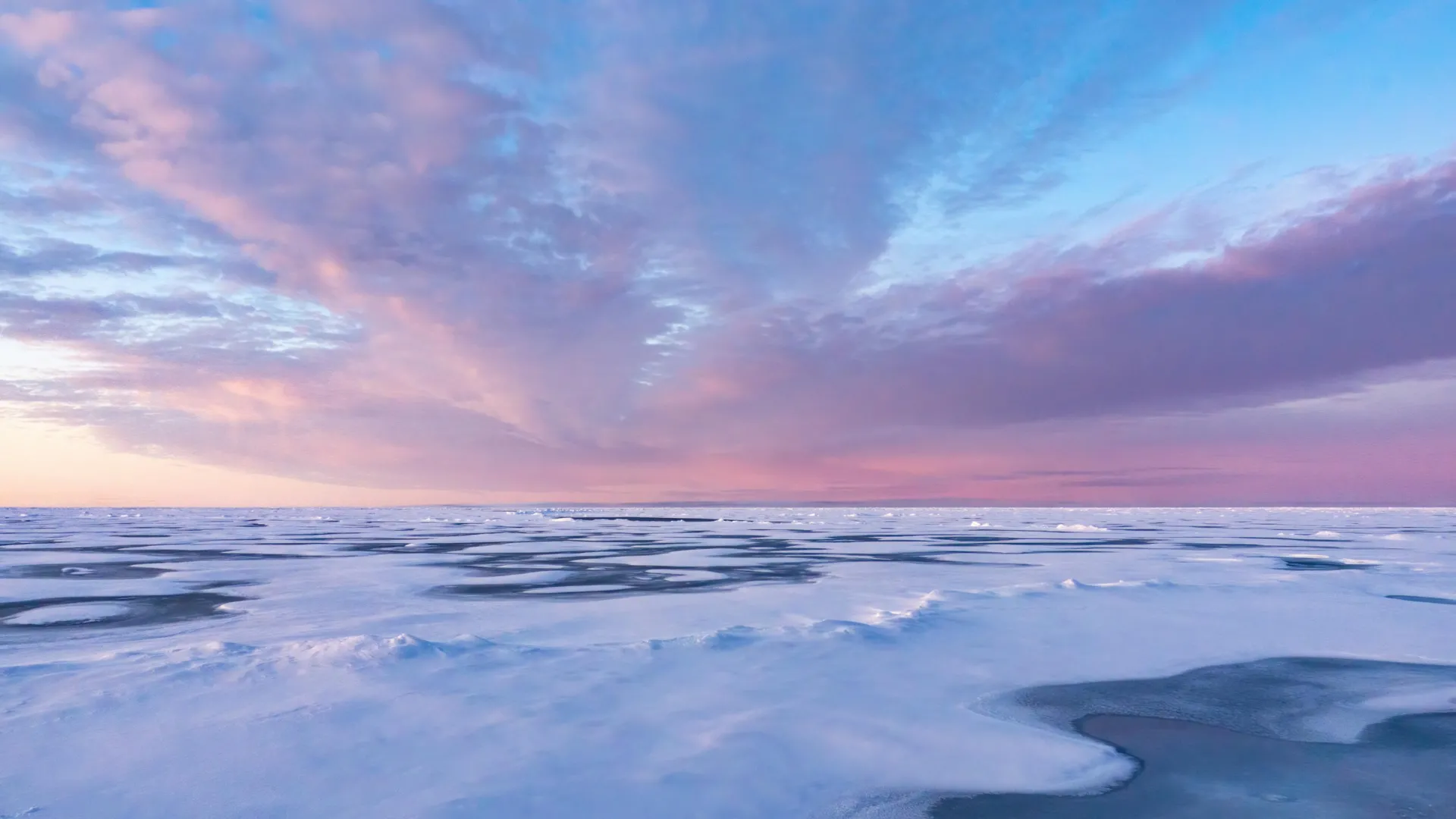
An international research team has identified a previously undocumented atmospheric process in the Arctic that generates cloud-forming particles at a much larger scale than previously understood. The findings were published in Nature Geoscience and resulted from fieldwork conducted in spring and summer 2022 aboard the Royal Research Ship Discovery in waters around Greenland and the Davis Strait.
The particle-formation mechanism operates in the marginal ice zone, where retreating sea ice meets open ocean. In this biologically productive region, naturally occurring iodine, sulfur, and organic compounds interact with sunlight to create atmospheric particles capable of seeding clouds. During observation periods, researchers documented a fifty-fold increase in cloud-forming particles within a single day and measured concentrations rising from approximately 50 to 1,500 particles per cubic centimeter during peak events. The process occurred on more than 80 percent of sunny days, indicating it is a regular feature of Arctic atmospheric dynamics.
The research team also identified a previously unknown class of atmospheric molecules called iodine-containing oxygenated organic molecules, which appear to facilitate the growth of newly formed particles to sizes large enough to influence cloud development. These compounds represent a chemical pathway not previously documented in atmospheric science, with laboratory validation having been limited to controlled experiments at research facilities.
The implications for Arctic climate dynamics are substantial. Since clouds play a critical role in regulating how much solar energy is reflected or absorbed, changes in cloud cover and thickness can affect regional temperature patterns and ice melt rates. As sea ice continues to retreat due to warming, the marginal ice zone expands, potentially increasing the geographic area where this particle-formation process occurs and amplifying its climatic effects.
Current climate models do not account for this mechanism, meaning its potential influence on Arctic climate projections remains unrepresented. The research team is working to incorporate the process into predictive models to improve understanding of regional climate dynamics and the Arctic’s role in global climate systems.
Article Attribution | Read More at Article Source
Article summary produced by Claude AI