

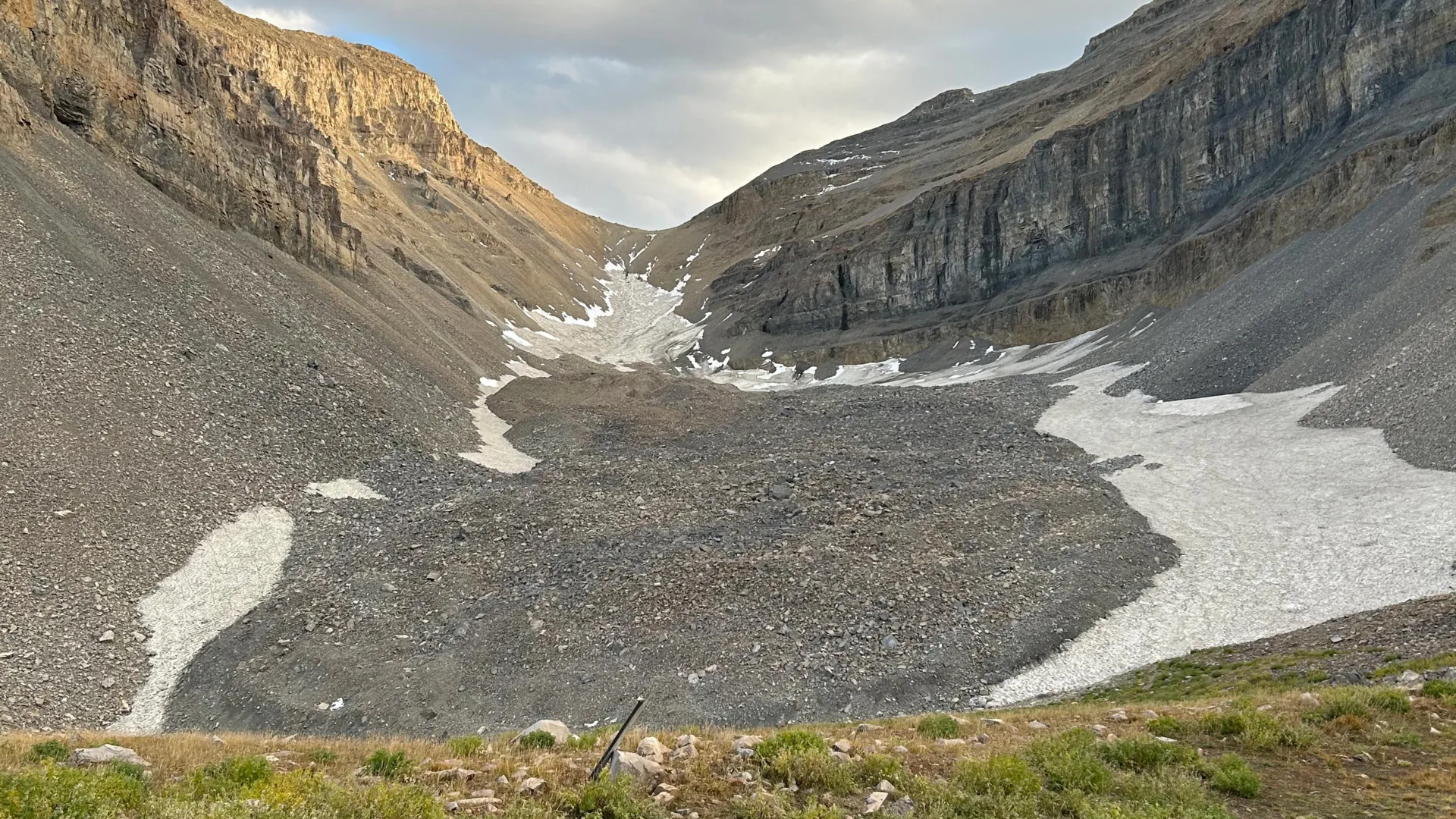
University of Utah geologists have completed a detailed investigation of Timpanogos Rock Glacier, one of the largest rock glaciers in Utah, located beneath Mount Timpanogos near Salt Lake City and Provo. Rock glaciers are formations that appear as fields of loose rock but contain substantial quantities of ice beneath the surface. Researchers developed a novel methodology to visualize the internal structure of the glacier by measuring extremely subtle differences in gravitational pull between dense rock and less-dense ice.
The study reveals that Timpanogos Rock Glacier contains approximately 1.5 million cubic meters of frozen water, equivalent to filling roughly 600 Olympic swimming pools or matching the volume of Egypt’s largest pyramid at Giza. The glacier composition is notably 83 percent ice and 17 percent loose rock. During fieldwork in fall 2024, researchers conducted gravity measurements at 232 locations across the glacier surface, using advanced gravimeter equipment to detect density variations. The team then applied Bayesian statistical methods and computational techniques to reconstruct a three-dimensional model of the glacier’s internal ice structure, accounting for gravitational variations caused by celestial bodies and terrain differences.
Research indicates that Utah’s rock glaciers formed during the thousands of years following the peak of the Ice Age, rather than being remnants from that period itself. Formation appears tied to repeated rockfalls that bury persistent snow in upper mountain sections, with debris layers protecting the snow from melting. Researchers established a mathematical relationship between surface area and subsurface ice volume using Timpanogos Rock Glacier data.
Scientists identified 836 rock glaciers across Utah through satellite imagery. When applying their findings broadly, researchers estimate that approximately 50,000 rock glaciers worldwide may collectively contain about 48 gigatons of water. Within Utah specifically, rock glaciers potentially hold approximately 1 gigaton of water. The research was published in August and April 2026 in peer-reviewed journals and received support from multiple government and academic institutions.
Article Attribution | Read More at Article Source
Article summary produced by Claude AI