

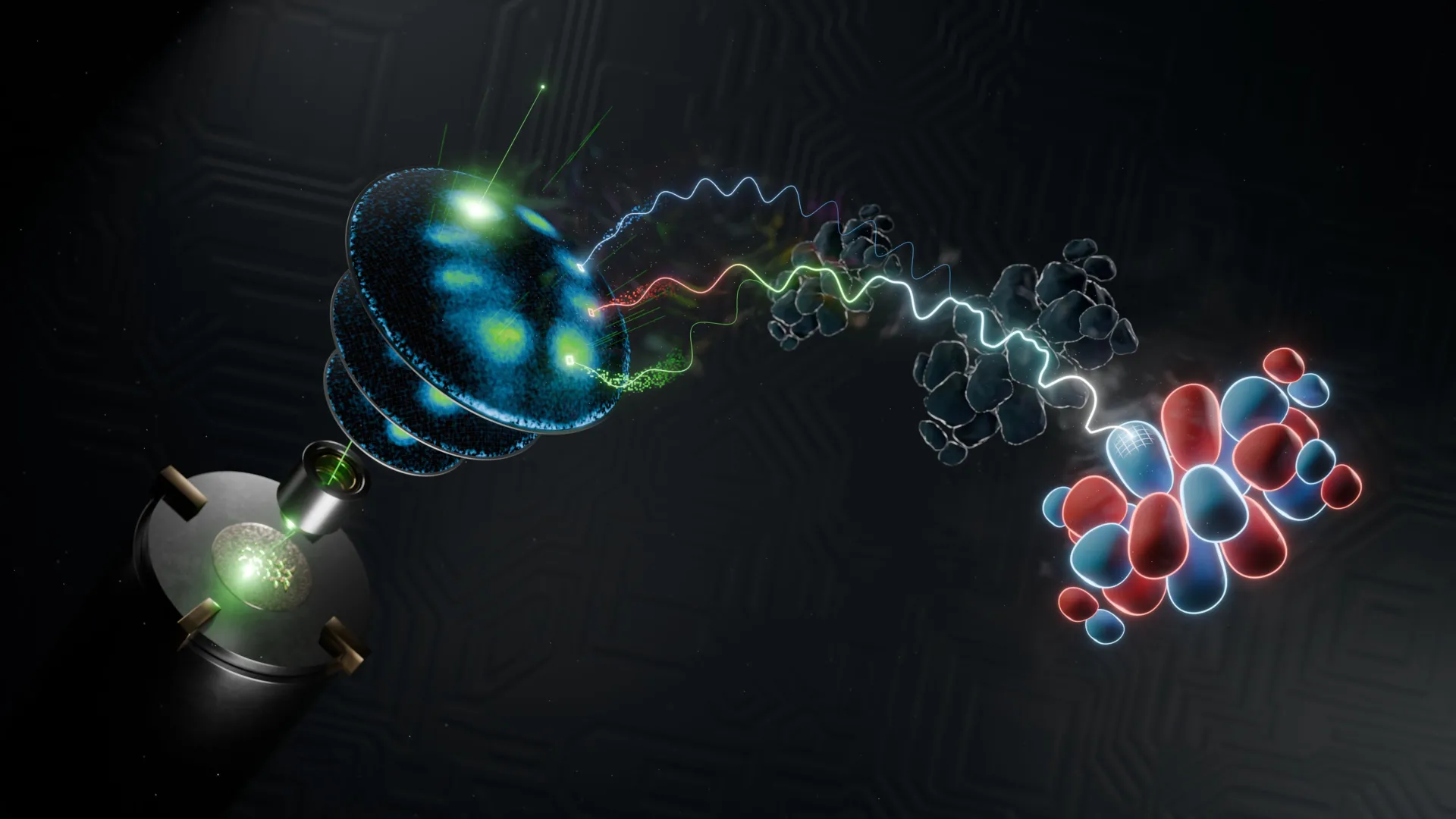
Scientists at the University of Göttingen have achieved a significant advance in quantum imaging by successfully capturing a three-dimensional picture of a molecular orbital—the region where electrons exist within a molecule. The researchers used a combination of photoelectron spectroscopy and sophisticated computer algorithms to accomplish this feat, with their work appearing in Nature Communications.
Molecular orbitals contain critical information about how molecules behave, interact with their surroundings, absorb light, and participate in chemical reactions. However, wavefunctions—the mathematical representations that describe the probability distribution of electrons—cannot be directly observed or measured. To work around this fundamental limitation, the team employed photoelectron spectroscopy to measure the momentum of electrons ejected from the molecule, capturing half of the wavefunction without disturbing its state. Computer algorithms then reconstructed the missing half to generate a complete image of the molecular orbital.
Previously, extending this imaging technique to three dimensions required extended measurement periods at major synchrotron facilities, limiting its practical application. The University of Göttingen team introduced two key innovations that address these constraints. They redesigned the underlying computer algorithm to generate reliable three-dimensional images using substantially less experimental data. Additionally, they based their measurements on a laboratory-based soft X-ray light source capable of producing ultrashort pulses, eliminating the need for access to large-scale research facilities.
These methodological improvements could make wavefunction imaging more accessible and practical for broader research applications. Looking forward, the technique may enable researchers to create time-resolved videos of molecular wavefunctions at extremely fast timescales, potentially revealing how molecules adapt to optical, electronic, or chemical stimuli. Such capabilities could provide new insights into molecular behavior and open possibilities for controlling molecular interactions at the atomic scale.
Article Attribution | Read More at Article Source
Article summary produced by Claude AI