

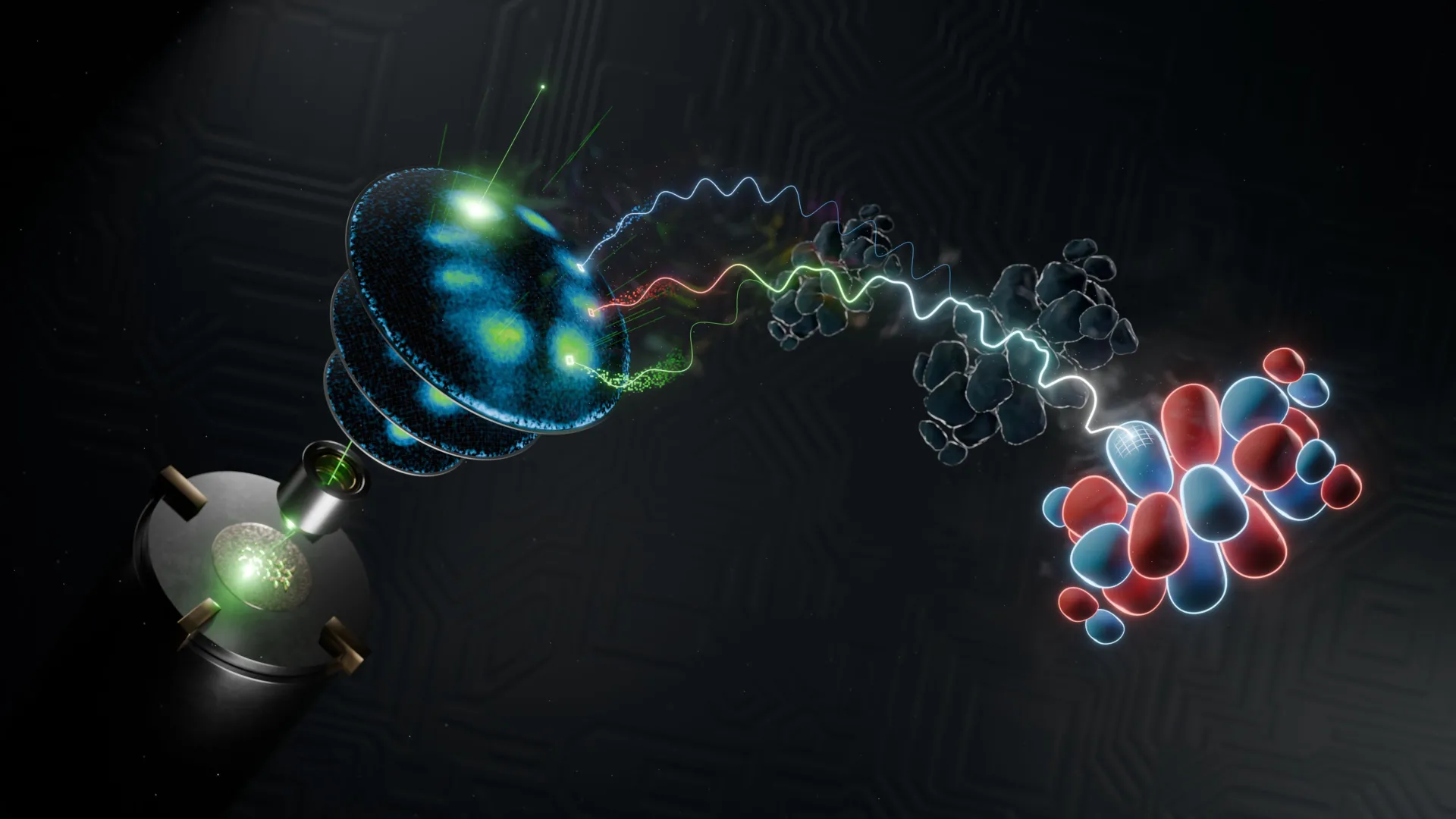
Researchers at the University of Göttingen have achieved a significant breakthrough in visualizing quantum mechanical properties of molecules. The team successfully captured a three-dimensional image of a molecular orbital—the wavefunction that describes how electrons behave within an organic molecule only nanometers in size. This accomplishment represents a major advancement in quantum mechanics research, as wavefunctions have historically been impossible to directly observe or measure.
The research team, led by Professor Stefan Mathias and Dr. Matthijs Jansen, employed an indirect measurement technique called photoelectron spectroscopy combined with sophisticated mathematical algorithms. Since wavefunctions cannot be directly observed, the spectroscopy method measures the momentum of electrons emitted from the molecule, providing partial information about the wavefunction. Computer algorithms then reconstructed the missing component, allowing scientists to generate a complete three-dimensional image. The resulting visualization was detailed enough to distinguish features smaller than the distance between carbon atoms within the molecule.
Previously, extending this imaging technique into three dimensions required extended measurement sessions at major synchrotron research facilities, limiting its practical application. The Göttingen team introduced two key innovations to overcome this obstacle. First, they redesigned the underlying computer algorithm to generate reliable three-dimensional images using significantly less experimental data. Second, they utilized a laboratory-based soft X-ray light source capable of producing ultrashort light pulses, eliminating the need for access to large-scale research facilities.
The implications of this work extend beyond static imaging. Researchers suggest the technique could eventually enable dynamic visualization of molecular wavefunctions as they change over time, potentially operating at femtosecond timescales. Such capability would allow scientists to observe how molecules respond to light, electronic effects, and chemical changes in real-time at atomic scales. This development could provide new insights into molecular behavior and enable more precise control of chemical interactions at the atomic level. The findings were published in Nature Communications.
Article Attribution | Read More at Article Source
Article summary produced by Claude AI