

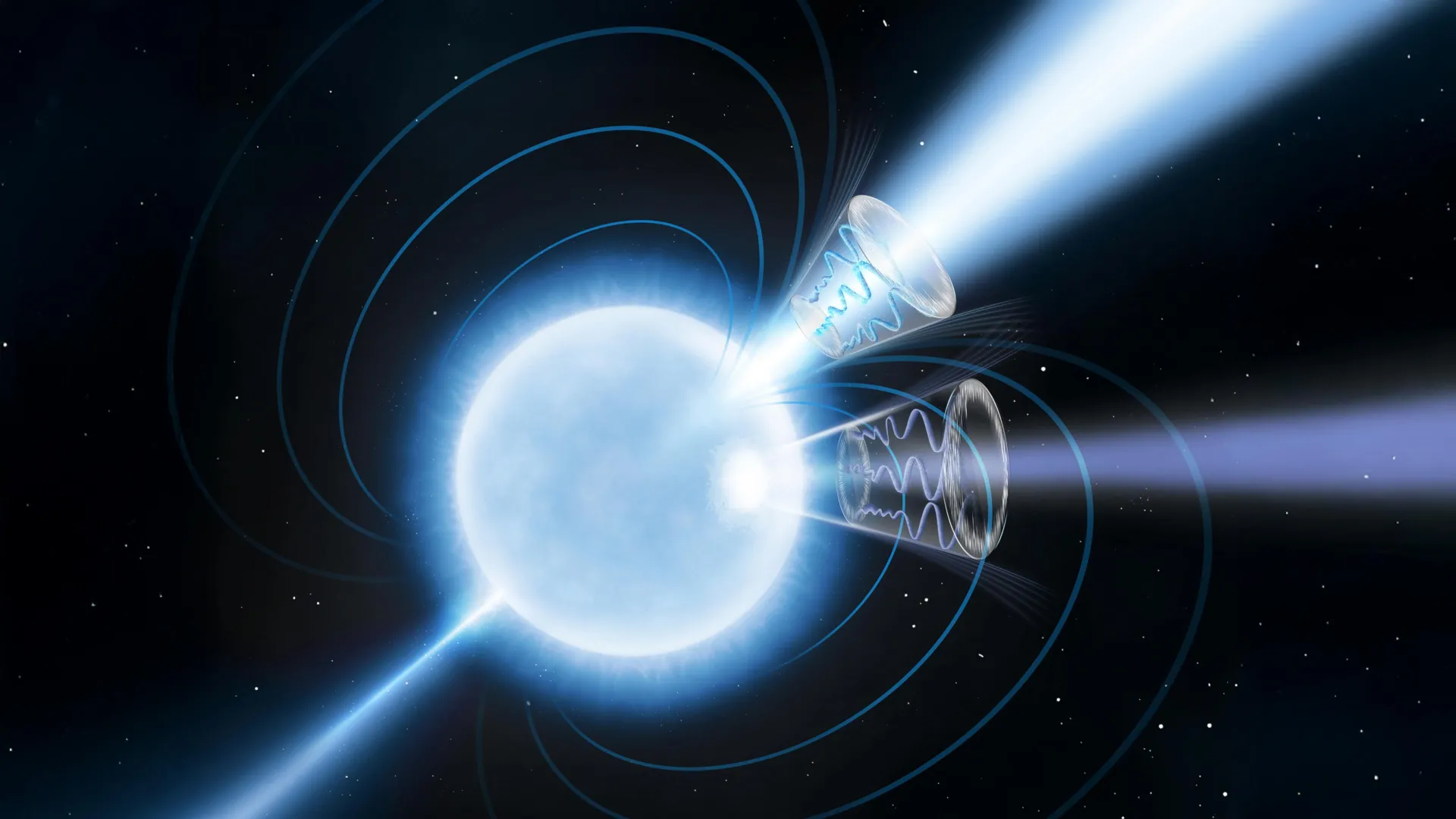
A team of international researchers has presented observations that could represent the first evidence of vacuum birefringence, a quantum phenomenon predicted by Werner Heisenberg in the 1930s. The effect describes how empty space, contrary to classical assumptions, contains virtual particles that can alter light’s behavior when exposed to extraordinarily strong magnetic fields. Despite decades of experimental physics and advances in particle accelerators, scientists had not previously confirmed this effect conclusively.
To test the theory, researchers studied the magnetar 1E 1547.0-5408, a rare neutron star with magnetic fields among the strongest known in the Universe. The international collaboration included institutions such as NASA’s Marshall Space Flight Center, the South African Radio Astronomy Observatory, Los Alamos National Laboratory, and multiple universities. Led by graduate student Rachael E. Stewart at George Washington University, the team conducted observations using CSIRO’s Murriyang radio telescope and analyzed the data with specialized supercomputing resources.
The researchers combined radio observations with measurements from NASA’s Imaging X-ray Polarimetry Explorer and the NICER telescope aboard the International Space Station. By tracking the polarization of radio and X-ray emissions as the magnetar rotated, they found that both types of radiation remained aligned with the magnetar’s magnetic field. The geometry of the magnetar, with its magnetic and rotational axes nearly aligned, provided ideal conditions for detecting the proposed quantum effect. These findings were published in Nature.
While the observations are considered promising indicators of vacuum birefringence, researchers acknowledged that further evidence is necessary. Additional observations and refined computer simulations are needed to confirm whether the detected signals originate from vacuum birefringence or from other known physical processes. If verified, the discovery would provide scientists with a new method to investigate quantum physics under extreme conditions unattainable in Earth-based laboratories.
Article Attribution | Read More at Article Source
Article summary produced by Claude AI