

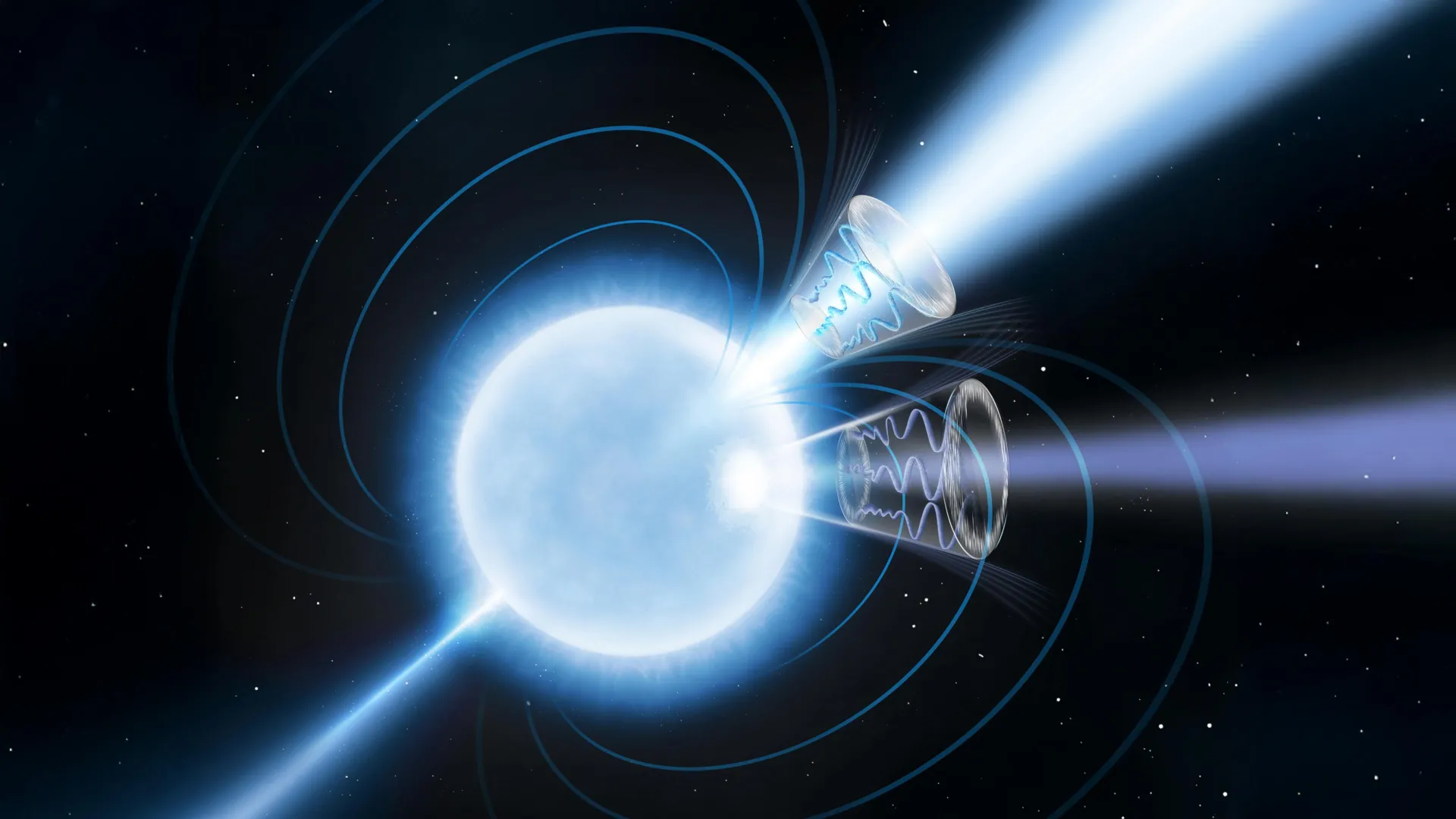
An international research team has identified what could be the first observational evidence for vacuum birefringence, a quantum mechanical effect predicted by Werner Heisenberg in the 1930s. The phenomenon describes how apparently empty space is not truly vacant but instead contains virtual particles that briefly materialize and vanish. These particles can influence the propagation of light when subjected to extraordinarily strong magnetic fields. The findings, published recently in Nature, were obtained through observations of magnetar 1E 1547.0-5408, a rare type of neutron star with the most intense magnetic fields known to exist in the cosmos.
Researchers led by Dr. Marcus Lower from Swinburne University of Technology employed multiple observational tools to investigate this long-standing quantum mystery. NASA’s Imaging X-ray Polarimetry Explorer detected X-rays from the magnetar, while the NICER X-ray telescope aboard the International Space Station and Australia’s Murriyang Parkes radio telescope provided supporting data. Analysis using Swinburne’s supercomputer processing capabilities allowed the team to examine how radio waves and X-rays changed direction as the magnetar rotated, tracking their polarization states with precision.
The magnetar’s unique geometry proved crucial to the investigation. Its magnetic and rotational axes are nearly aligned, and observations occur from a nearly pole-on perspective, creating ideal conditions for detecting the predicted quantum effect. The researchers identified two significant indicators consistent with vacuum birefringence: the X-rays displayed exceptionally high polarization levels, and the polarization direction remained correlated with the magnetar’s magnetic field in ways matching radio observations.
According Dr. Lower, confirming this result requires magnetic fields over 100 million times stronger than any created in terrestrial laboratories, making magnetars invaluable natural laboratories for testing quantum predictions. Additional observations and improved computer simulations are planned to distinguish whether the detected signal originates from vacuum birefringence or other physical processes occurring near magnetars. If verification succeeds, the discovery would provide physicists with new methods to test quantum mechanics under the universe’s most extreme conditions and potentially resolve a question that has persisted for nearly 90 years.
Article Attribution | Read More at Article Source
Article summary produced by Claude AI