

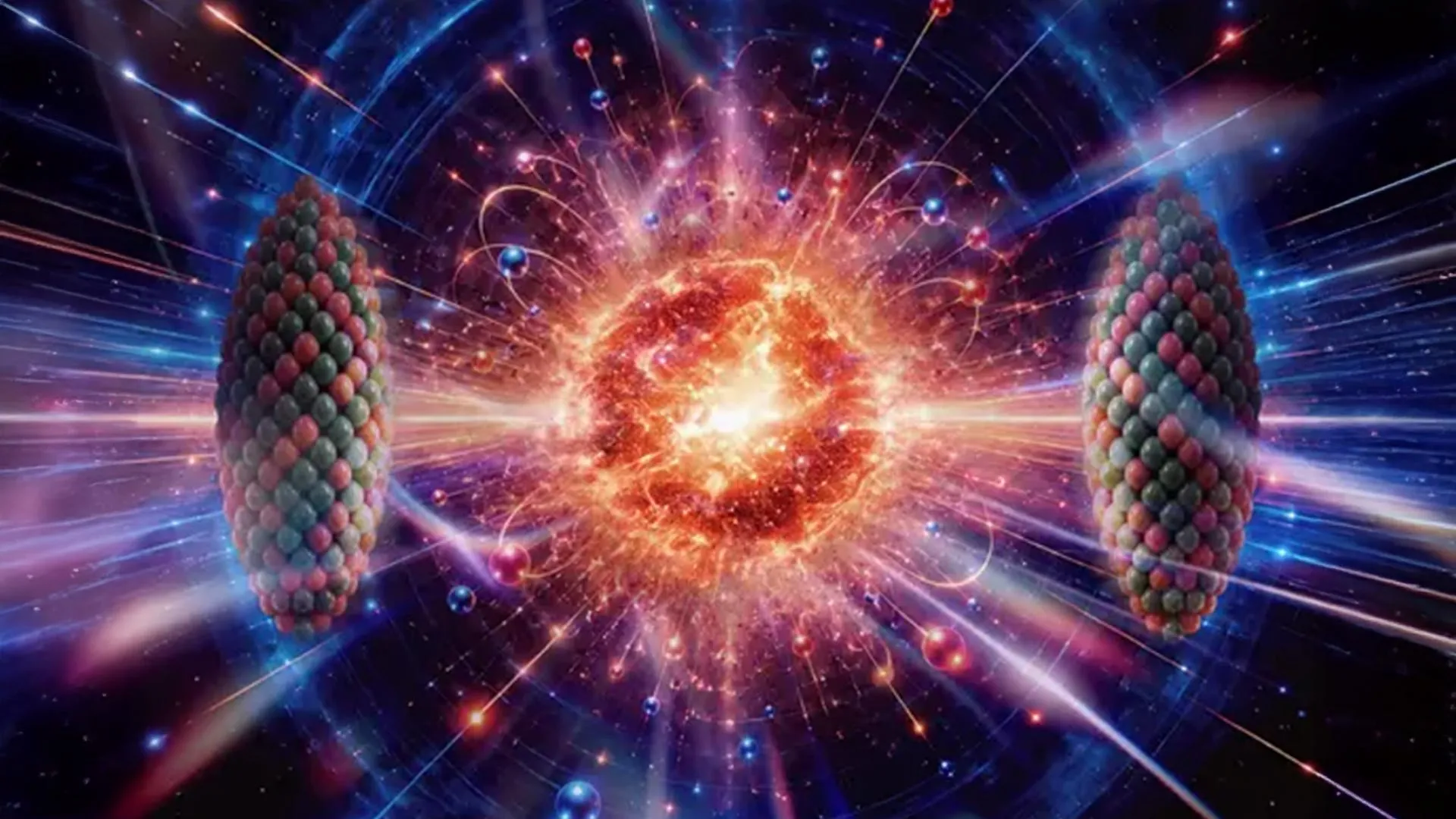
Researchers from Fudan University have conducted an investigation into the role of acceleration within quark-gluon plasma, the extremely hot state of matter produced when atomic nuclei collide at near-light speeds. While previous studies have emphasized the plasma’s swirling motion and electromagnetic fields, this team focused on acceleration, a parameter that has received comparatively limited attention despite its direct contribution to the expansion of the resulting fireball.
The research team combined two particle transport models known as AMPT and UrQMD with a mathematical technique called Gaussian smearing to transform discrete particle data into continuous fields representing energy, momentum, and velocity. This method enabled them to examine the plasma as a fluid and track how acceleration varies across different collision energies, ranging from 3.5 GeV to 2.76 TeV. The simulations revealed that peak proper acceleration can reach several hundred MeV at both lower and higher collision energies, with the strongest outward-pointing acceleration consistently appearing near the outer edge of the fireball.
The findings suggest that acceleration may function as a thermodynamic control parameter for the matter governed by quantum chromodynamics, or QCD. The researchers observed that conditions at the plasma’s boundary—where pressure drops sharply while enthalpy density remains low—create a hotspot for acceleration. The behavior of the plasma varies depending on collision energy: at lower energies, nuclear stopping initially decelerates the matter, while at ultrarelativistic energies, the nuclei pass through each other rapidly, producing brief, intense acceleration pulses.
The implications extend beyond the plasma’s motion. Through a quantum effect known as the Unruh effect, an observer undergoing acceleration would perceive empty space as having thermal properties. An acceleration of several hundred MeV could therefore resemble temperatures approaching the QCD transition temperature, suggesting that acceleration might represent a new dimension in the phase structure of QCD matter. This could influence both the chiral transition and the transition associated with quark confinement, while potentially generating new transport effects and influencing particle spin alignment.
The research team plans to refine their calculations by incorporating more realistic hydrodynamic evolution and to identify experimental signals that could demonstrate acceleration’s influence, particularly in patterns of hyperon spin polarization. By connecting quantum effects associated with acceleration to measurable particle behavior at collision experiments, the work establishes a new research direction for understanding the properties of extreme matter.
Article Attribution | Read More at Article Source
Article summary produced by Claude AI