

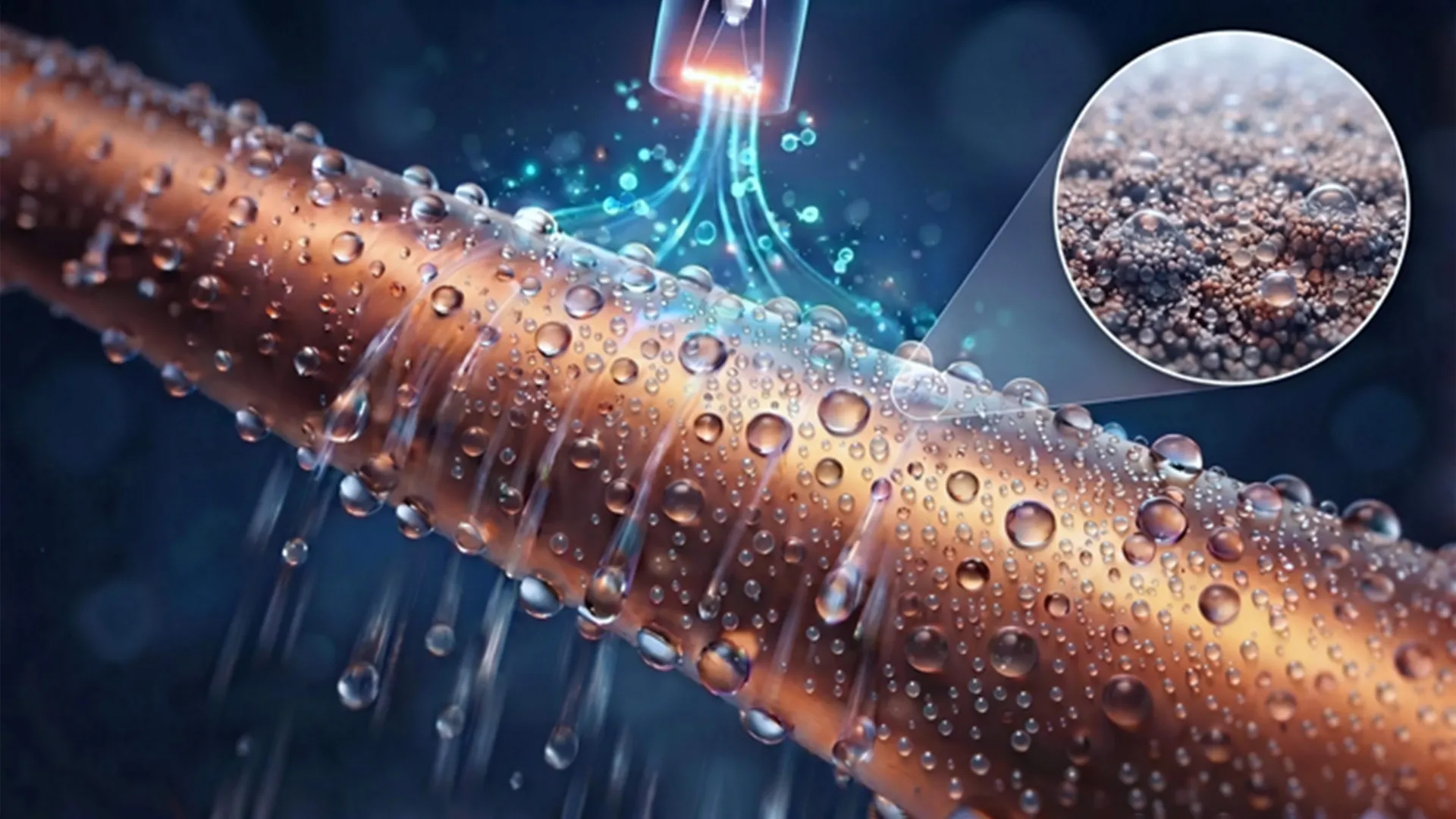
Scientists at KAIST announced the development of a specialized surface coating designed to significantly enhance condensation heat transfer performance. The technology achieves performance improvements of up to 5.5 times compared to conventional copper surfaces and demonstrates more than 50% better results than standard hydrophobic coatings. The coating works by optimizing two key aspects of the condensation process: increasing the sites where water droplets initially form and facilitating their rapid departure from the surface.
Condensation is critical to numerous industrial and technological applications, including the conversion of steam back to liquid water in power generation facilities, freshwater production through desalination, and heat dissipation in electronic cooling systems. Traditional surfaces face a fundamental limitation: while rough textures provide abundant nucleation sites for droplet formation, they tend to trap water and impede its removal. Conversely, smoother surfaces allow droplets to detach easily but offer fewer locations for new droplet generation. This trade-off has long constrained performance in condensation-based systems.
The research team, led by Professor Youngsuk Nam and Professor Sung Gap Im, addressed this constraint through an innovative approach to polymer coating design. Using initiated chemical vapor deposition technology, they created an ultrathin polymer layer and discovered that nanoscale polymer aggregates—previously regarded as manufacturing defects—could serve as effective nucleation sites for water droplet formation. By deliberately controlling the thickness of the polymer film and applying thermal treatment, the researchers independently optimized both droplet nucleation and detachment. Thinner films produced approximately three times as many droplets as thicker variants, while thermal treatment weakened the adhesive forces holding droplets to the surface.
When tested on copper tubes typical of industrial condenser systems, the coated surfaces achieved a condensation heat transfer coefficient of approximately 88 kW·m-2·K-1, representing a substantial performance improvement over uncoated copper. The approach demonstrates that surface imperfections can be engineered as functional features rather than eliminated as defects. Applications for this technology span power generation facilities, water treatment systems, and electronic device cooling. The research was published online in Nature Communications on July 16.
Article Attribution | Read More at Article Source
Article summary produced by Claude AI