

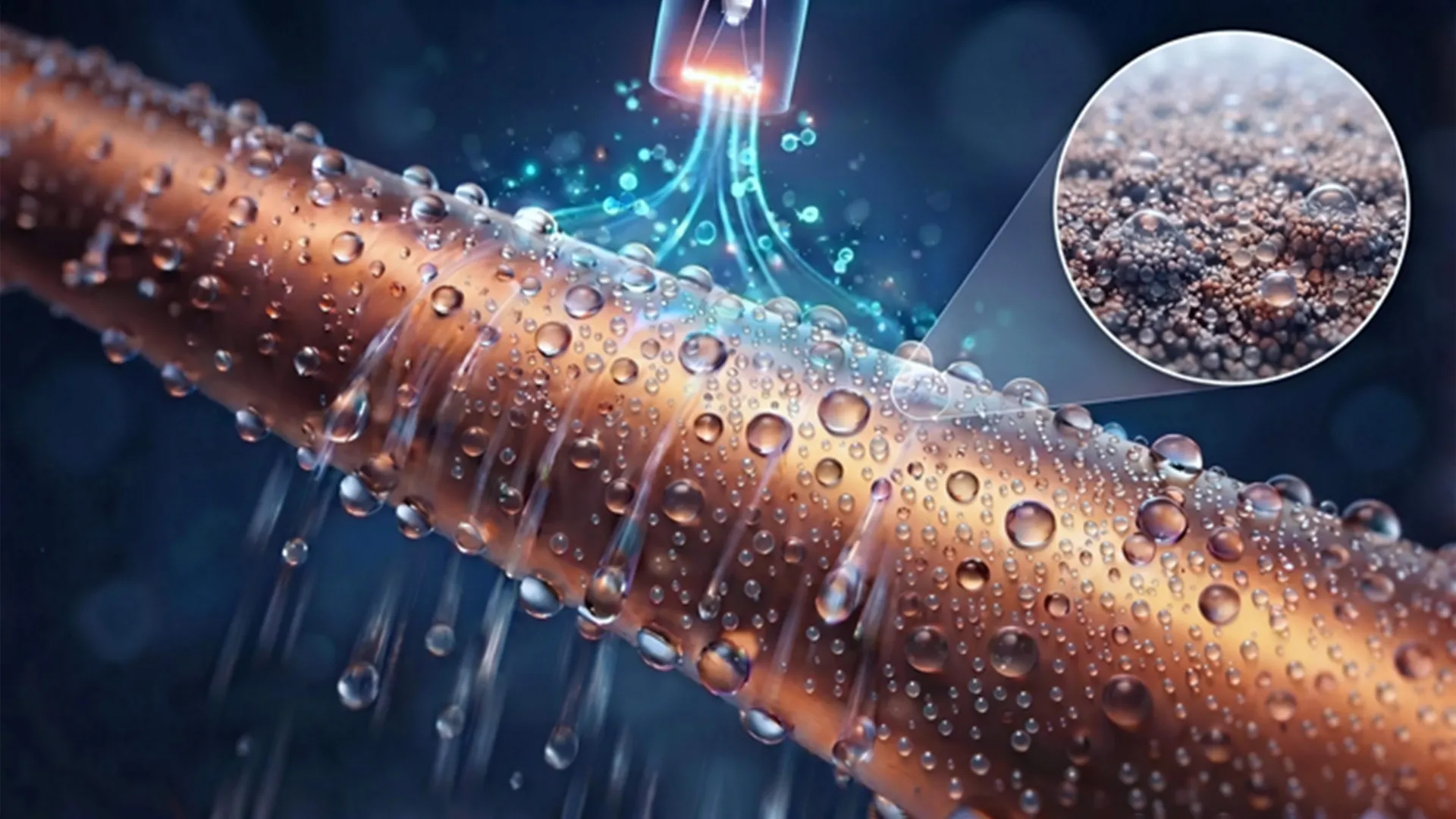
Scientists at KAIST announced the development of a surface coating technology designed to significantly enhance condensation heat transfer performance. The coating was created through collaboration between the Department of Mechanical Engineering and the Department of Chemical and Biomolecular Engineering, utilizing a process called initiated chemical vapor deposition to apply an ultrathin polymer layer. The research addresses a fundamental challenge in thermal engineering where water condensation efficiency directly impacts industrial applications.
Condensation heat transfer plays a critical role in numerous industrial and consumer applications, including steam conversion in power generation, desalination processes, and thermal management in electronic devices. The efficiency of these systems depends on how quickly condensed water is removed from surfaces. On conventional metal surfaces, small water droplets tend to merge into a continuous film that impedes heat flow. Dropwise condensation, where water remains as individual droplets that repeatedly form and detach, offers superior heat transfer performance. However, achieving optimal dropwise condensation has historically required balancing competing priorities: rough surfaces promote droplet formation but trap moisture, while smooth surfaces allow easy droplet removal but provide fewer nucleation sites.
The research team resolved this trade-off by reconceptualizing nanoscale polymer aggregates that previously were considered manufacturing defects. By controlling the thickness of the polymer coating and applying thermal treatment, researchers created surfaces with abundant nucleation sites while simultaneously reducing adhesive forces that hold droplets in place. The thinner polymer films generated approximately three times more droplets than thicker variants, while thermal treatment facilitated faster droplet detachment.
Testing on copper tubes demonstrated performance improvements of up to 5.5 times compared to conventional copper surfaces and over 50 percent improvement compared to standard hydrophobic coatings. The maximum heat transfer coefficient reached approximately 88 kW·m-2·K-1. The technology’s potential applications span multiple sectors, including improved energy efficiency in power plants and industrial heat exchangers, enhanced water recovery in desalination facilities, and better thermal management for electronic devices. The ultra-thin, uniform coating can be applied to surfaces with complex geometries, potentially enabling widespread industrial adoption. Results were published in Nature Communications on July 16.
Article Attribution | Read More at Article Source
Article summary produced by Claude AI