

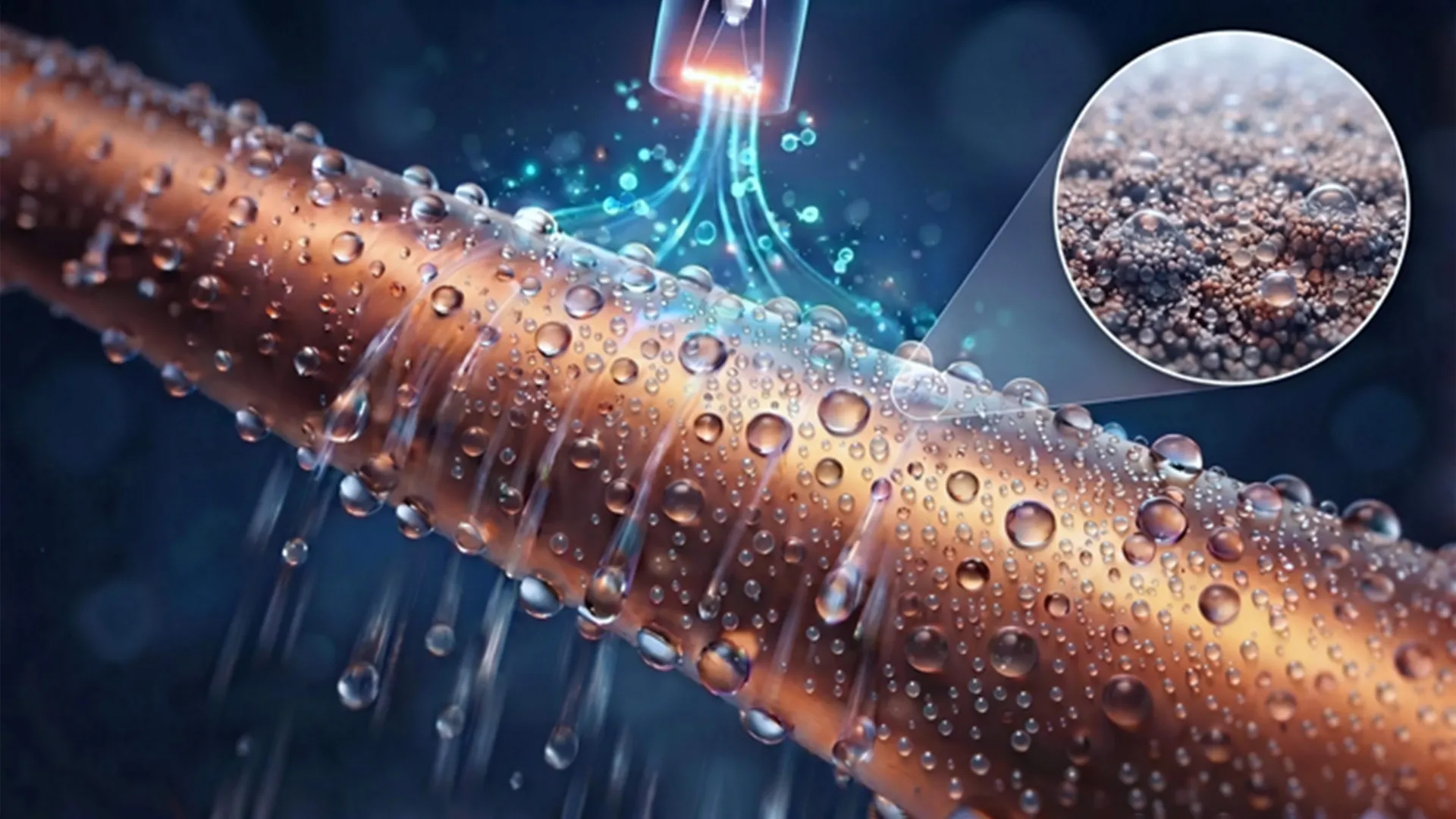
Scientists at KAIST announced the development of an advanced surface coating designed to significantly improve heat transfer during condensation processes. The coating operates by enhancing the formation of water droplets while simultaneously facilitating their rapid removal from the surface. Testing on copper tubes demonstrated condensation heat transfer performance reaching approximately 88 kW·m-2·K-1, representing up to 5.5 times greater efficiency compared to conventional copper surfaces and more than 50% improvement over standard hydrophobic coatings.
The technology addresses a fundamental challenge in condensation engineering: the trade-off between creating numerous droplet nucleation sites and enabling droplet mobility. Traditional rough surfaces provide abundant locations for droplets to form but trap them in place, while smoother surfaces allow easier droplet removal but offer fewer formation sites. The research team overcame this limitation by repurposing nanoscale polymer aggregates that were previously considered defects in polymer coatings. Using initiated chemical vapor deposition, researchers created ultrathin polymer films containing these aggregates as intentional nucleation sites. Thermal treatment subsequently weakened the adhesive forces holding droplets to the surface, allowing them to detach more readily.
This dual-control approach produced substantial improvements in droplet dynamics. Thinner polymer films generated approximately three times more droplets than thicker variants, while the heat treatment enabled faster droplet departure. The combination creates a continuous cycle of droplet formation and removal, continually exposing fresh surface area and maximizing heat transfer efficiency. The mechanism parallels natural processes where vacant spaces are rapidly refilled, maintaining optimal conditions for thermal energy movement.
The potential applications span multiple industrial sectors. In power generation facilities and heat exchangers, improved heat transfer efficiency could reduce energy consumption. Desalination and water-harvesting systems could benefit from enhanced condensation collection, while electronic cooling applications could achieve better thermal management. Professor Nam noted that the coating’s ability to form thin, uniform layers on geometrically complex surfaces further broadens its applicability across various energy and environmental technologies. Research findings were published in Nature Communications on July 16.
Article Attribution | Read More at Article Source
Article summary produced by Claude AI