

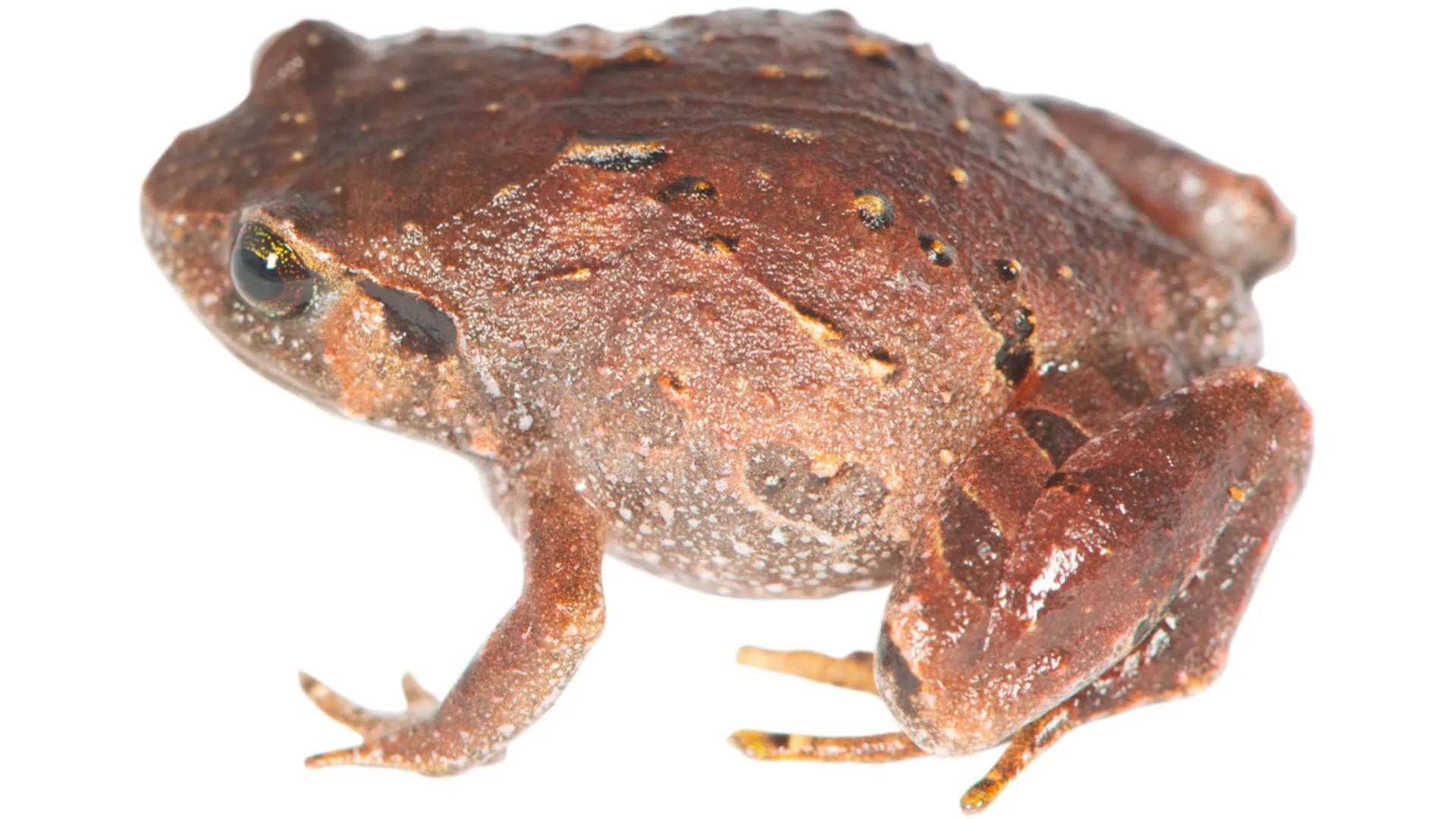
An international team of scientists has announced the discovery of seven previously undescribed species of diamond frogs (Rhombophryne) native to Madagascar. The research combined field observations, museum specimens, and DNA analysis to identify the new species and resolve taxonomic uncertainties that had persisted for decades.
Diamond frogs represent a distinctive group of Madagascan amphibians with considerable variation in appearance and behavior. Some species are extremely round and spend most of their time beneath the forest floor, while others feature long legs and inhabit moss-covered areas. Many species display cryptic coloration but possess vivid markings, including bright orange or bold black and white patterns, that become visible when the frogs move. These markings may function as predator deterrents. The secretive nature of these frogs has made them among Madagascar’s least studied vertebrates.
The research effort began more than twelve years ago when scientists encountered frogs that appeared to represent undescribed species but faced challenges matching them to existing species names and genetic lineages. A significant breakthrough came through museomics, a technique involving DNA sequencing of historical museum specimens. By comparing genetic information from older collections with newly collected frogs and analyzing external features, skeletal anatomy, and vocalizations, researchers successfully connected historical species names to correct evolutionary lineages and resolved long-standing taxonomic confusion.
The discovery has direct implications for conservation efforts in Madagascar, where many forests face rapid deforestation and fragmentation. The findings were already incorporated into conservation planning, including a protected area planning workshop held in March 2026 as part of Madagascar’s Biodiversity 30×30 Program. However, researchers acknowledge that knowledge gaps remain regarding breeding biology, population sizes, and ecological requirements for many species, making comprehensive conservation assessment difficult.
With the addition of seven new species, the known Rhombophryne species count has reached 27. Researchers believe additional undescribed species likely remain undiscovered, suggesting that further biodiversity research in Madagascar’s amphibian populations will continue to yield significant findings.
Article Attribution | Read More at Article Source
Article summary produced by Claude AI