

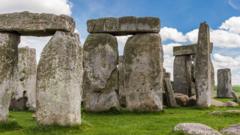
A team of archaeologists has identified what they believe to be a predecessor to Stonehenge located approximately 3 miles from the well-known prehistoric monument. The discovery, made in the village of Bulford, consists primarily of two post holes that once held wooden structures estimated to stand between 2 and 4 meters high and positioned 120 meters apart. Analysis reveals these posts were precisely aligned with sunrise on the summer solstice and sunset on the winter solstice, mirroring the astronomical alignments characteristic of Stonehenge itself.
Radiocarbon dating techniques established the site’s age at approximately 5,000 years, predating Stonehenge by roughly 500 years. The post holes represent a much simpler construction compared to the massive stone circle, yet they demonstrate the same sophisticated understanding of solar movements. Excavation of the surrounding area revealed numerous additional holes containing artifacts that provide insight into the lives of prehistoric inhabitants, including pottery fragments, flint tools, animal bones, and an antler used for digging.
Among the notable findings was a rare Neolithic knife crafted from flint and shaped into a disc, displaying remarkable workmanship and suggesting careful placement with possible symbolic significance. The variety and quality of artifacts recovered indicate that gatherings occurred at the location, pointing to organized community activity. According to researchers, the structure was uncovered a decade earlier during ground clearing for military housing, though detailed analysis of its astronomical alignment was only recently completed. This required reconstructing celestial positions as they existed 5,000 years ago to verify precise solar alignments.
Experts suggest the discovery may indicate that people inhabiting or seasonally gathering at Bulford could have been involved in the earliest construction phases of Stonehenge. For early farming communities, the Sun held particular significance due to its direct connection to agricultural cycles and seasonal survival. While the summer solstice attracts modern visitors to Stonehenge, researchers believe the winter solstice held greater importance to ancient peoples, potentially marking a critical time for rituals intended to ensure the return of spring and the prosperity of crops and livestock.
Article Attribution | Read More at Article Source
Article summary produced by Claude AI