

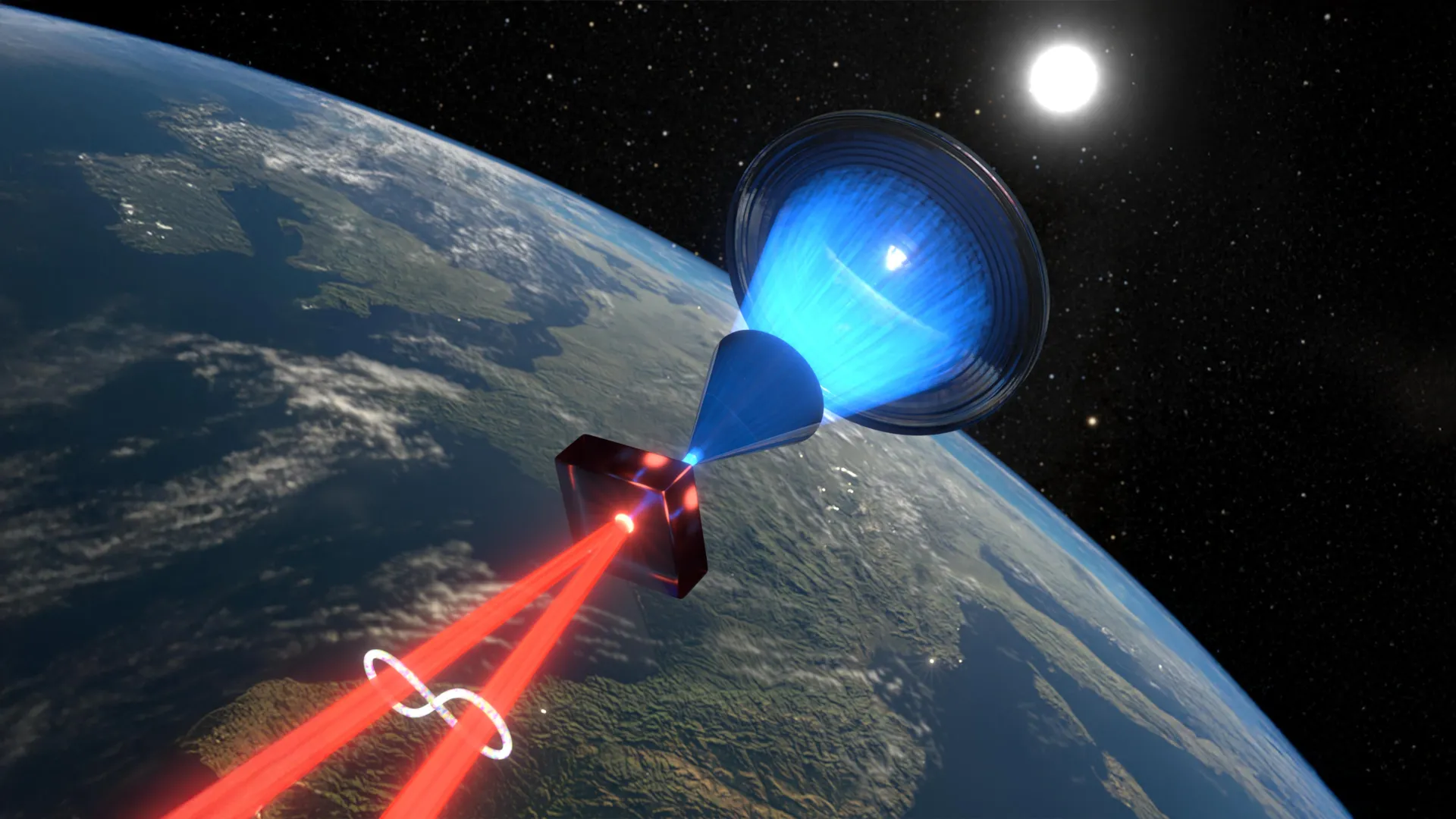
Scientists have successfully produced quantum entanglement using sunlight rather than conventional lasers, according to research published in the journal Optica. The achievement combines theoretical predictions from the University of Ottawa with a specialized solar concentrator developed at the Max Planck Institute for the Science of Light in Germany.
Quantum entanglement represents a critical capability for secure communications, precision sensing, and advanced computing systems. Traditional approaches have relied on coherent light from lasers to establish the correlations necessary for entanglement. However, earlier work by researchers at the University of Ottawa suggested that incoherent light sources, such as LEDs, could also produce entanglement under specific conditions. The key insight involved recognizing that light could be disordered in certain characteristics while remaining correlated through others, such as polarization.
The latest research extended this principle to sunlight, which presents significant technical challenges due to its multidirectional propagation and broad color spectrum. The team employed spontaneous parametric down-conversion, an established optical technique where photons split into entangled pairs when passing through a nonlinear crystal. The sunlight was strongly polarized while being incoherent across space and time, allowing entanglement to depend solely on the light’s oscillation direction rather than its color or propagation path.
A practical obstacle involved concentrating sufficient sunlight onto a millimeter-sized crystal. The researchers addressed this through an all-glass solar concentrator featuring a Fresnel lens approximately window-sized that channels sunlight through an optical fiber into the nonlinear crystal. Outdoor testing at the institute demonstrated that entanglement quality reached approximately 94% of theoretical maximum, with measured photon correlations violating Bell’s inequality—confirming genuine quantum entanglement rather than classical effects.
The team is now focused on increasing the brightness and improving entanglement quality for potential applications beyond laboratory settings. Researchers suggest the approach could extend to additional nonlinear optical techniques, potentially enabling satellite-based secure communications and reducing energy demands for quantum computing infrastructure.
Article Attribution | Read More at Article Source
Article summary produced by Claude AI