

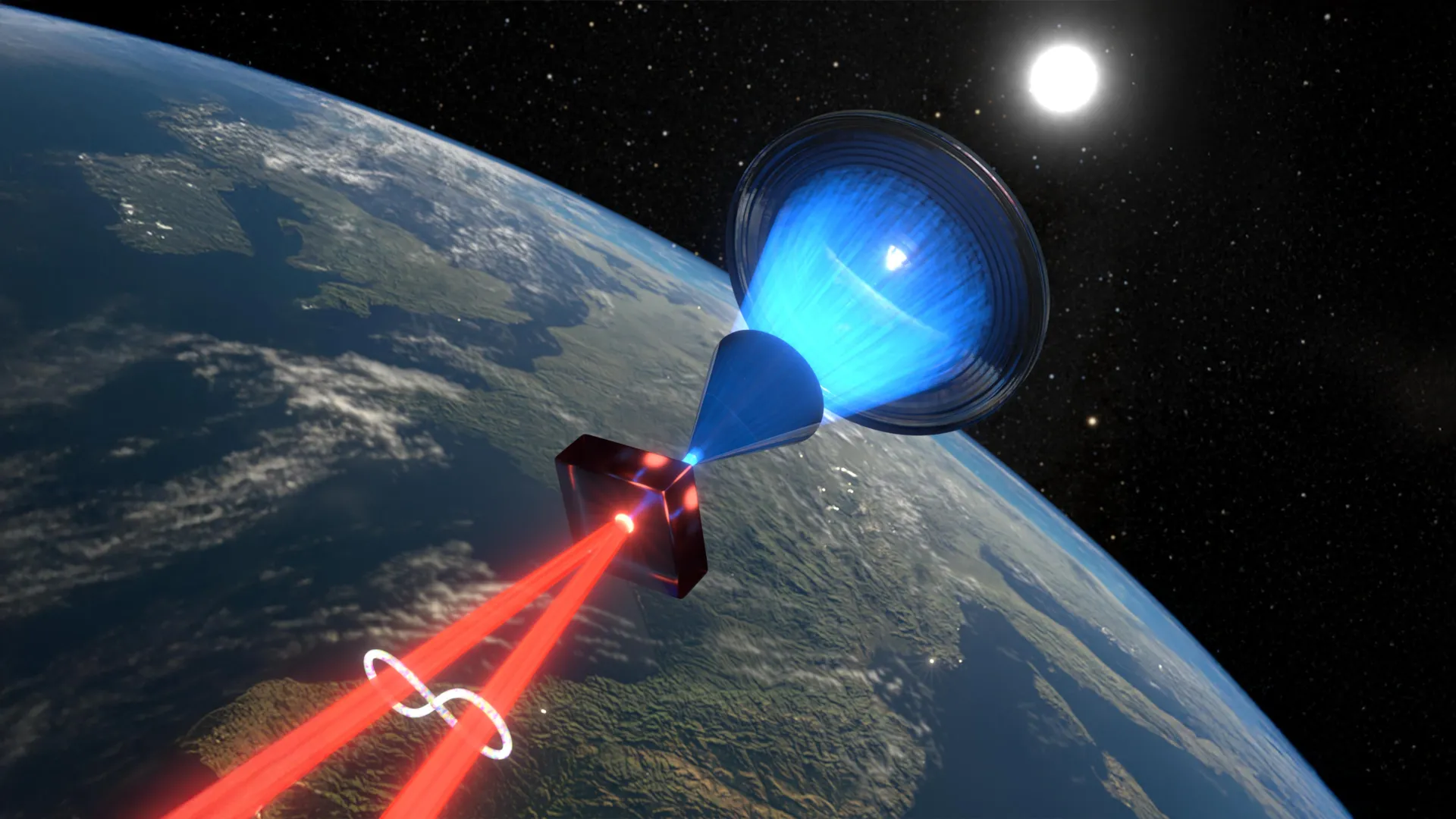
Scientists have successfully generated quantum entanglement using sunlight instead of conventional lasers, according to research published in Optica. The achievement combines theoretical predictions from researchers at the University of Ottawa with an innovative solar concentrator developed at the Max Planck Institute for the Science of Light in Germany. The work suggests that abundant natural light sources could power quantum technologies with significantly lower energy consumption than current laser-dependent systems.
Quantum entanglement has traditionally been thought to require coherent light produced by lasers, where light waves remain synchronized in a predictable pattern. However, earlier research challenged this assumption by demonstrating that incoherent light from LEDs could also generate entangled photons. The new study extends this principle further by utilizing sunlight, which presents unique challenges due to its directional spread and broad color spectrum. Researchers designed their experimental setup so that variations in color and propagation direction would not affect the photons’ polarization, the characteristic through which entanglement was created.
The team employed spontaneous parametric down-conversion, an established optical process where individual photons split into entangled pairs within a nonlinear crystal. A major technical hurdle involved concentrating sufficient sunlight onto a crystal measuring approximately one millimeter in size. This was resolved through a specialized solar concentrator featuring a Fresnel lens roughly the size of a window that channels concentrated light through an optical fiber into the crystal.
Outdoor experiments at the institute confirmed that sunlight-generated entanglement achieved approximately 94 percent similarity to a perfectly entangled state. The resulting photons displayed correlations that violate Bell’s inequality, providing evidence of genuine quantum entanglement that cannot be explained by classical physics. Researchers are now working to increase brightness and improve entanglement quality for potential real-world applications, including secure satellite communications and scaled quantum computing systems with reduced energy demands.
Article Attribution | Read More at Article Source
Article summary produced by Claude AI