

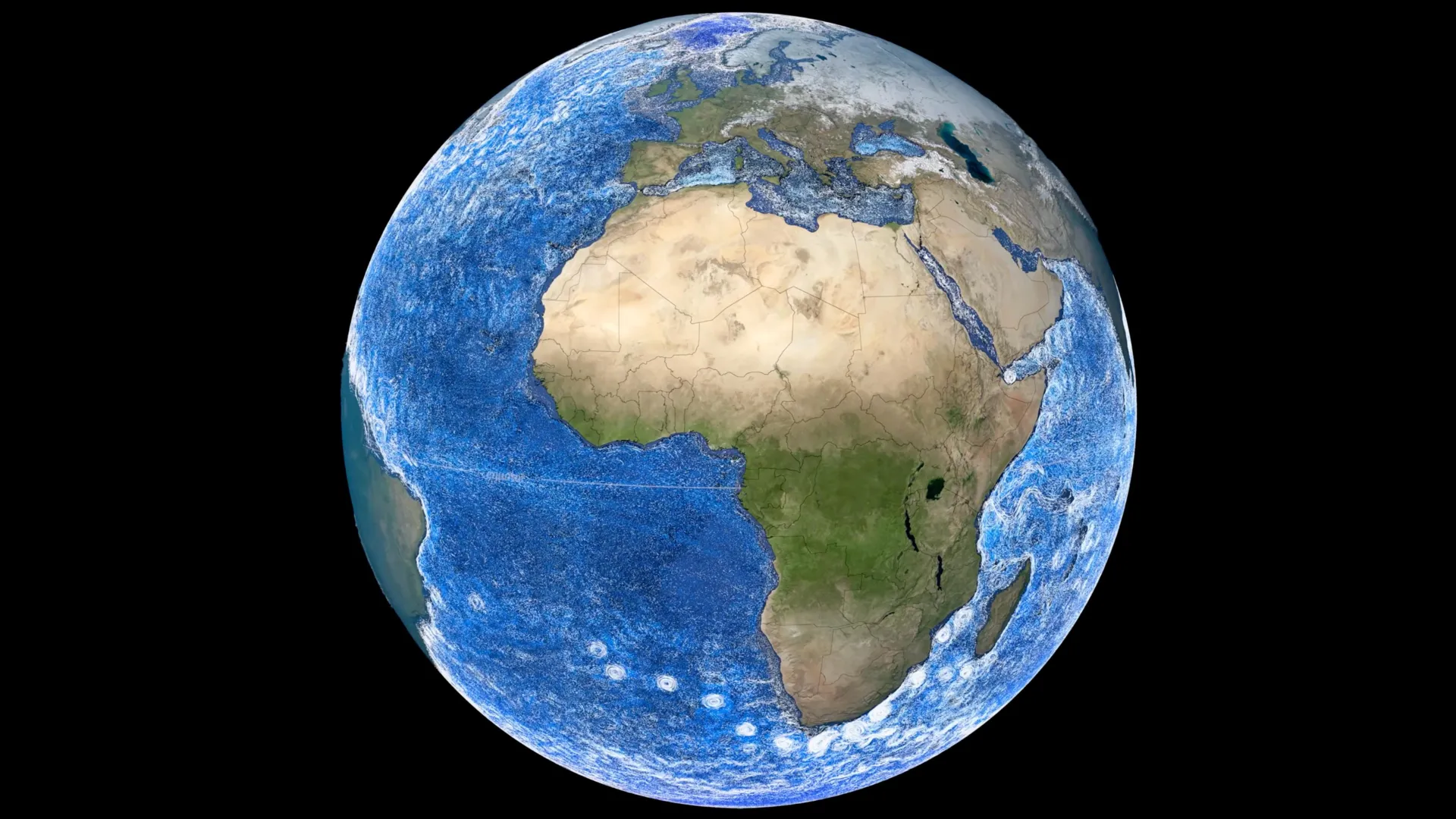
An international research team has found that the relationship between Agulhas Leakage and the Atlantic Meridional Overturning Circulation (AMOC) is more complex than previously understood. Scientists have traditionally believed that warm, salty water flowing from the Indian Ocean around South Africa into the Atlantic strengthens the AMOC, one of the planet’s most critical ocean circulation systems. However, new geological evidence from the late Pliocene period suggests this relationship does not always hold true.
The research team, led by Dr. Suning Hou from Utrecht University, examined marine sediment cores and fossil microplankton from the Agulhas Plateau, approximately 500 kilometers south of South Africa. By analyzing these materials, researchers reconstructed conditions spanning from 3.6 to 2.6 million years ago, including a significant glacial event and the warmer mid-Piacenzian period that followed. The team compared their geological findings with climate model simulations and temperature records from multiple Atlantic locations to understand how ocean circulation systems responded to climate shifts.
The analysis revealed a striking pattern: around 3.4 million years ago, the subtropical front began shifting northward, and regional ocean temperatures dropped roughly 3 degrees Celsius. These changes indicate that Agulhas Leakage weakened dramatically and nearly ceased. According to conventional theory, this reduction in salty water transport should have weakened the AMOC. Instead, geological evidence and computer models showed the opposite—the formation of North Atlantic Deep Water intensified, and overturning circulation strengthened at lower latitudes during the glacial period.
These findings suggest that local processes controlling deep water formation in the North Atlantic may be equally or more important than the salt supply from southern waters under certain climate conditions. The researchers caution that their conclusions apply specifically to late Pliocene geography and climate, and should not be viewed as direct predictions for modern AMOC responses to current or future warming. The broader implication is that the dominant mechanisms controlling Atlantic overturning circulation may vary across different climate states throughout Earth’s history.
Article Attribution | Read More at Article Source
Article summary produced by Claude AI