

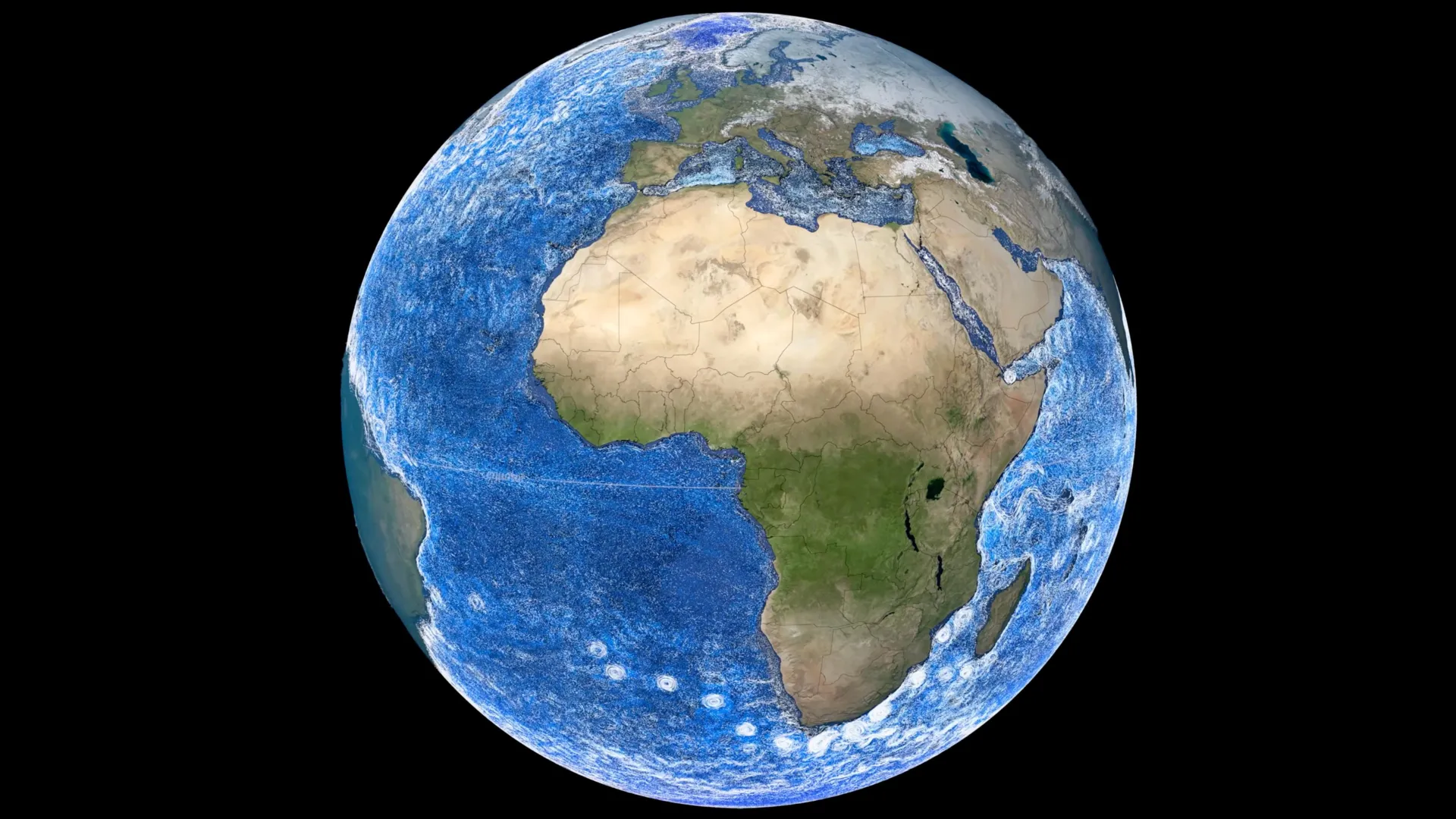
Scientists from the Netherlands, USA, China, and UK have found that the relationship between Agulhas Leakage and the Atlantic Meridional Overturning Circulation (AMOC) is more complex than traditionally understood. Agulhas Leakage, the flow of warm, salty water from the Indian Ocean around southern Africa into the Atlantic, has long been considered crucial to maintaining the AMOC, which is a key component of global ocean circulation that transports warm water northward and cold water southward at depth.
Led by Dr. Suning Hou from Utrecht University, the research team examined geological conditions during the late Pliocene, a period spanning 3.6 to 2.6 million years ago that included a glacial event followed by the mid-Piacenzian Warm Period. The researchers analyzed sediment cores from the Agulhas Plateau, south of South Africa, using fossilized microplankton and organic biomarkers to track historical ocean temperatures and movements of the Southern Ocean subtropical front. They combined these findings with temperature records from the Gulf of Mexico and published data from multiple Atlantic locations to create a comprehensive reconstruction.
The geological evidence and computer simulations revealed a surprising pattern. Around 3.4 million years ago, the subtropical front shifted northward, ocean temperatures in the Agulhas region dropped approximately 3 degrees Celsius, and Agulhas Leakage weakened dramatically, nearly ceasing entirely. However, contrary to conventional theory, this weakening did not reduce the AMOC. Instead, North Atlantic Deep Water formation intensified, and overturning circulation strengthened at lower latitudes, causing the thermocline to become shallower across the Atlantic basin.
The findings suggest that direct salt supply from Agulhas Leakage may not be the primary control on AMOC behavior under all climate conditions. Local processes governing deep water formation in the North Atlantic may be equally or more important depending on specific climate states and ocean geography. The researchers caution that these conclusions apply specifically to late Pliocene conditions and should not be interpreted as forecasts for how the AMOC will respond to current or future climate change, noting that the modern system is influenced by different factors including Arctic freshwater and saltwater inputs.
Article Attribution | Read More at Article Source
Article summary produced by Claude AI